
Loading, please wait...
_900x900.jpg "English Medieval Silver Vesica-Shaped Seal Matrix for John Baring")
_200x200.jpg "English Medieval Silver Vesica-Shaped Seal Matrix for John Baring")
.jpg "English Medieval Silver Vesica-Shaped Seal Matrix for John Baring")
LOT 0289
English Medieval Silver Vesica-Shaped Seal Matrix for John Baring
CIRCA 14TH-15TH CENTURY A.D. OR LATER
1 3/8 in. (18.4 grams, 35 mm).
A silver vesica seal matrix with pierced lug to the reverse; central incuse fleur-de-lys motif; outer band with incuse legend "+ SIGIL IOhIS : bARING:" (seal of John Baring); collector number '109' to reverse.
ProvenanceThe Matrix Collection, formed by David Morris since the late 1980s.
Matrix Collection catalogue no.0109.
Many of the seals within the collection were published in a book titled 'The Matrix Collection', by David Morris in 2012.
Accompanied by a copy of the illustrated collection notes.
Cf. Linenthal, Richard and Noel, William, Medieval Seal Matrices in the Schoyen Collection, 2004, nos.335 and 340, for similar styles.
FootnotesThe 'A' of Baring is formed with a chevron bar (as is seen on some English coins of the medieval period); the 'N' is retrograde and the 'G' of Lombardic form; a member of the Baring family was Prior of Winchester Abbey (1364-1384 AD) and vesica-shaped matrices are often associated with clerics.
CONDITIONTimeLine Auctions follows a vetting process to ensure the authenticity and legality of all items, reinforcing our commitment to integrity and responsible trading. Each antiquity, antique, and coin lot undergoes thorough examination by a vetting committee of at least ten external specialists, professional trade association members, scientists, and archaeologists: Our Vetting Process
AUCTIONS:
TimeLine is a leading auction house specialising in antiquities, ancient art, collectables, natural history, coins, medals, and books. Our auctions offer museums, collectors, historians, and enthusiasts the opportunity to acquire unique and historically significant pieces.
LOT 0289
English Medieval Silver Vesica-Shaped Seal Matrix for John Baring
Sold for (Inc. bp): £520
-
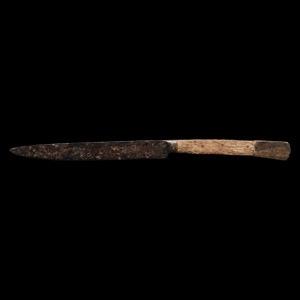
Medieval Knife with Bronze Pommel and Veiled Figure
Circa 1500 A.D.Estimate: £200 - 300 (+bp*)
Opening Bid: £100
A scale tanged knife with iron blade and single cutting edge, wooden scales, bronze pommel seemingly decorated with an incised veiled female figure to one face and a Mendicant beggar holding staff and pouch to the other. 37.4 grams, 21 cm long
Acquired 1960s-1990s. Late Alison Barker collection, a retired London barrister. -
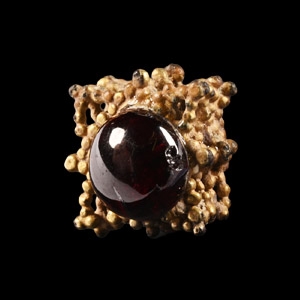
Medieval Gold Amulet with Cabochon Garnets
12th-15th century A.D.Estimate: £150 - 200 (+bp*)
Opening Bid: £75
A gold amulet formed with an openwork granulated body and polished garnet cabochons. 2.15 grams, 11 mm
Acquired 1980-2015. Ex Abelita family collection. -
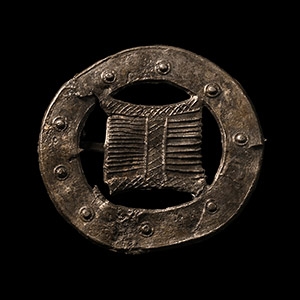
Published Medieval 'Thames' Saint Blaise of Canterbury Pilgrim's Badge
Circa 14th-15th century A.D.Sold for (Inc. bp): £546
An openwork lead pilgrim's badge displaying the wool-combe emblem of St Blaise of Canterbury within a pelletted roundel; complete with pin. 2.92 grams, 30 mm
Found on the Thames foreshore, London, UK. Acquired on the UK antiques market between 1974-1985. Albert Ward collection, Essex, UK.
St Blaise is believed to have been a bishop located somewhere in Asia Minor who was martyred in the early 4th century by beheading, following a period of torture with iron combs which later became his emblem. Canterbury, where his shrine stood behind the high altar and near to that of Saint Thomas Becket, claimed to have relics directly associated with Blaise, and miracles attributed to the saint continued to attract pilgrims into the 15th century.
