
Loading, please wait...
_900x900.jpg "English Medieval Oval-Shaped Seal Matrix for William of Thornton")
_200x200.jpg "English Medieval Oval-Shaped Seal Matrix for William of Thornton")
.jpg "English Medieval Oval-Shaped Seal Matrix for William of Thornton")
LOT 1288
English Medieval Oval-Shaped Seal Matrix for William of Thornton
EARLY 14TH CENTURY A.D.
1 in. (12.8 grams, 25 mm).
A bronze ellipsoid seal matrix with pierced quatrefoil finial; incuse motif of Mary seated with infant Jesus on her lap, star above her shoulder, kneeling robed and tonsured figure beside her with hand raised in prayer; Lombardic script legend to the border with beaded bands '* S' WILL'I DE ThORNTONE' (seal of William of Thornton).
ProvenanceThe Matrix Collection, formed by David Morris since the late 1980s.
Matrix Collection catalogue no.909.
Many of the seals within the collection were published in a book titled 'The Matrix Collection', by David Morris in 2012.
Accompanied by a copy of the illustrated collection notes.
Thornton is a village in West Yorkshire, close to the city of Bradford and mentioned in Domesday Book; it was where the Brontë sisters spent their early lives before moving to Haworth.
CONDITIONTimeLine Auctions follows a vetting process to ensure the authenticity and legality of all items, reinforcing our commitment to integrity and responsible trading. Each antiquity, antique, and coin lot undergoes thorough examination by a vetting committee of at least ten external specialists, professional trade association members, scientists, and archaeologists: Our Vetting Process
AUCTIONS:
TimeLine is a leading auction house specialising in antiquities, ancient art, collectables, natural history, coins, medals, and books. Our auctions offer museums, collectors, historians, and enthusiasts the opportunity to acquire unique and historically significant pieces.
LOT 1288
English Medieval Oval-Shaped Seal Matrix for William of Thornton
Sold for (Inc. bp): £312
-
.jpg)
Medieval Decorated Bone Artefact
14th-15th century A.D.Sold for (Inc. bp): £26
A bone item, likely the hilt of a knife, composed of a slightly tapering cuboid body with a thin piece of bone sandwiched between the two halves, one face ornamented with ring-and-dot motifs along the length of the body, crosses formed at regular intervals, one face with diagonal hatching, one face with columns composed of ring-and-dot motifs, one face with vertical hatching. 19.77 grams, 70 mm
Fine condition.
Acquired 1960s-1990s. Private collection of the late Alison Barker, a retired London barrister.
The careful repairs in antiquity suggest that this item was greatly treasured by its owner. -
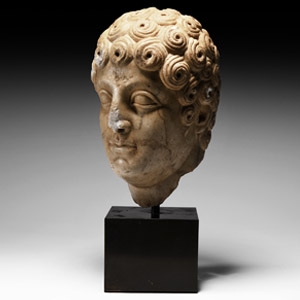
Medieval Marble Bust of Emperor Constantine
14th-16th century A.D. and laterSold for (Inc. bp): £4,940
A marble bust of Emperor Constantine with the hair formed as large lank curls; narrow face with large almond-shaped eyes and broad mouth; face reworked from an earlier late medieval head; mounted on a custom-made stand. 6.3 kg total, 30 cm high including stand
French collection, 1960s-early 2000s. From an important Paris gallery, France. This lot has been checked against the Interpol Database of stolen works of art and is accompanied by search certificate no.11660-199347. -
.jpg)
Medieval 'Thames' Wine Tavern Token
Circa 14th-15th century A.D.Sold for (Inc. bp): £111
A lead-alloy bifacial token with on one face a hatched sexfoil rosette within a pelletted border, and the other two opposed birds supporting a processional cross. 0.84 grams, 16 mm
Found on the Thames foreshore, London, UK. Acquired on the UK antiques market between 1974-1985. Albert Ward collection, Essex, UK.
Tokens of this type were used in taverns and similar establishments.
