
Loading, please wait...
LOT 1070
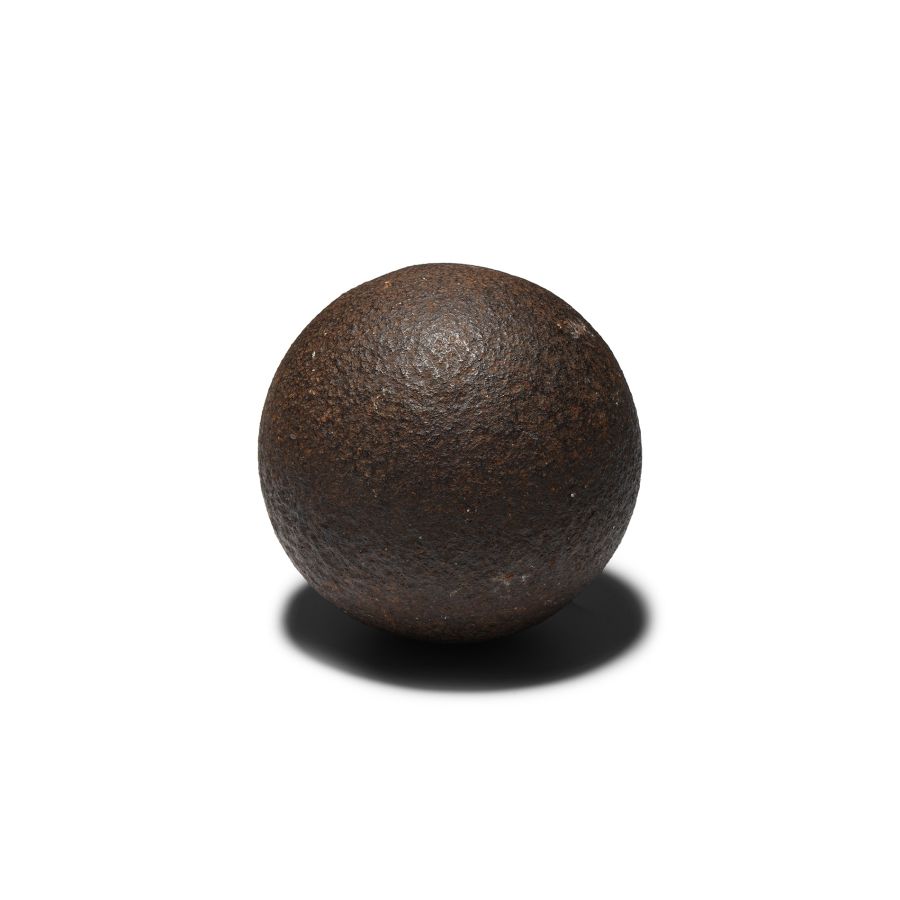
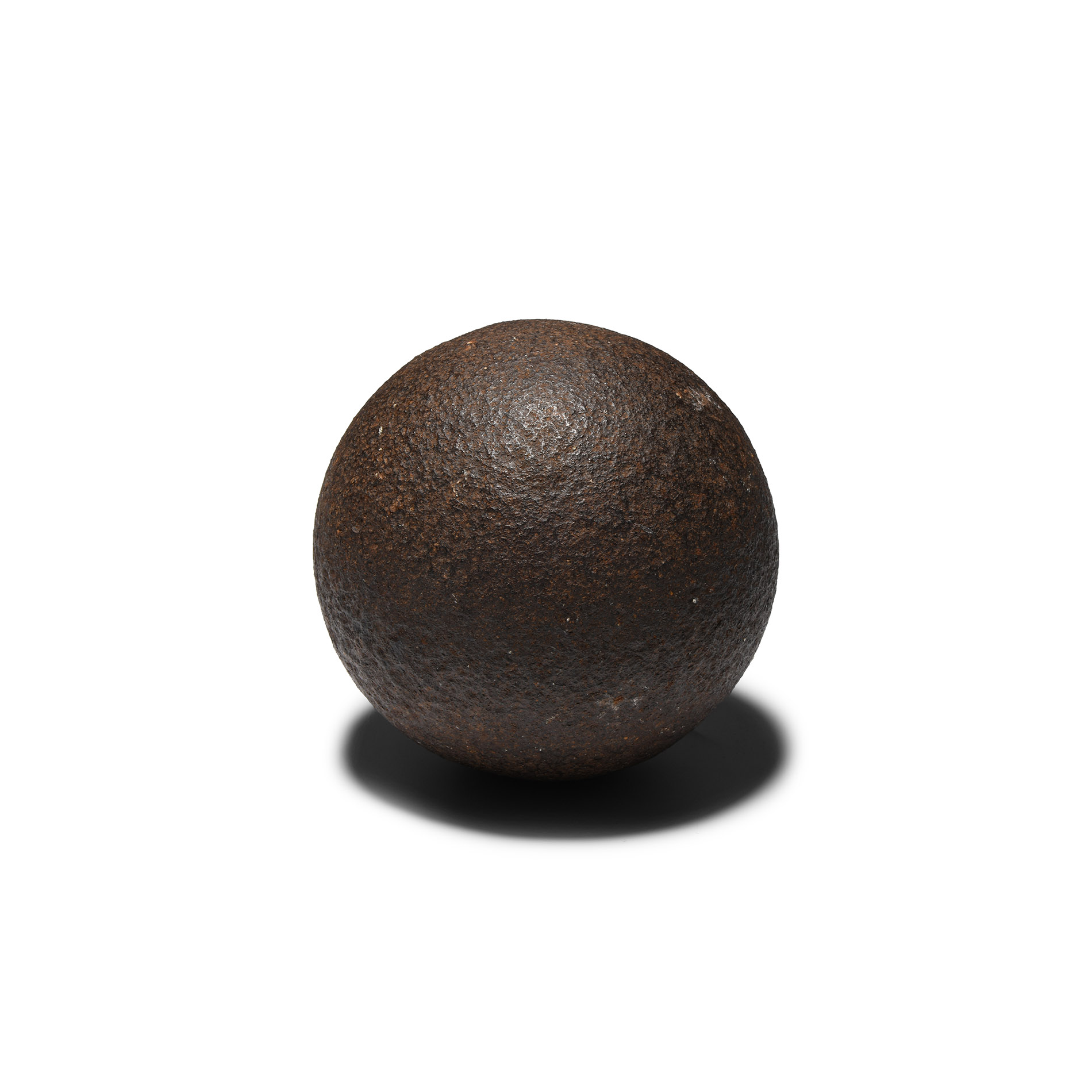
English Civil War Iron Cannon Ball
1642-1651 A.D.
3 7/8 in. (4.3 kg, 98 mm wide).
Possibly made for a naval long gun, a 'long nine'. [No Reserve]
ProvenanceFound in a churchyard in Derbyshire, UK, before 1950.
Acquired from the son of the clergyman that found it, in 2004.
Property of a Nottinghamshire gentleman.
TimeLine Auctions follows a vetting process to ensure the authenticity and legality of all items, reinforcing our commitment to integrity and responsible trading. Each antiquity, antique, and coin lot undergoes thorough examination by a vetting committee of at least ten external specialists, professional trade association members, scientists, and archaeologists: Our Vetting Process
AUCTIONS:
TimeLine is a leading auction house specialising in antiquities, ancient art, collectables, natural history, coins, medals, and books. Our auctions offer museums, collectors, historians, and enthusiasts the opportunity to acquire unique and historically significant pieces.
-
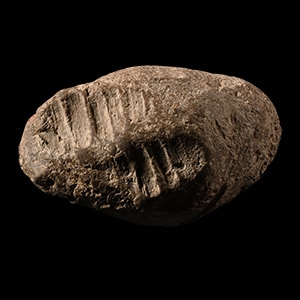
Roman Praetorian Guard Terracotta Sling Shot with Scorpion
1st century A.D.Sold for (Inc. bp): £286
Lentoid section with a raised 'keel' to one end, depicting a stylised scorpion. 25.75 grams, 43 mm
Ex Simmons Gallery, London E11, UK, in the 1990s. From a North London collection.
The sling (funda) with its lead (plumbea pondera) and stone missiles was used by special funditores, illustrated on Trajan’s Column where they are dressed in broad tunics with no armour, but carry a shield. Interestingly, this glans has the emblem usually associated with the Praetorian Guard - the scorpion. It was an emblem also used in Ptolemaic Egypt, and it is not impossible that this bullet could be Ptolemaic or Romano-Egyptian. We believe this bullet could be associated with the Praetorian regiments which means this could be one of the first pieces of evidence for their use. -
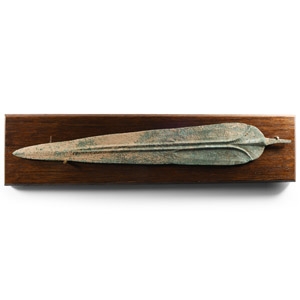
North West Persian Short Sword with Blood Channels
2nd-1st millennium B.C.Estimate: £300 - 400 (+bp*)
Opening Bid: £150
With short tang for an organic hilt, the blade showing multiple grooves forming a pronounced mid-rib spanning roughly more than three-quarters of the blade; accompanied by a custom-made display stand. 1.18 kg total, 45.5 cm (49 cm including stand)
Ex P.A., Hertfordshire, UK, specialist collection of Greek art, 1980-1990s.
Luristan was hardly an ethnic or political entity, but the people of Luri had relations through warfare and traded with Sumerians, Lullubi, Assyrians, Babylonians and Elamites over a long period of time, spanning from the 3rd to the 2nd millennium B.C. The ruling elites of warrior horsemen were buried with their weapons and horses. -
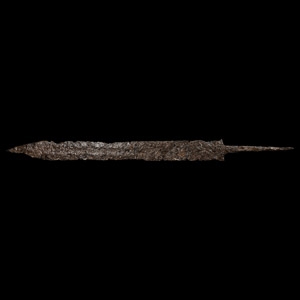
Roman Iron Gladius
1st-2nd century A.D.Sold for (Inc. bp): £1,300
Or semi-spatha blade with parallel-sided lentoid-section body and a long rectangular-section tang; Mainz type, Wederath-Canterbury-Kopki variant; repaired and surface treated. 557 grams, 83 cm
Ex South London collection, acquired 1970-1990. The Kusmirek Collection, UK. Accompanied by an academic report by Dr Raffaele D'Amato.
In contrast to the average length of the Roman Pompeii type gladius, some Roman swords, continuing the typology of the Mainz gladius, tend to be longer and transform themselves into a semi-spatha. Both the weapon from Eich (Miks, 2001, AI43), and especially a gladius from Korytnica with approximate blade length of 548mm (total length 762mm) is very close to the length limit of a semi-spatha. The same can be said of a blade from Godmanchester (Miks, 2001, no.A824) for its dimensions and proportions, where the tip of the blade already gives a significantly shorter impression, showing a certain relationship to 'Lauriacum-Hrornöwka', 'Mainz-Canterbury' variant type spathae.
