
LOT 3498
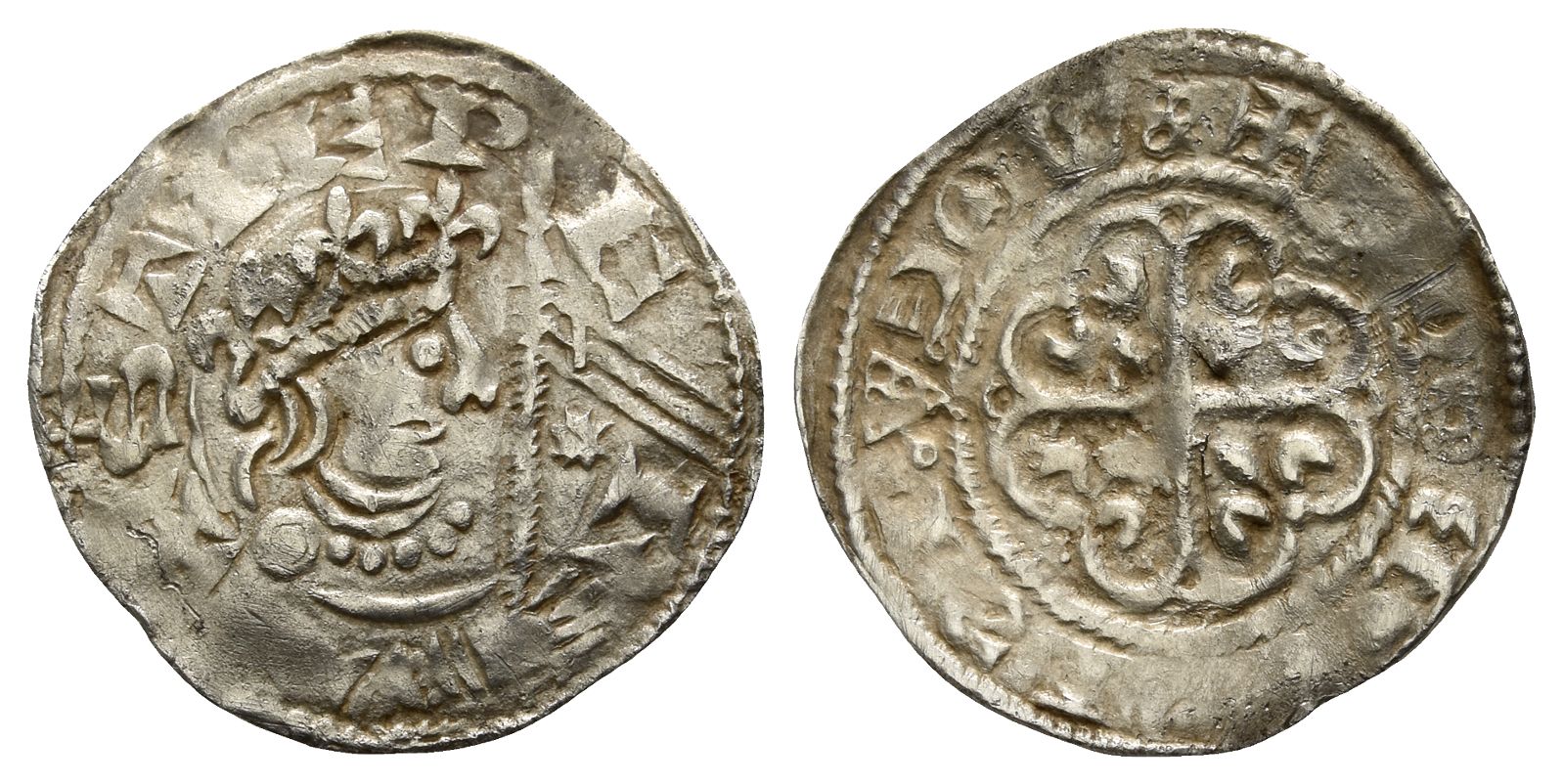
England. Norman, Stephen AR Penny. 1135-1154.
York mint. Local and irregular issues of the Civil War. 'Ornamental' Group, Flag type. ✠ STIEP-E-N, crowned and draped bust to right, holding staff with flag or 'triple banner' in right hand; star to right of banner / Legend with ornaments, cross moline, lis in quarters. North 919; SCBC 1313. Very Fine. Very rare.(1.03gr, 19mm, 12h.).
ProvenanceFound near York, Yorkshire, UK, in the 1980s.
Recorded by the Corpus of Early Medieval Coin Finds of the Fitzwilliam Museum, Cambridgeshire, with reference no. EMC 2024.0424.
From Martin Allen, The York Local Coinage of the Reign of Stephen (1135-54) in NC 2016, vol. 176, p.287-8: Mack adopted Packe's suggestion that the flag refers to the standard carried into battle at Northallerton in August 1138 by the army raised on Stephen's behalf by Archbishop Thurstan of York to fight David I of Scotland (1124-53), and that it was issued soon after the victorious conclusion of this Battle of the Standard, although Brooke had reserved judgement on this attribution. Boon offered an alternative interpretation of the Flag type, suggesting that it was probably based upon Stephen's seal (in use from 1139 to the end of the reign in 1154), which depicts a mounted figure of Stephen carrying a banner (gonfalon). The obverse (majesty side) seal has a star beside the king's head, and this is a motif also found on the Flag to the right of the flag. Seaby argued that the banner on York coins of the Flag Standard types is a papal gonfalon, of a kind sent by Pope Eugenius III (1145-53) to participants in the second Crusade of 1145-9, before the departure of the crusading armies and fleet in 1147. All of these interpretations of the Flag type are possible the York local coinage began in the mid-1140s, as Blackburn proposed.
TimeLine Auctions follows a vetting process to ensure the authenticity and legality of all items, reinforcing our commitment to integrity and responsible trading. Each antiquity, antique, and coin lot undergoes thorough examination by a vetting committee of at least ten external specialists, professional trade association members, scientists, and archaeologists: Our Vetting Process
AUCTIONS:
TimeLine is a leading auction house specialising in antiquities, ancient art, collectables, natural history, coins, medals, and books. Our auctions offer museums, collectors, historians, and enthusiasts the opportunity to acquire unique and historically significant pieces.
-
England. Norman, Stephen AR Penny. 1135-1154.
Sold for (Inc. bp): £6,500
York mint. Local and irregular issues of the Civil War. 'Ornamental' Group, Flag type. ✠ STIEP-E-N, crowned and draped bust to right, holding staff with flag or 'triple banner' in right hand; star to right of banner / Legend with ornaments, cross moline, lis in quarters. North 919; SCBC 1313. 1.03gr, 19mm, 12h.
Very Fine. Very rare.
Found near York, Yorkshire, UK, in the 1980s. Recorded by the Corpus of Early Medieval Coin Finds of the Fitzwilliam Museum, Cambridgeshire, with reference no. EMC 2024.0424.
From Martin Allen, The York Local Coinage of the Reign of Stephen (1135-54) in NC 2016, vol. 176, p.287-8: Mack adopted Packe's suggestion that the flag refers to the standard carried into battle at Northallerton in August 1138 by the army raised on Stephen's behalf by Archbishop Thurstan of York to fight David I of Scotland (1124-53), and that it was issued soon after the victorious conclusion of this Battle of the Standard, although Brooke had reserved judgement on this attribution. Boon offered an alternative interpretation of the Flag type, suggesting that it was probably based upon Stephen's seal (in use from 1139 to the end of the reign in 1154), which depicts a mounted figure of Stephen carrying a banner (gonfalon). The obverse (majesty side) seal has a star beside the king's head, and this is a motif also found on the Flag to the right of the flag. Seaby argued that the banner on York coins of the Flag Standard types is a papal gonfalon, of a kind sent by Pope Eugenius III (1145-53) to participants in the second Crusade of 1145-9, before the departure of the crusading armies and fleet in 1147. All of these interpretations of the Flag type are possible the York local coinage began in the mid-1140s, as Blackburn proposed. -
England. Norman, Stephen AR Penny. 1135-1154.
Sold for (Inc. bp): £910
Warwick mint; Eadræd, moneyer. Struck circa 1136-1145. Cross moline (Watford) type (BMC i). [...]TIEFRE R, crowned bust right, holding lis-tipped sceptre / ✠ E[...]ED : [O]N : [...]C :, cross moline. Cf. Mack 38a; EMC 2002.0143 = Coin Register 2002, 213 (this coin); North 873; SCBC 1278. 1,35gr, 20mm, 12h.
Near Very Fine. Flan crack at 10h. Bold portrait. Rare.
Found near Barton Hill, Bedfordshire, circa 1995. Ex Spink 4018 (6 October 2004), lot 500. Recorded by the Corpus of Early Medieval Coin Finds of the Fitzwilliam Museum, Cambridgeshire, with reference no. EMC 2002.0143.
As noted in the Spink catalogue, “The obverse of this coin appears to be of local workmanship. The portrait is of an unusual, slightly derivative style, and the reading stief rex is not one of the eight variants of the king's title recorded by Mack (BNJ 1966, p.40). The reverse legend is possibly e[dre]d:on:[parpi]c, but remains uncertain.” In his study of the Anglo-Saxon and Norman mint at Warwick in BNJ 1965, N. J. Ebsworth only records two examples from this moneyer, neither of which exhibit these legends. -
.jpg)
England. Norman, Henry I AR Penny. 1100-1135.
Sold for (Inc. bp): £182
London mint; Brunic moneyer. Quadrilateral on Cross Fleurée type (BMC xv). Illegible inscription, crowned bust facing slightly to left, holding sceptre / ✠ BRV[...]VND :, quadrilateral with incurved sides and fleurs at limbs; all over cross fleurée. North 871; SCBC 1276. 1.23gr, 18mm, 6h.
Fair. Very rare moneyer.
Found Cambridgeshire, UK.
