
.jpg "England. Cross and Pellets Pb Token.")
LOT 3615
England. 'Cross and Pellets' Pb Token. 1425-1490.
London or Paris mint. Mitchiner Type Mb. IHC (retrograde) in Gothic within anti-clockwise ray border / Cross with dot in each angle; al within anti-clockwise ray border. Mitchiner & Skinner type M, 50 var. (IHC not retrograde; clockwise ray border). Very Fine.(0.69gr, 12mm.).
ProvenanceFound from Billingsgate spoil from the Thames foreshore, London, UK, in the 1980s.
Property of an Essex collector.
The 'cross and pellets' tokens differ from the other series of fifteenth-century tokens found in London by virtue of their close links with a series of French tokens. They have been found with not quite equal frequency in London and in Paris. The uniformity of design suggests centralised production control (such as by a guild) but the range of symbols - religious, merchant, brothels - suggests a wide range of users.
TimeLine Auctions follows a vetting process to ensure the authenticity and legality of all items, reinforcing our commitment to integrity and responsible trading. Each antiquity, antique, and coin lot undergoes thorough examination by a vetting committee of at least ten external specialists, professional trade association members, scientists, and archaeologists: Our Vetting Process
AUCTIONS:
TimeLine is a leading auction house specialising in antiquities, ancient art, collectables, natural history, coins, medals, and books. Our auctions offer museums, collectors, historians, and enthusiasts the opportunity to acquire unique and historically significant pieces.
-
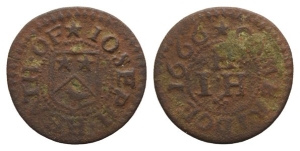
England. Cambridgeshire, Joseph Heath AE Farthing. Dated 1666.
Sold for (Inc. bp): £33
★ IOSEPH • HEATH • OF, shield of arms / ★ CAMBRIDGE • 1666, H I • H in three lines, stars in fields. Dickinson 52. 1.26gr, 16mm, 12h.
Near Fine.
Acquired on the UK art market before 2000. Property of an Essex, UK, gentleman. -
.jpg)
England. 'Late Plantagenet' Pb Token. 1425-1490.
Sold for (Inc. bp): £13
London mint. Mitchiner Type La. Expanding cross with convex arms and central dot / Expanding cross with convex arms and central dot. Cf. Mitchiner & Skinner type L, 6-7. 1.03gr, 12mm.
Near Very Fine.
Found from Billingsgate spoil from the Thames foreshore, London, UK, in the 1980s. Property of an Essex collector. -
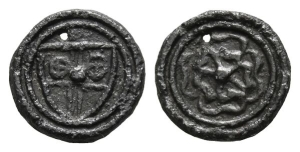
England. 'Shield and Rose' Pb Token. 1425-1672.
Sold for (Inc. bp): £26
Shield quartered by void and linear cross with central dot; cross-in-circle in two upper quarters / Tudor double rose of five and four petals. Mitchiner & Skinner -. 0.80gr, 11mm.
Very Fine. Pierced. Exceedingly rare and apparently unpublished.
Found from Billingsgate spoil from the Thames foreshore, London, UK, in the 1980s. Property of an Essex collector.
