
Loading, please wait...
LOT 0347
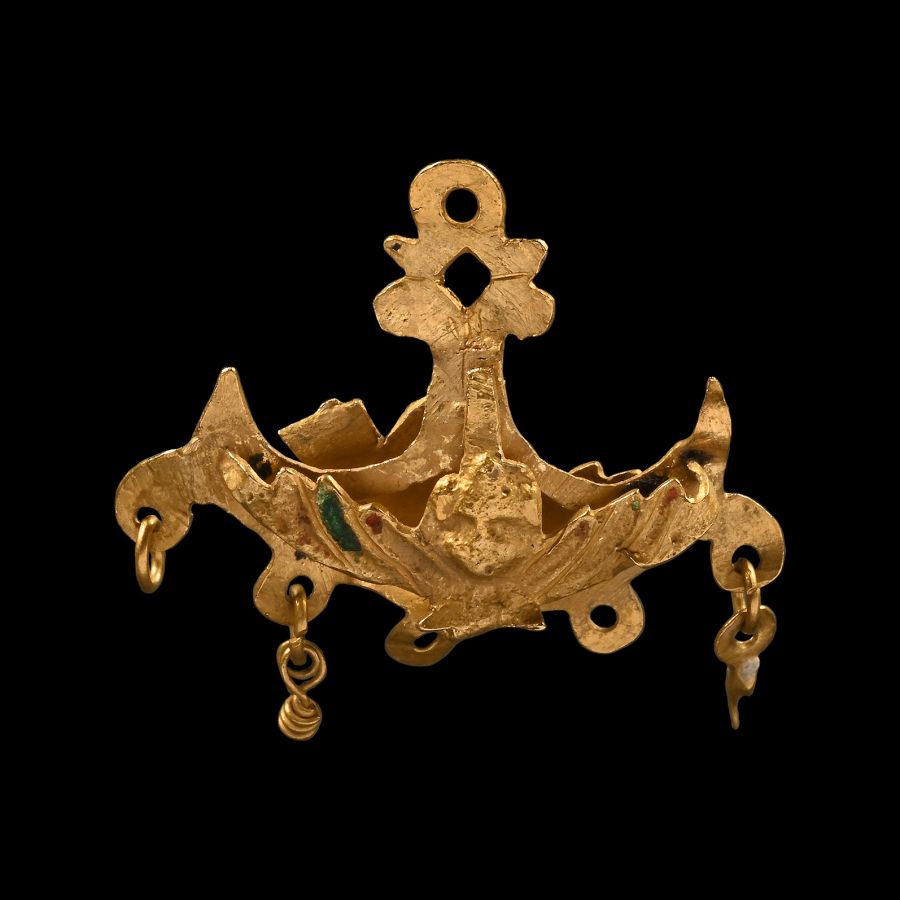
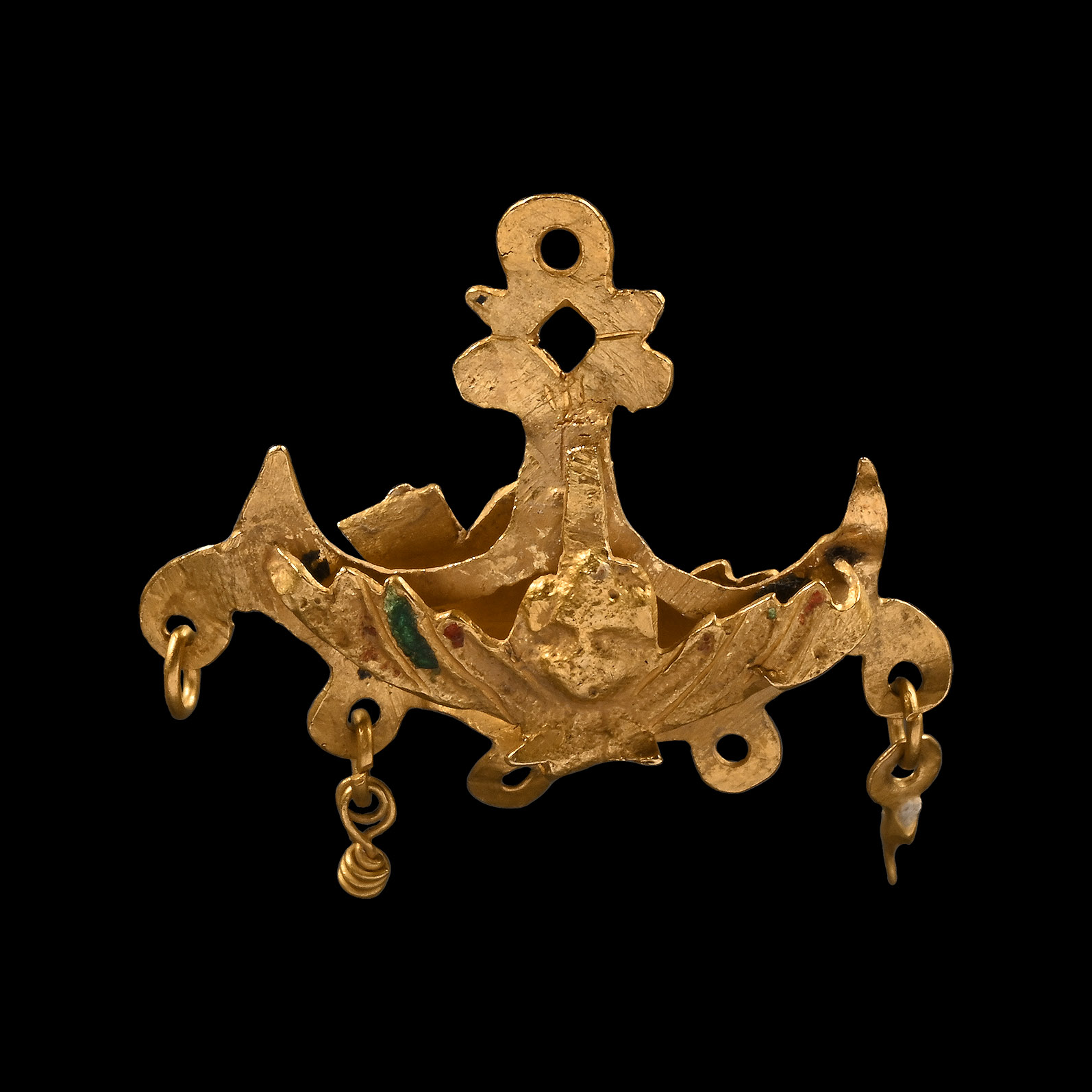
Elizabethan Boat-Shaped Pendant with Putti
16TH-EARLY 17TH CENTURY A.D.
1 in. (2.77 grams, 27 mm).
A gold pendant formed as a crescent frame with vertical bar and two outer bands; bar with trefoil finial, pierced for suspension; crescent with pierced lugs to the lower edge and wire dangles; outer bands with putto mask to the centre, frond detailing and green enamelling.
ProvenanceAcquired 1960s-1990s.
Late Alison Barker collection, a retired London barrister.
TimeLine Auctions follows a vetting process to ensure the authenticity and legality of all items, reinforcing our commitment to integrity and responsible trading. Each antiquity, antique, and coin lot undergoes thorough examination by a vetting committee of at least ten external specialists, professional trade association members, scientists, and archaeologists: Our Vetting Process
AUCTIONS:
TimeLine is a leading auction house specialising in antiquities, ancient art, collectables, natural history, coins, medals, and books. Our auctions offer museums, collectors, historians, and enthusiasts the opportunity to acquire unique and historically significant pieces.
LOT 0347
Elizabethan Boat-Shaped Pendant with Putti
Estimate £1,000 - 1,400€1,160 - 1,620 (for guidance only)$1,350 - 1,890 (for guidance only)
-
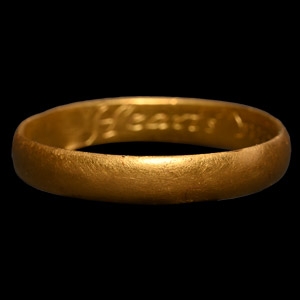
Post Medieval Gold 'Hearts United Lives Contented' Posy Ring
Circa 18th century A.D.Sold for (Inc. bp): £715
A large gold posy ring with D-section hoop, inscribed internally with 'Hearts vnited lives contented' lower case inscription with 'GM' maker's mark punch, possibly for the London goldsmith George Morris, recorded from a dated piece as working 1749-1750. 4.32 grams, 22.46 mm overall, 20.12 mm internal diameter (approximate size British T 1/2, USA 9 3/4, Europe 21.89, Japan 21)
Acquired on the UK antiques market between 1974-1985. Albert Ward collection, Essex, UK. -

Ethiopian Processional Cross
15th-16th century A.D.Sold for (Inc. bp): £494
A bifacial bronze Yämäṩor Mäsqäl processional cross finial with later replaced socket, flanking bird motifs and dense block of tendrils and wheels with seven cross-shaped finials, central panel with Virgin Mary, Holy Child and angels to the front, saints and Evangelists to the back. 55 grams, 26 cm (37.5 cm including stand)
Acquired on the London art market, 2006. UK private collection.
In contrast with the hand cross that is fitted with a grip, the processional cross has a hollow shaft into which the pole supporting the cross is inserted, although the use of both is interconnected in the liturgy and ceremonial aspects of the Ethiopian Orthodox Church. In Amharic it received the name of yämäṩor mäsqäl or "cross to [carry] on a pole", the term mäṩor also meaning a wooden handle. Processional crosses are used on "every qaddase day" occasions - an expression meaning whenever the liturgy is performed. This includes displaying the cross during the reading of the Gospels and other sacred texts, as well as holding it up to be viewed at the end of the service for the final blessing. -
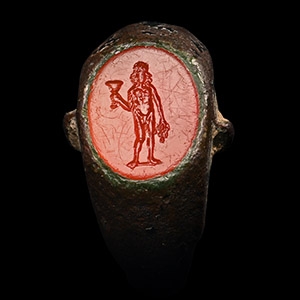
Ring with Standing Figure Gemstone
Circa 17th century A.D.Sold for (Inc. bp): £117
A copper-alloy ring with expanding arms and raised triangular knop to two faces, set with a carnelian intaglio gemstone engraved with a standing nude male figure holding a bunch of grapes and a goblet, possibly representing the god of wine. 9.25 grams, 26.43 mm overall, 17.76 mm internal diameter (approximate size British O 1/2, USA 7 1/4, Europe 15.61, Japan 15)
Acquired in the late 1990s-2000. Property of an East London gentleman.
