
Loading, please wait...


_900x900.jpg "Elamite Silver Beaker with Three Ibexes")
_200x200.jpg "Elamite Silver Beaker with Three Ibexes")
_900x900.jpg "Elamite Silver Beaker with Three Ibexes")
_200x200.jpg "Elamite Silver Beaker with Three Ibexes")
.jpg "Elamite Silver Beaker with Three Ibexes")
.jpg "Elamite Silver Beaker with Three Ibexes")
LOT 0193
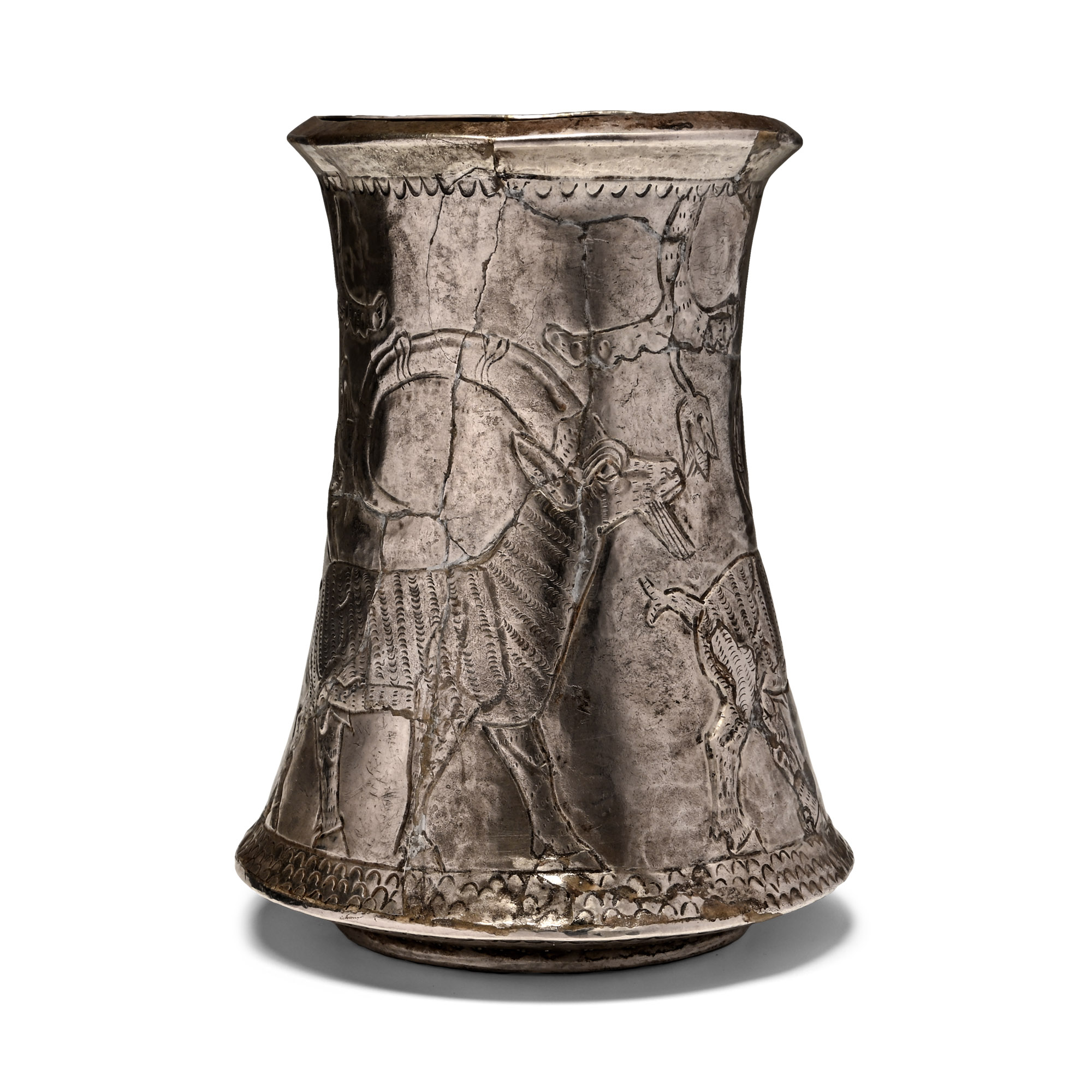
Elamite Silver Beaker with Three Ibexes
CIRCA 2500-1500 B.C.
4 1/2 in. (148 grams, 11.7 cm high).
Raised from a single sheet, conical in form with concave body and everted rim; the body, executed in repoussè technique and chased details, decorated by a frieze of three male ibexes, rows of ovules under the rim and beneath the animals; the beasts with muscular bodies and curving horns, each reaching for a flower hanging from above, and eight-petalled flower to the base; late Elamite or Marlik; repaired.
ProvenanceAcquired in New York, USA, 1966.
Private collection.
Accompanied by an academic report by Dr Raffaele D’Amato.
This lot has been checked against the Interpol Database of stolen works of art and is accompanied by a search certificate no.12167-220488.
This lot has been cleared against the Art Loss Register database, and is accompanied by an illustrated lot declaration signed by the Head of the Antiquities Department, Dr Raffaele D'Amato.
See Negahban, E.O., A preliminary report on Marlik excavations, Gohar Rud Expedition, Rudbar, 1961-1962, Teheran,1964; Moorey, P.R.S., Bunker, C.M., Porada, E., Markoe, G., Ancient Bronzes Ceramics and seals, Los Angeles, 1981, fig.409; Mahboubian H., Elam, Art and civilization of Ancient Iran, 3000-2000 BC, Salisbury, 2004, nos.1-5, for similar; Muscarella, O.W., Archaeology, Artifacts and Antiquities of the Ancient Near East, Leiden, Boston, 2013; Oudbashi, O., Hessari, M. ‘Iron Age tin bronze metallurgy at Marlik, Northern Iran: an analytical investigation’ in Archaeological and Anthropological Sciences Volume: 9 Issues: 2, 2017; the decoration of the vessel finds a good correspondence with a silver beaker of hammered repoussè and chasing from Fars (see Mahboubian, 2004, pp.34-35), the decoration of a jar from Western Iran (Moorey, Bunker, Porada, Markoe, 1981, pp.84-85), but especially with a North Western Iranian vase published by Muscarella (1988, pp.82ff.) and belonging to the Marlik culture.
FootnotesThis splendid vessel, decorated with a design possibly of Elamite origin, probably originates from North-Western Iran, or from southern Caspian area. Hammered sheet vessels were produced in Western Iranian metal workshops since the 3rd millennium B.C. (Moorey, Bunker, Porada, Markoe, 1981, p.82).
CONDITIONTimeLine Auctions follows a vetting process to ensure the authenticity and legality of all items, reinforcing our commitment to integrity and responsible trading. Each antiquity, antique, and coin lot undergoes thorough examination by a vetting committee of at least ten external specialists, professional trade association members, scientists, and archaeologists: Our Vetting Process
AUCTIONS:
TimeLine is a leading auction house specialising in antiquities, ancient art, collectables, natural history, coins, medals, and books. Our auctions offer museums, collectors, historians, and enthusiasts the opportunity to acquire unique and historically significant pieces.
LOT 0193
Elamite Silver Beaker with Three Ibexes
Estimate £25,000 - 35,000€29,000 - 40,600 (for guidance only)$33,750 - 47,250 (for guidance only)
-
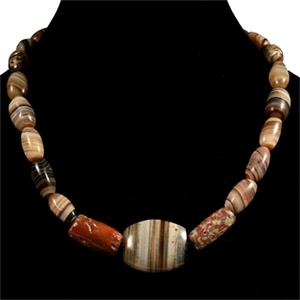
Western Asiatic Banded Agate Bead Necklace
3rd century B.C.-3rd century A.D. and laterSold for (Inc. bp): £156
A restrung necklace of mainly barrel-shaped banded agate beads with central banded agate tabular bead; modern clasp. 109 grams, 45 cm
From the collection of a European lady; part of a private collection formed in Germany in the 1990s. Property of a Californian, USA, collector. This lot has been cleared against the Art Loss Register database, and is accompanied by an illustrated lot declaration signed by the Head of the Antiquities Department, Dr Raffaele D'Amato. -
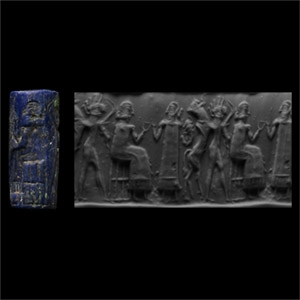
Early Dynastic Lapis Lazuli Cylinder Seal
Circa 2550-2400 B.C.Sold for (Inc. bp): £2,210
Engraved with a religious scene comprising a seated king on a throne-shaped chair, holding a cup and wearing a long garment; standing worshipper or priest before him; before them, a nude hero and a bull-man presented in a contest scene. 4.75 grams, 23 mm
From the 'S' collection, acquired 1970-1990s. The collection was seen and studied by W.G. Lambert, late Professor of Assyriology at the University of Birmingham, 1970-1993. Accompanied by a copy of a report from Assyriologist Hui Li. This lot has been checked against the Interpol Database of stolen works of art and is accompanied by a search certificate number no.12558-231428. This lot has been cleared against the Art Loss Register database, and is accompanied by an illustrated lot declaration signed by the Head of the Antiquities Department, Dr Raffaele D'Amato.
The clearly engraved facial features, the almond-shaped eyes, pointed noses, and abstract outlines shaping the bodies, attest to the iconic glyptic practices of the late Early Dynastic Period. The cup held by the king, containing holy ointment or oil, might have been used as an emblem to signify the elevated rank of a deified king. It may have also been used an alternative religious practice, connecting the secular authority and the divine power during the Early Dynastic Period. -
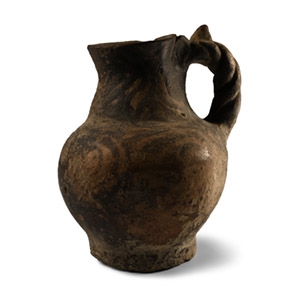
Western Asiatic Painted Terracotta Jug
1st millennium B.C.Sold for (Inc. bp): £59
Squat in profile with basal ring, trumpet-shaped mouth with rounded rim, loop handle to rear of twisted construction with spiked thumb-pad. 280 grams, 12 cm
From a London, UK, gentleman's collection of ancient pottery and artefacts, 1990s. This lot has been cleared against the Art Loss Register database, and is accompanied by an illustrated lot declaration signed by the Head of the Antiquities Department, Dr Raffaele D'Amato.
