
Loading, please wait...
_900x900.jpg "Elamite Silver Beaker with Three Ibexes")
_200x200.jpg "Elamite Silver Beaker with Three Ibexes")
_900x900.jpg "Elamite Silver Beaker with Three Ibexes")
_200x200.jpg "Elamite Silver Beaker with Three Ibexes")
.jpg "Elamite Silver Beaker with Three Ibexes")
.jpg "Elamite Silver Beaker with Three Ibexes")
LOT 0257
Elamite Silver Beaker with Three Ibexes
CIRCA 2,500-1,500 B.C.
4 3/4 in. (153 grams, 12 cm).
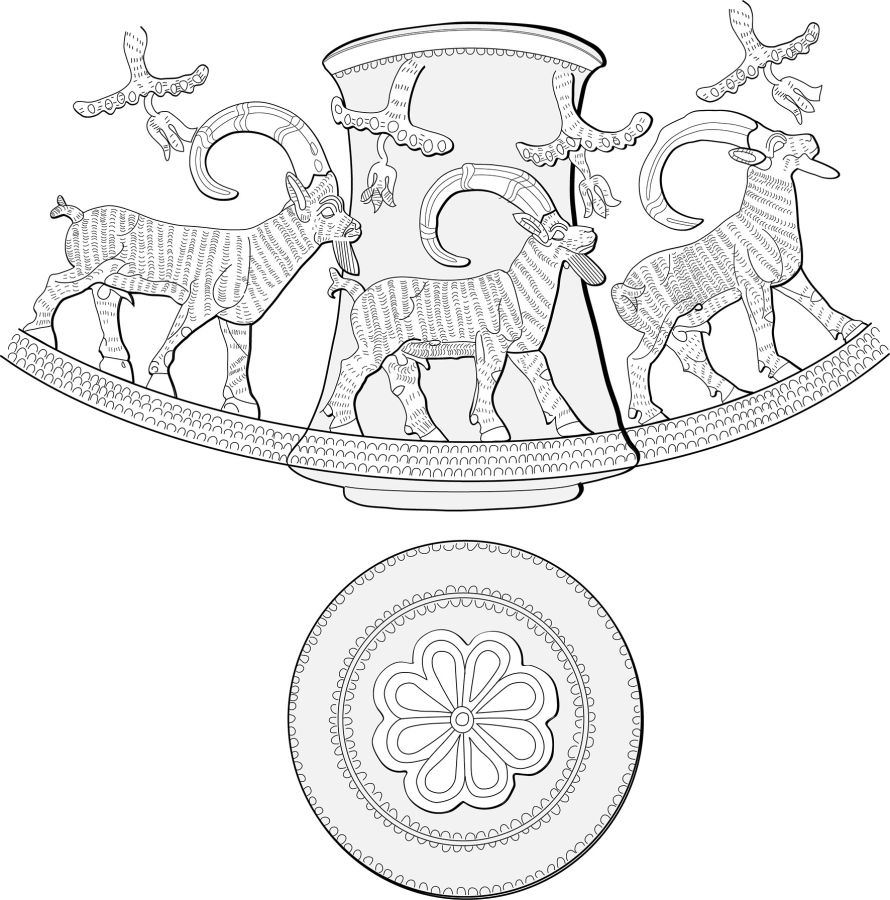
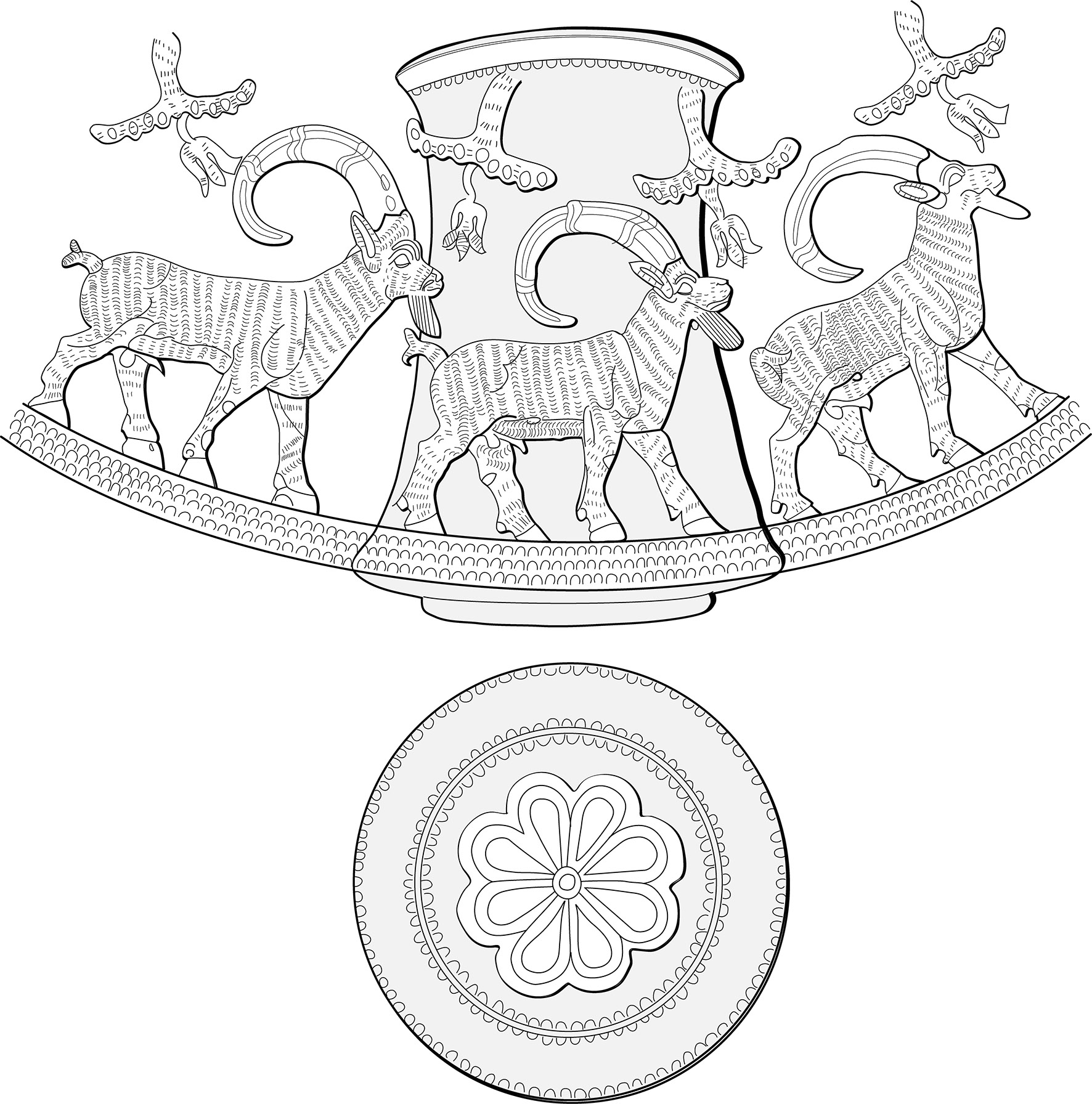
Raised from a single sheet with conical body and everted rim, three striding ibexes in repoussè, each with its head held up high and depicted with defined musculature and genitalia; band of ovule decoration above and below, three hanging flowers separating the ibexes; the base with an eight-petalled flower; late Elamite or Marlik.
ProvenanceAcquired in New York, USA, 1966.
Private collection.
Accompanied by an academic report by Dr Raffaele D’Amato.
This lot has been checked against the Interpol Database of stolen works of art and is accompanied by a search certificate no.12161-218632.
See Negahban, E.O., A preliminary report on Marlik excavations, Gohar Rud Expedition, Rudbar, 1961-1962, Teheran, 1964; Moorey P.R.S., Bunker, C.M., Porada, E., Markoe, G., Ancient Bronzes Ceramics and seals, Los Angeles, 1981, fig.409; Mahboubian H., Art and civilization of Ancient Iran, 3000-2000 BC, Salisbury, 2004, nos.1-5, for similar; Muscarella, O.W., Archaeology, Artifacts and Antiquities of the Ancient Near East, Leiden, Boston, 2013; Oudbashi, O., Hessari, M., ‘Iron Age tin bronze metallurgy at Marlik, Northern Iran: an analytical investigation’ in Archaeological and Anthropological Sciences Volume: 9 Issues: 2, 2017; the decoration of this vessel correspondence with a silver beaker in repoussè and chasing from Fars (see Mahboubian, 2004, p.33), the decoration of a jar from Western Iran (Moorey, Bunker, Porada, Markoe, 1981, pp.84-85), but especially with a North Western Iranian vase published by Muscarella (1988, pp.82ff.) and belonging to the North Iranian Marlik culture.
FootnotesThis splendid vessel, decorated with a design possibly of Elamite origin, probably originates from North-Western Iran, or from southern Caspian area. Hammered sheet vessels were produced in Western Iranian metal workshops since the 3rd millennium B.C. (Moorey, Bunker, Porada, Markoe, 1981, p.82).
CONDITIONTimeLine Auctions follows a vetting process to ensure the authenticity and legality of all items, reinforcing our commitment to integrity and responsible trading. Each antiquity, antique, and coin lot undergoes thorough examination by a vetting committee of at least ten external specialists, professional trade association members, scientists, and archaeologists: Our Vetting Process
AUCTIONS:
TimeLine is a leading auction house specialising in antiquities, ancient art, collectables, natural history, coins, medals, and books. Our auctions offer museums, collectors, historians, and enthusiasts the opportunity to acquire unique and historically significant pieces.
LOT 0257
Elamite Silver Beaker with Three Ibexes
Estimate £25,000 - 35,000€29,000 - 40,600 (for guidance only)$33,750 - 47,250 (for guidance only)
-
Mesopotamian Stone Bull Stamp Seal
2nd-1st millennium B.C.Sold for (Inc. bp): £260
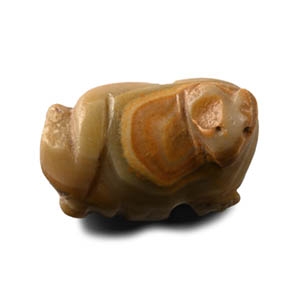
Modelled in the round as a recumbent bull with piriform head, pierced at the shoulder, with abstract drilled design to the underside. 7.1 grams, 27 mm
From the private collection of Mr K.A., acquired in the 1990s-early 2000s. -
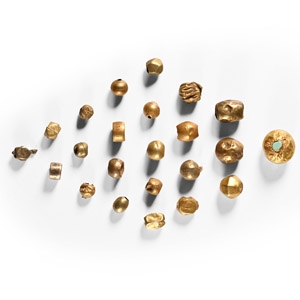
Western Asiatic Gold Bead Group
2nd-1st millennium B.C.Sold for (Inc. bp): £538
Including spherical, biconical, barrel-shaped and other types. 7.98 grams total, 5-12 mm
Ex property of a late Japanese collector, 1970s-2000s. -
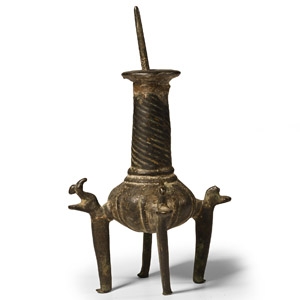
Western Asiatic Bronze Kohl Pot with Applicator
Circa 8th-10th century A.D.Sold for (Inc. bp): £85
With bulbous body segmented to the underside, tall tubular neck with spiral ornament to the outer face, stepped collars and flange rim, four zoomorphic legs; the applicator round-section, fusiform with square-section central handle, geometric ornament. 441 grams total, 14-14.2 cm
Ex property of a Surrey gentleman. From a private collection of an Exeter gentleman since 2015.
