
Loading, please wait...
LOT 1396
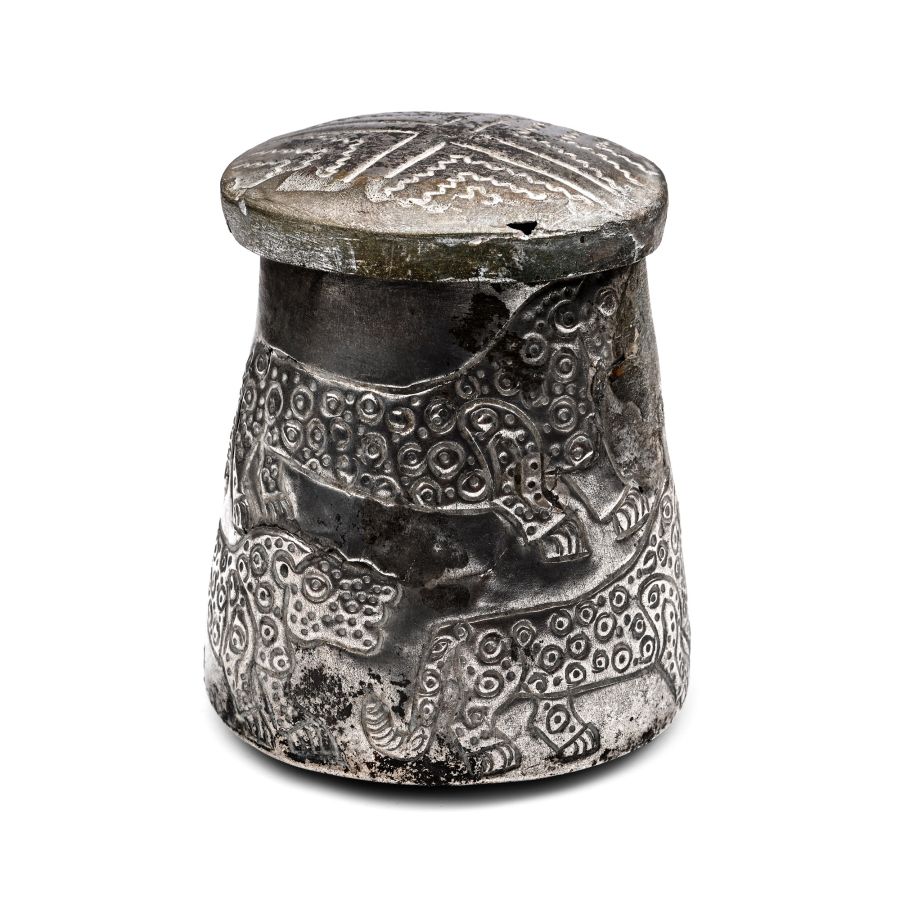
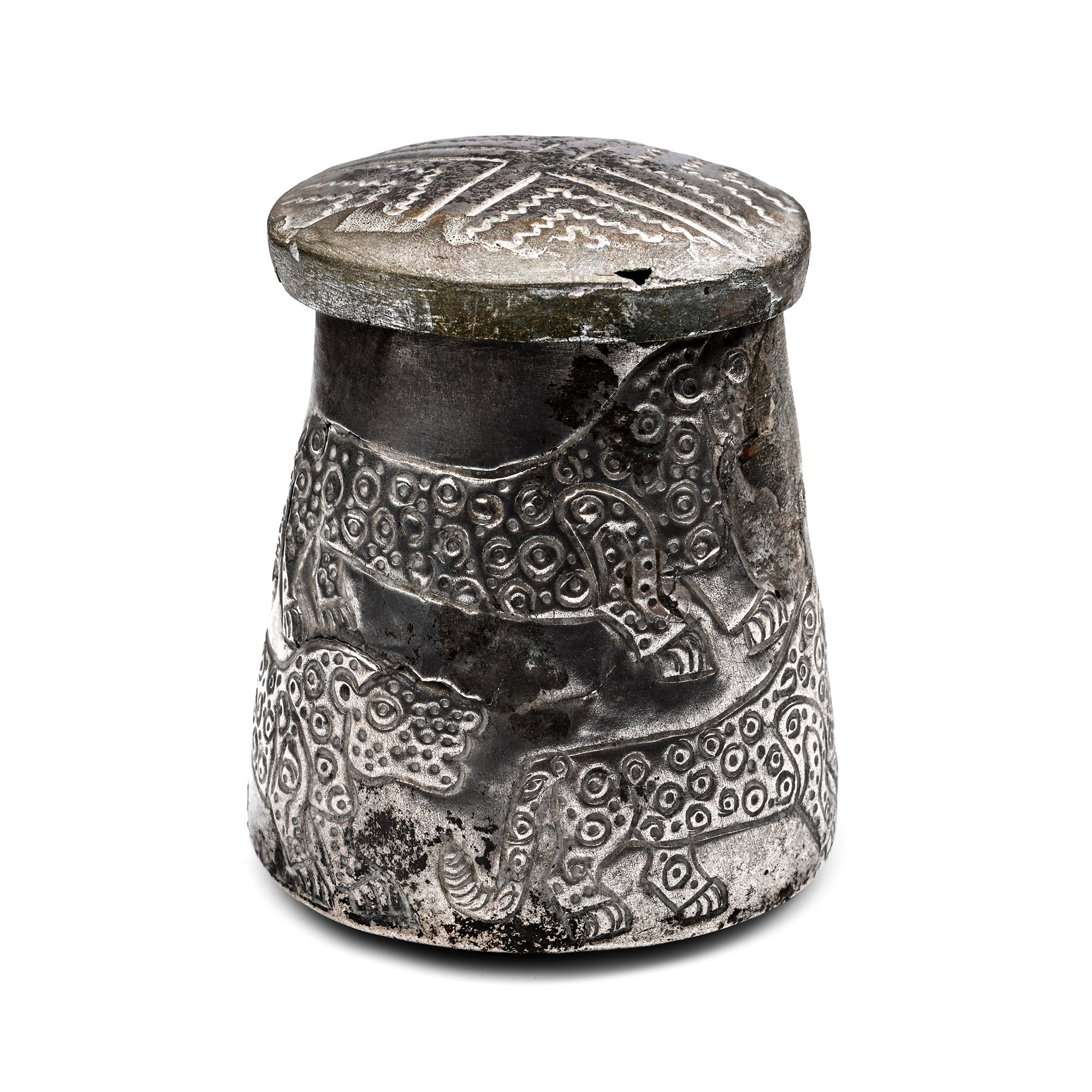
Elamite Silver Beaker with Leopards
CIRCA 2500-1500 B.C.
3 3/8 in. (47 grams, 87 mm).
Sheet-silver pyxis with tapering sides and slightly curved base, everted rim; discoid lid with lip, impressed cruciform design with zigzags in the quadrants; sidewall with impressed frieze of leopards in profile, ring-and-dot and chased detailing to fur; some restoration.
ProvenanceUK private collection before 2000.
Acquired on the UK art market.
with TimeLine Auctions, 5 September 2024, no.1255.
Private collection, London, UK.
See von Bothmer, (ed.), Glories of the Past, Ancient Art from the Shelby White and Leon Levy Collection, Metropolitan Museum of Art, New York, 1991; Mahboubian, H., Elam – Art and Civilization of Ancient Iran, London, 2004, for discussion.
CONDITIONTimeLine Auctions follows a vetting process to ensure the authenticity and legality of all items, reinforcing our commitment to integrity and responsible trading. Each antiquity, antique, and coin lot undergoes thorough examination by a vetting committee of at least ten external specialists, professional trade association members, scientists, and archaeologists: Our Vetting Process
AUCTIONS:
TimeLine is a leading auction house specialising in antiquities, ancient art, collectables, natural history, coins, medals, and books. Our auctions offer museums, collectors, historians, and enthusiasts the opportunity to acquire unique and historically significant pieces.
-
.jpg)
Elamite Bronze Spouted Vessel with Floral Design
2nd-1st millennium B.C.Estimate: £1,800 - 2,400 (+bp*)
Opening Bid: £900
With a hollow-formed biconvex body, tiered rim and short straight spout, repoussé octofoil motifs to the shoulder, trumpet-shaped stepped base. 349 grams, 16 cm
Acquired before 1983. Ex London gallery, 1990s. Private collection, London. Accompanied by an academic report by Dr Raffaele D’Amato. This lot has been checked against the Interpol Database of stolen works of art and is accompanied by search certificate number no.13027-246802.
The Elamite culture was an important civilisation in the ancient Near East that lasted for many centuries, from the 3rd millennium to the 6th century BC. They developed their own style of art, metalwork, and seal designs, as well as their own form of cuneiform writing. Although the Elamites were eventually absorbed into later empires, many aspects of their culture continued to influence the ancient world around them. -
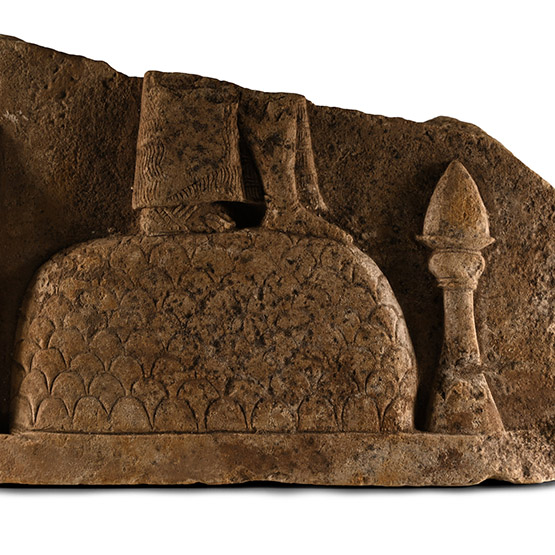
Neo-Assyrian Stone Relief with Standing Figure
9th-8th century B.C.Sold for (Inc. bp): £3,900
Corner fragment from a high-relief pictorial panel with raised border; domed dais with low-relief scaled detailing; lower legs and sandaled feet in advancing pose with ankle-length open-fronted robe, horizontal woven texture and curled fleece; high-relief stele with flared base, bulbous upper and sugar-loaf finial; pitted surface, with tooling to reverse. 2.81 kg, 24.3 cm
Ex German collection, c.1980. with Toufic Arakji, Hamburg, 1997. Private collection, Europe. Accompanied by an academic report by Dr Raffaele D'Amato. This lot has been checked against the Interpol Database of stolen works of art and is accompanied by search certificate no.12579-232134.
Stylistically, the figure seems to be linked to the kingdom of Ashurnasirpal II (883-859 B.C.) or his son Shalmaneser III (858-824 B.C.). The exposed lower leg with exaggerated musculature is seen in many Assyrian and Babylonian depictions of divine and heroic figures. The position of the figure, corresponding to some reliefs kept in the Louvre, where a spirit is worshipping a poppy flower (Houston, 1954, pl.V.1), and the high-relief carving, strongly refer to a cult scene. -
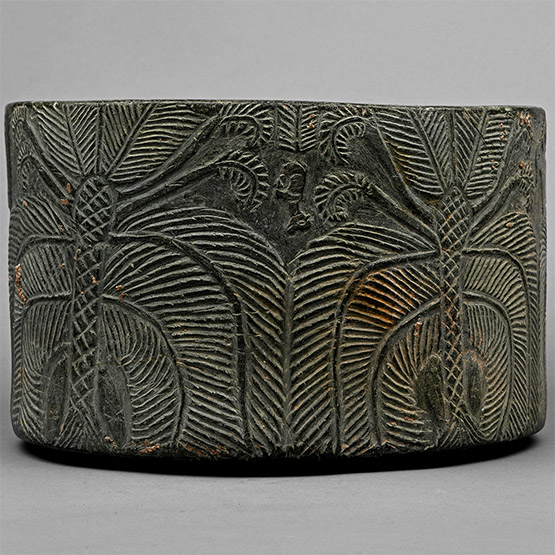
Mesopotamian Steatite Bowl with Animals and Palm Trees
3rd millennium B.C.Estimate: £12,000 - 17,000 (‡+bp*)
Opening Bid: £6,000
Drum-shaped steatite vessel with broad flat rim; low-relief frieze to the outer face: dense vegetation panels with hatched treetrunks and fronds, resting quadrupeds, each with the legs folded beneath the body. 5.3 kg, 24.5 cm wide
Acquired by a Swiss family in the mid-1980s to late 1990s, thence by descent. Private collection, Switzerland, since the late 1990s. Accompanied by an academic report by Dr Raffaele D’Amato. This lot has been checked against the Interpol Database of stolen works of art and is accompanied by search certificate number no.13026-246787.
