
Loading, please wait...
LOT 1072
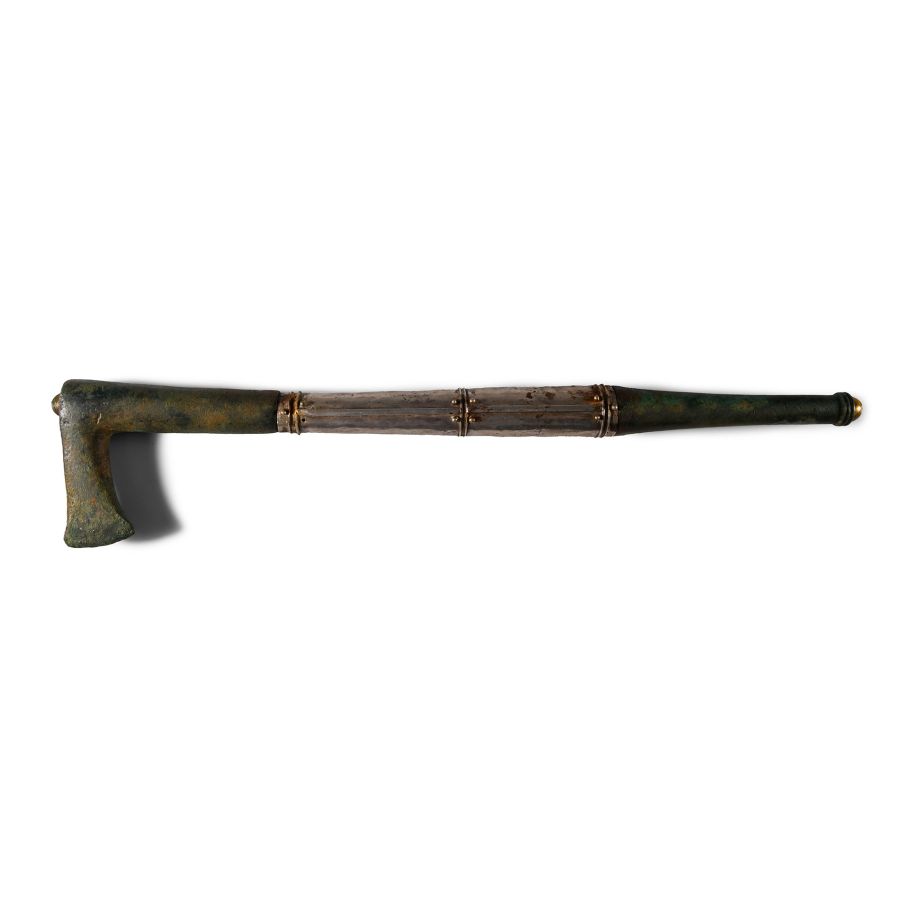
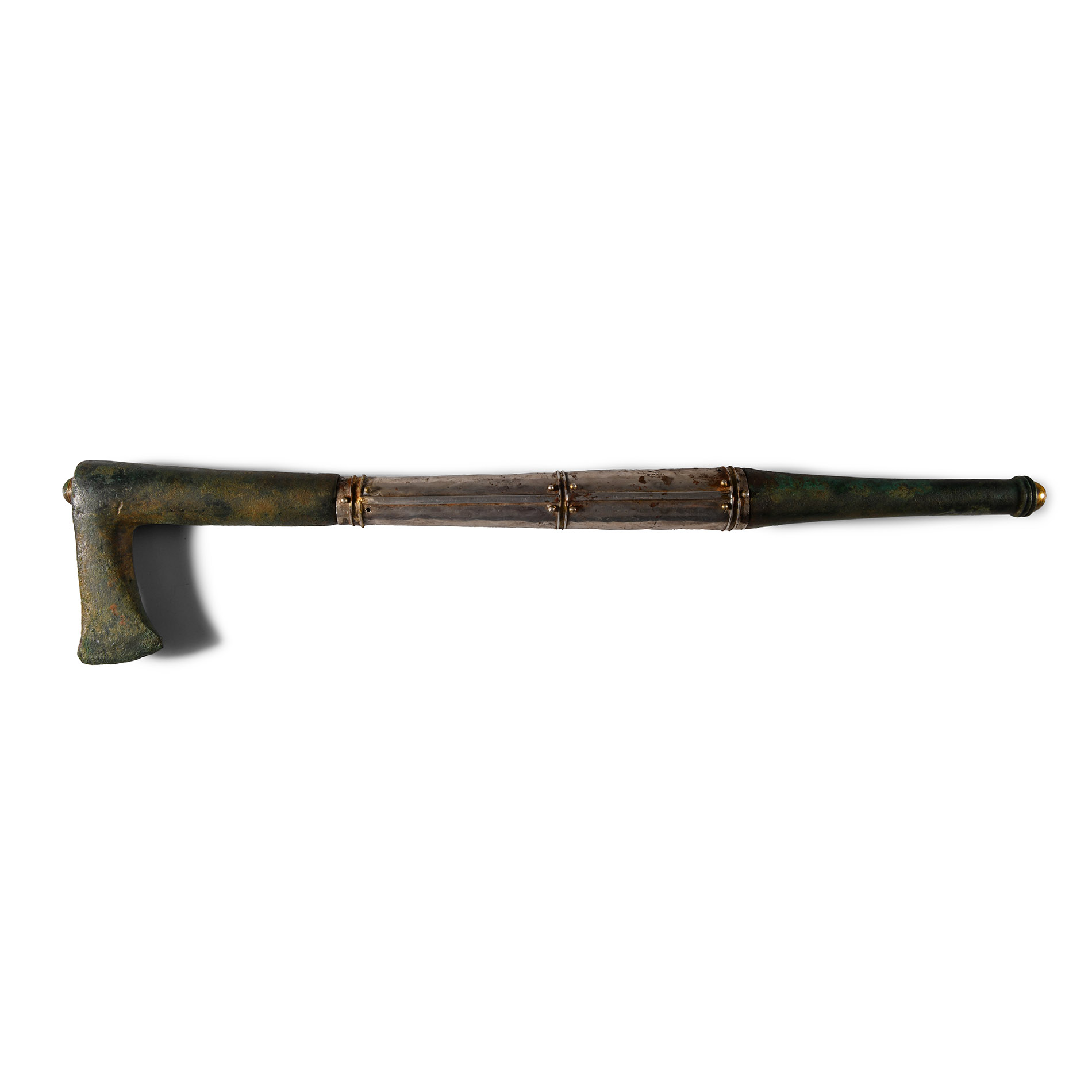
Elamite Ceremonial Axe with Silver Sleeve
3RD-2ND MILLENNIUM B.C.
18 in. (750 grams, 45.5 cm).
With later sheet-silver sleeve to the shaft, attached with ball-headed rivets; gilt dome finial to each end, the lower one in a gusseted collar.
ProvenanceAcquired in 1996.
Ex Samad Khameneh collection.
Private Swiss collection.
This lot has been checked against the Interpol Database of stolen works of art and is accompanied by search certificate no.11647-199005.
Cf. similar axehead in the British Museum, item no. 128617; cf. for the type Maxwell-Hyslop, R., ‘Western Asiatic Shaft-Hole Axes’ in Iraq, Vol. 11, No. 1 (Spring, 1949), pp.90-129, pl.XXXIV, fig.4b.
FootnotesThe axe belongs typologically to Type 4 of Maxwell-Hyslop’s classification, with a long and thin shaft narrowing towards the base.
When technical developments resulted in heavier axe-blades, it was necessary to prolong the socket into a shaft tube and to cut away the underside of the blade where it joined the shaft. The edge of the blade was curved and this shifted the point of impact of the cutting edge.
TimeLine Auctions follows a vetting process to ensure the authenticity and legality of all items, reinforcing our commitment to integrity and responsible trading. Each antiquity, antique, and coin lot undergoes thorough examination by a vetting committee of at least ten external specialists, professional trade association members, scientists, and archaeologists: Our Vetting Process
AUCTIONS:
TimeLine is a leading auction house specialising in antiquities, ancient art, collectables, natural history, coins, medals, and books. Our auctions offer museums, collectors, historians, and enthusiasts the opportunity to acquire unique and historically significant pieces.
LOT 1072
Elamite Ceremonial Axe with Silver Sleeve
Estimate £12,000 - 17,000€13,920 - 19,720 (for guidance only)$16,200 - 22,950 (for guidance only)
-
Pre-Achaemenid Bronze Short Sword with Bifurcated Pommel
Circa 8th century B.C.Estimate: £3,000 - 4,000 (+bp*)
Opening Bid: £1,400
The blade with mid-rib divided in five vertical lines, emerging from the mouth of two stylised lion-heads, the eyes recessed to accept red inlay; the grip and upper part of the blade with incised spiral decoration; the ribbed pommel with twin roundels, each decorated with a recessed six-petalled rosette, traces of red pigment still visible. 665 grams, 50 cm
Ex old English collection. London art market, pre 2000. Property of a London, UK, gentleman. This lot has been checked against the Interpol Database of stolen works of art and is accompanied by search certificate no.11974-210547.
Examples of swords and daggers with the guard in the form of addorsed animal heads with the blade projecting from the mouths are known from Assyrian reliefs (for example on the orthostats from Tell al Rimah). -
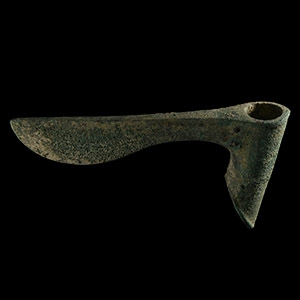
Luristan Sar-e Tabar Socketted Axehead
2nd millennium B.C.Sold for (Inc. bp): £208
With plain cylindrical socket and staff, off-set at the base, of simple undecorated shape with a long lentoid-section D-shaped blade with scooped profile. 465 grams, 18 cm
Earlier 20th century collection. Mayfair, London gallery, UK. Dr D.G. collection, 1990s-2019.
Many examples of bronze axeheads are attributed to the Luristan culture and various shapes have been discussed by different scholars. Moorey (1971, pp.39-41) shows similar axeheads, stating that the texts executed on some specimens have shown them made of arsenical bronze, and attributes them to the late 3rd millennium B.C. or 2nd millennium B.C., period in which this alloy was used abundantly. -
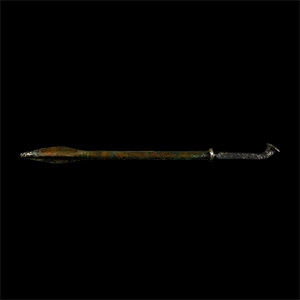
Western Asiatic Bronze Javelin Head
Late 3rd millennium B.C.Estimate: £300 - 400 (+bp*)
Opening Bid: £150
Featuring a tripartite weapon with short, narrow leafy blade, elongated stem decorated by embossed geometric lines and folded tang. 220 grams, 32.3 cm
Acquired 1980-2015. Ex Abelita family collection.
The points within this typology are biconvex or leaf-shaped, not very sharp. These types of spears have been found in the tombs of Palestine from Tell el-'Ajjul (tomb 227) to the sites of the central plains and the banks of Jordan: Yavne, 'Ain Samiya, Jebel Qa'aqir, tombs G 83 and M 13 of Jericho, tombs 2100 and 2111 of Lachish. All are dated to the last two centuries of the 3rd millennium.
