
Loading, please wait...
LOT 0227
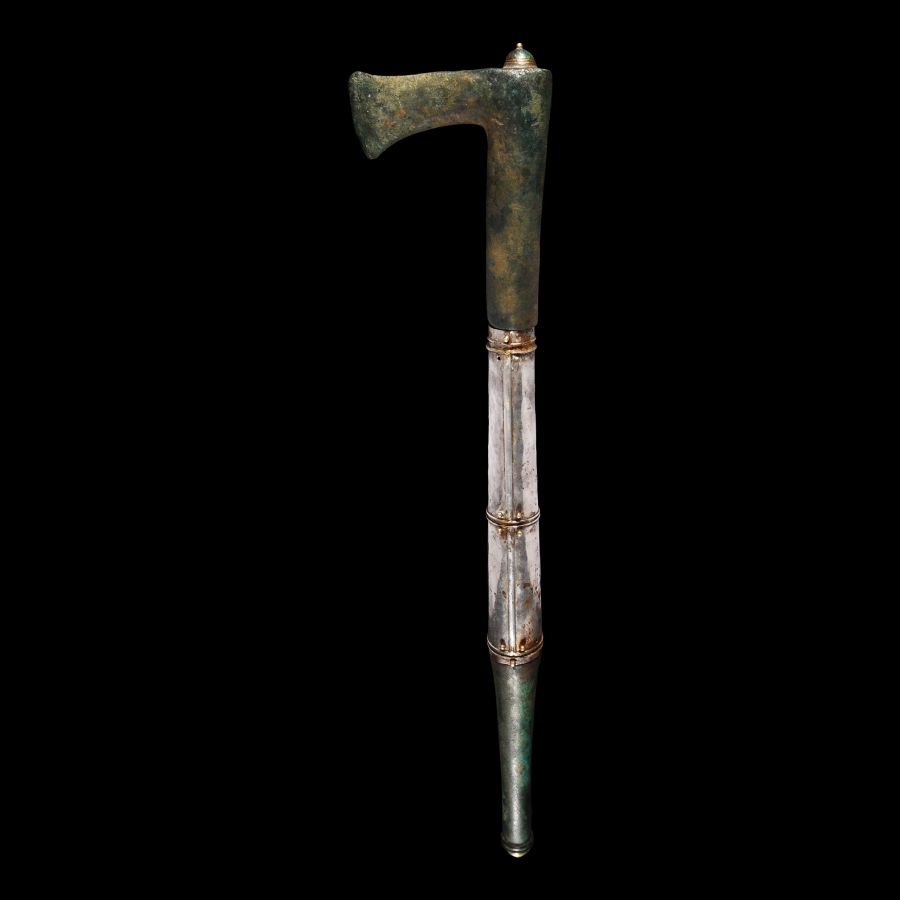
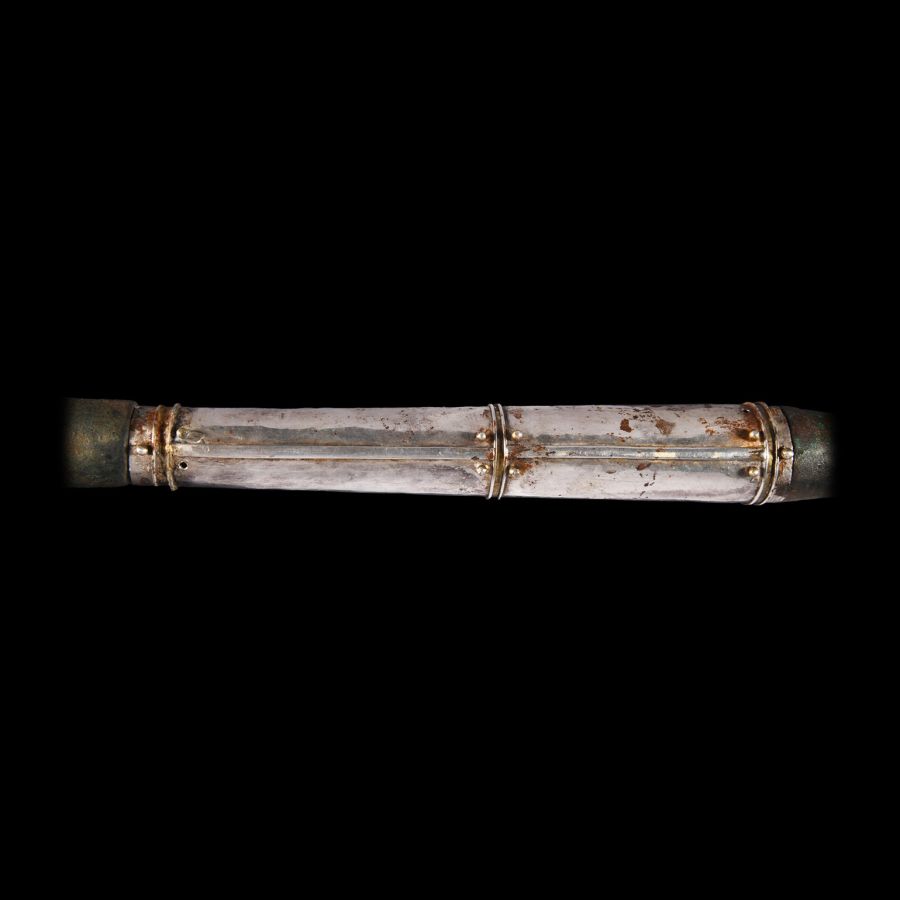
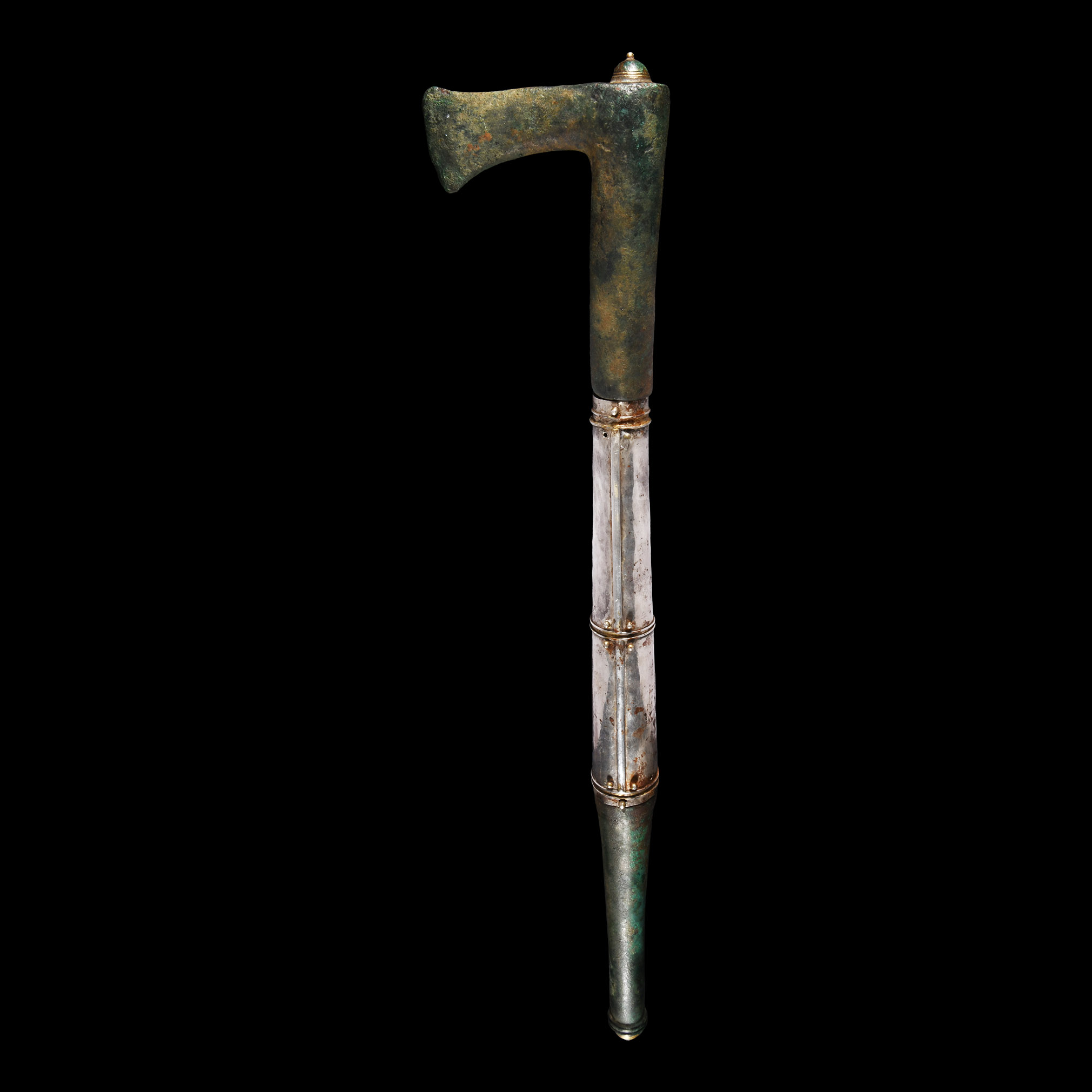
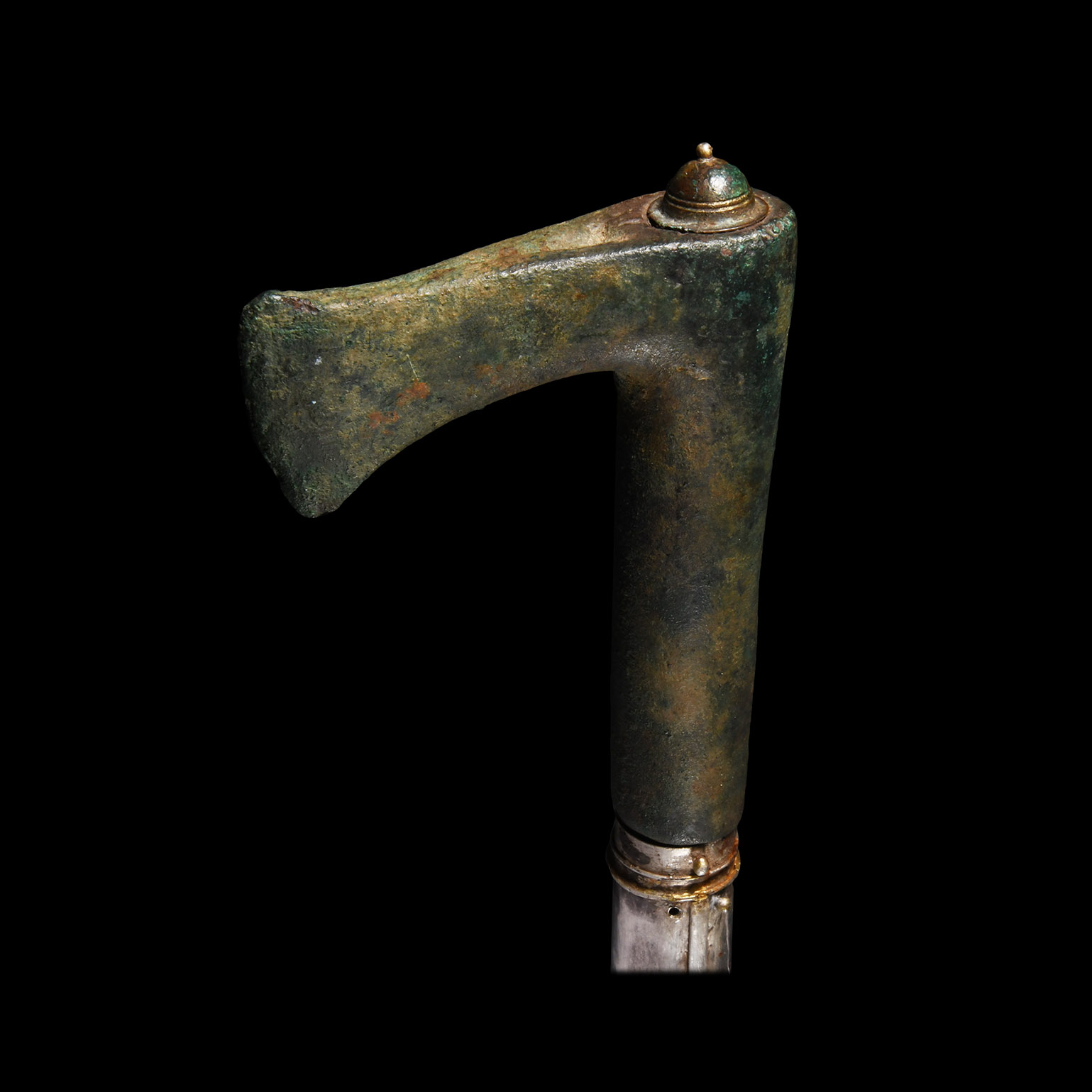
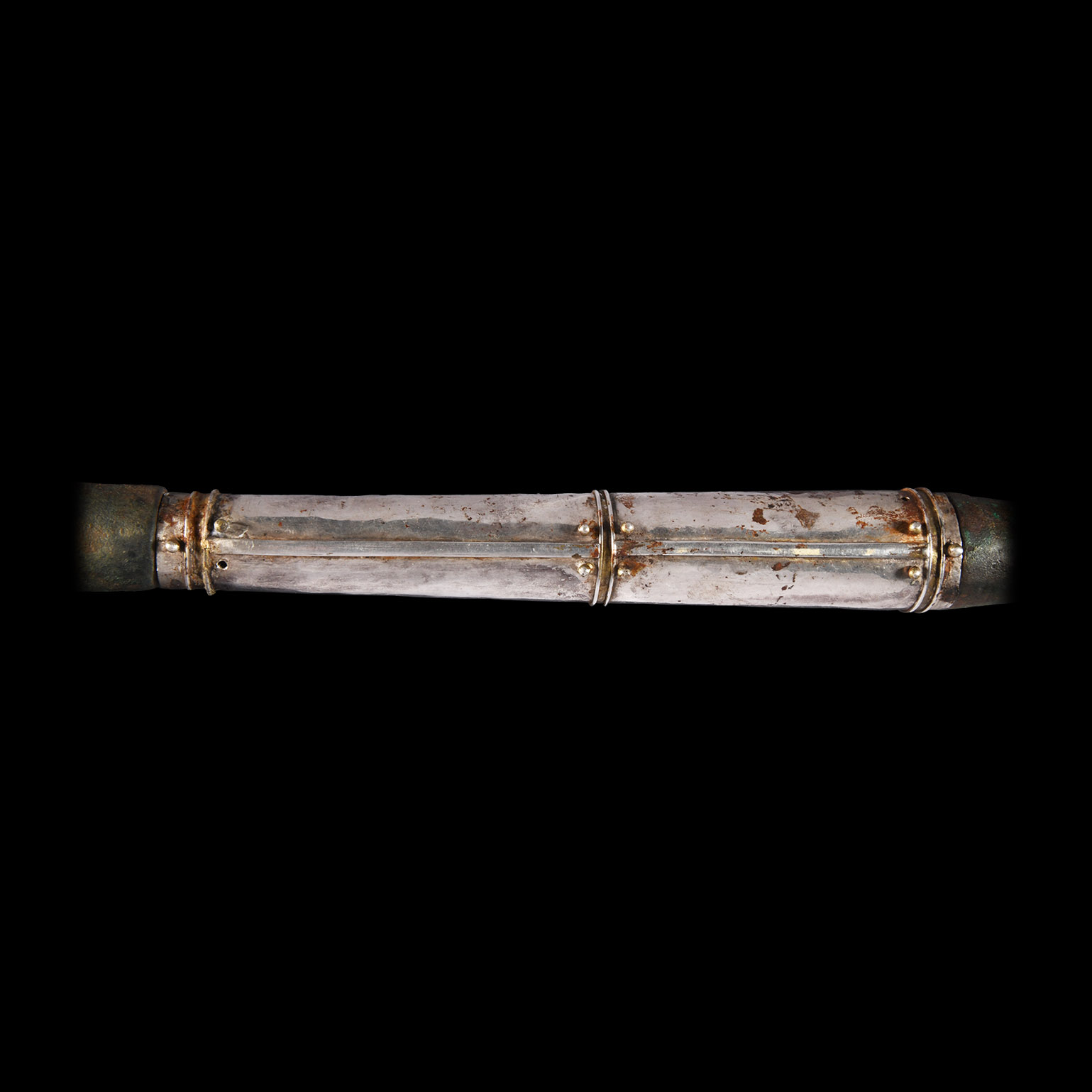
Elamite Ceremonial Axe with Silver Sleeve
3RD-2ND MILLENNIUM B.C.
18 in. (750 grams, 45.5 cm).
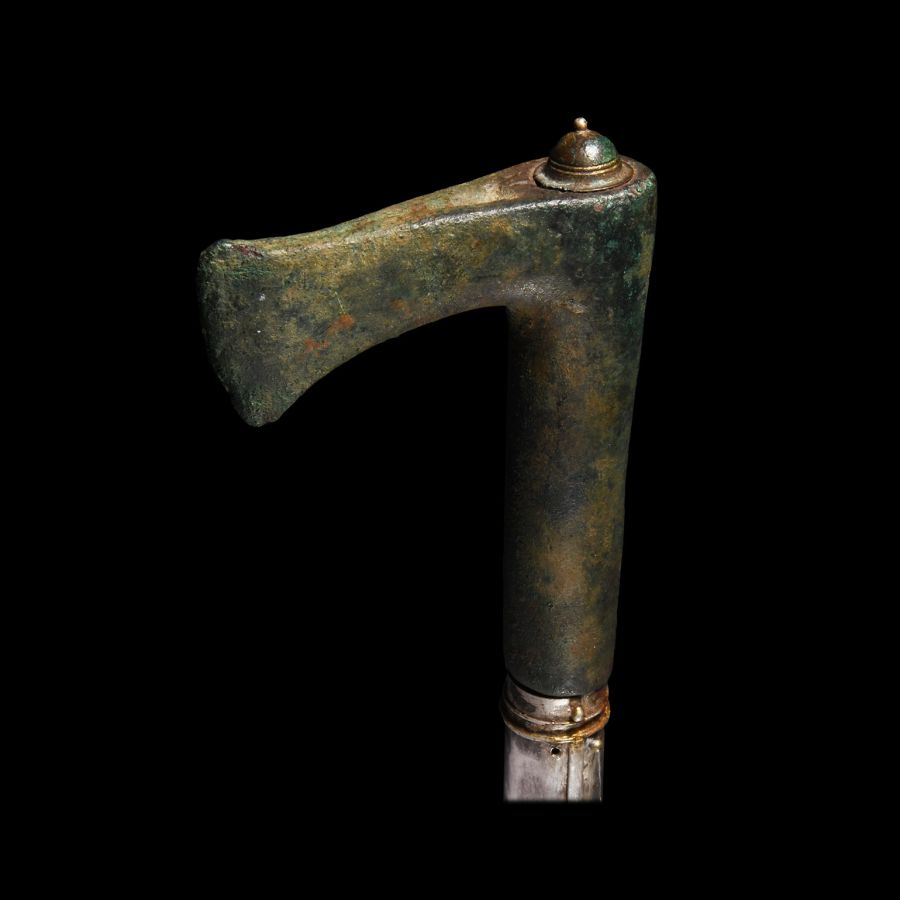
A bronze ceremonial axe with later sheet-silver sleeve to the shaft, attached with ball-headed rivets; gilt dome finial to each end, the lower one in a gusseted collar.
ProvenanceAcquired in 1996.
Ex Samad Khameneh collection.
Private Swiss collection.
This lot has been checked against the Interpol Database of stolen works of art and is accompanied by search certificate no.11647-199005.
Cf. similar axehead in the British Museum, item no. 128617; cf. for the type Maxwell-Hyslop, R., ‘Western Asiatic Shaft-Hole Axes’ in Iraq, Vol. 11, No. 1 (Spring, 1949), pp.90-129, pl.XXXIV, fig.4b.
FootnotesThe axe belongs typologically to Type 4 of Maxwell-Hyslop’s classification, with a long and thin shaft narrowing towards the base.
When technical developments resulted in heavier axe-blades, it was necessary to prolong the socket into a shaft tube and to cut away the underside of the blade where it joined to the shaft. The edge of the blade was curved and this shifted the point of impact of the cutting edge.
TimeLine Auctions follows a vetting process to ensure the authenticity and legality of all items, reinforcing our commitment to integrity and responsible trading. Each antiquity, antique, and coin lot undergoes thorough examination by a vetting committee of at least ten external specialists, professional trade association members, scientists, and archaeologists: Our Vetting Process
AUCTIONS:
TimeLine is a leading auction house specialising in antiquities, ancient art, collectables, natural history, coins, medals, and books. Our auctions offer museums, collectors, historians, and enthusiasts the opportunity to acquire unique and historically significant pieces.
LOT 0227
Elamite Ceremonial Axe with Silver Sleeve
Estimate £12,000 - 17,000€13,920 - 19,720 (for guidance only)$16,200 - 22,950 (for guidance only)
-
.jpg)
Roman Julius Caesar Sling Shot from the Battle of Munda
45 B.C.Sold for (Inc. bp): £572
A biconical facetted lentoid-section lead sling shot (glans), inscription monogram a combination of letters 'C', 'A' and 'E', for 'C A E S' referring to Julius Caesar. 63.29 grams, 36 mm
Fine condition.
Found near to an important village site, close to Seville, 1960-1970. From an old Spanish collection. Swiss private collection. Accompanied by a copy of the Spanish export licence. Accompanied by an academic paper by military specialist Dr Raffaele D'Amato, dated 4th May 2022 and titled 'Roman Res Publica - Lead Slingshots (glandes) of Caesarian Age - 45 B.C circa'.
The shot (type IIb of the Völling classification) is marked with the abbreviated name of Julius Caesar; it was used in quantity at the Battle of Monda (or Munda) against the last fellows of Pompey, the leaders of the Optimates, on the 17th March 45 BC. Similar shots were used in the Caesar's wars. The slingers of Caesar's age were part of the light infantry. Caesar speaks of his Balearic slingers during the conquest of Gaul. They wore a short tunic, with leather or rope sandals to the feet, and a warm overcoat which could also have been used to store projectiles. They also used a satchel to carry very deadly lead-like stones or bullets. -
Roman Legionary Helmet with Inscription
1st century B.C.Estimate: £12,000 - 17,000 (‡+bp*)
Opening Bid: £6,000
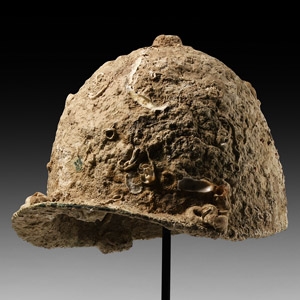
A bronze Montefortino helmet with bulbous domed skull and a plain crest knob with flattened top; plain and flat neck guard with thickened rim; the front with punched Latin inscription 'A N CFN'; the surface largely covered in marine encrustations; accompanied by a custom-made display stand. 2.2 kg, 28 cm (4 kg total, 45 cm high including stand)
Private Swiss collection, acquired 2001. Accompanied by an academic report by Dr Raffaele D'Amato. This lot has been checked against the Interpol Database of stolen works of art and is accompanied by searcher certificate no.11576-198953.
This Montefortino specimen belongs to type C or D of Robinson’s classification, also identified under the continental system as Buggenum. The helmets of this category, mainly legionary helmets, were produced in mass by the state to be supplied to the troops fighting in the civil wars of the 1st century B.C. Artistic sources of the same period provide evidence for the use of Montefortino and Buggenum type helmets in sea battles, which has been confirmed by archaeological finds from the Albenga ship. The legionary helmets had inscriptions punched upon them, indicating the name of the wearer and the unit, i.e. cohors, centuria or turma. Here the punched letters 'AN' refer probably to the initials of the owner (Ancus N.?), and 'CFN' to centuria of Fabius C. -

Luristan Socketted Cudgel
13th-7th century B.C.Estimate: £300 - 400 (+bp*)
Opening Bid: £150
A bronze cudgel or handle of an axe or mace reinforced at both ends by raised moulding, the handle adorned with a double spiral in relief. 473 grams, 15.5 cm wide
Fine condition.
Private family collection formed in London, mid 1980s to early 1990s.
