
Loading, please wait...
LOT 0292
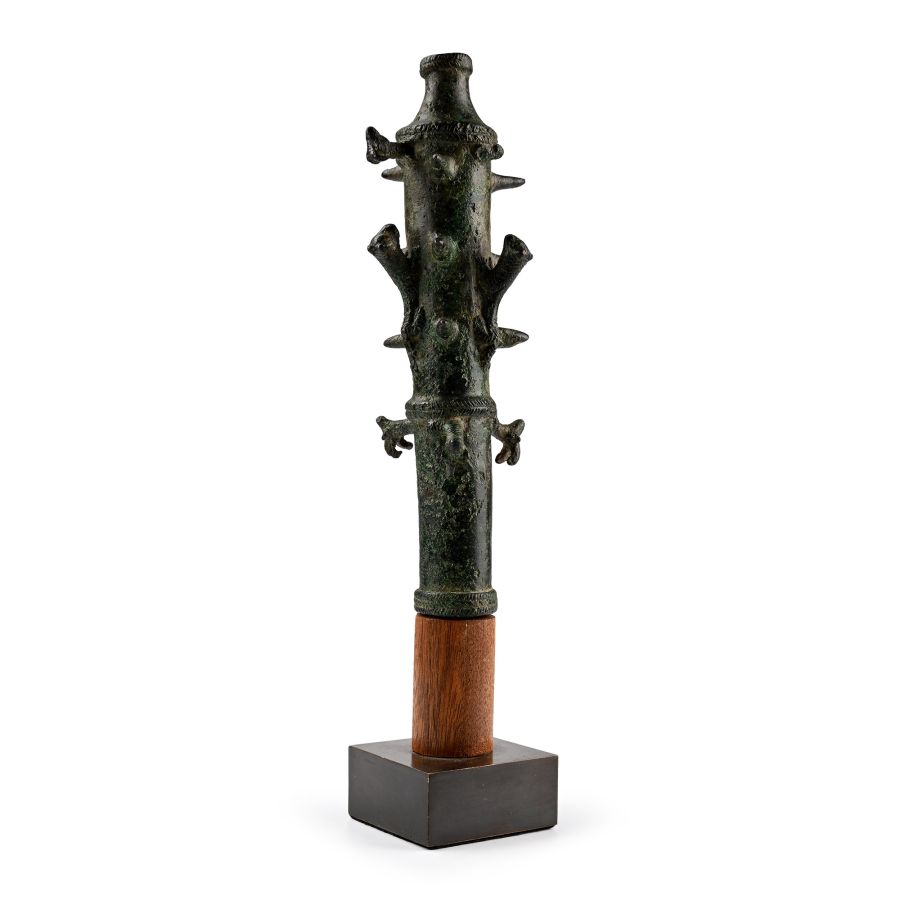
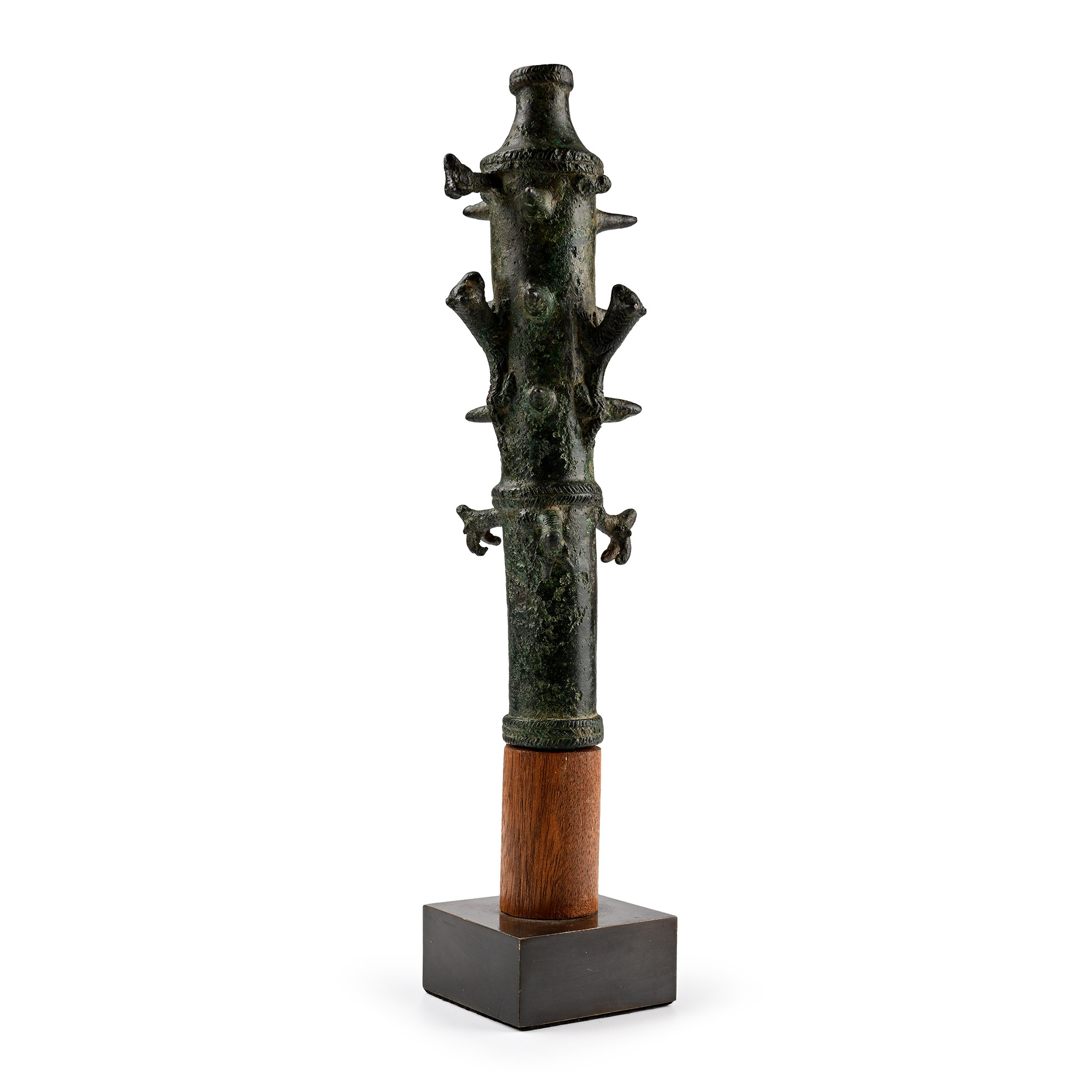
Elamite Bronze Parade Macehead with Animals
2ND MILLENNIUM B.C.
7 1/2 in. (10 1/4 in.) (519 grams, 19 cm (647 grams total, 26 cm including stand)).
Tubular sleeve with ribbed collars to the mouth and shank; scooped upper end narrowing to the top; three vertical lines of conical spikes with interstitial crawling lions, rams' heads at the top, ibex heads below the lower collar; mounted on a custom-made stand.
ProvenanceKuizenga collection, the Netherlands, acquired Hamburg 22 December 1995.
Private collection, London, UK.
This lot is accompanied by an illustrated lot declaration signed by the Head of the Antiquities Department, Dr Raffaele D'Amato.
Cf. Moorey, P.R.S., Ancient Persian Bronzes in the Adam Collection, Oxford, 1974, p.49, no.18; and Mahboubian, H., Art of Ancient Iran. Copper and Bronze, London, 1997, p.169, no.177.
CONDITIONTimeLine Auctions follows a vetting process to ensure the authenticity and legality of all items, reinforcing our commitment to integrity and responsible trading. Each antiquity, antique, and coin lot undergoes thorough examination by a vetting committee of at least ten external specialists, professional trade association members, scientists, and archaeologists: Our Vetting Process
AUCTIONS:
TimeLine is a leading auction house specialising in antiquities, ancient art, collectables, natural history, coins, medals, and books. Our auctions offer museums, collectors, historians, and enthusiasts the opportunity to acquire unique and historically significant pieces.
LOT 0292
Elamite Bronze Parade Macehead with Animals
Estimate £1,000 - 1,400€1,160 - 1,620 (for guidance only)$1,350 - 1,890 (for guidance only)
-
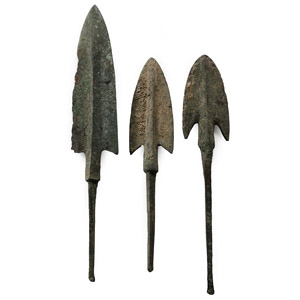
Luristan Bronze Arrowhead Collection
2nd-1st millennium B.C.Estimate: £100 - 140 (+bp*)
Opening Bid: £50
Comprising: two large triangular arrowheads with barbed shoulders and rounded midrib; one large arrowhead with lanceolate head and rounded shoulders. 94 grams total, 12.5-16.1 cm
Acquired in the 1990s. Ex Abelita family collection. This lot is accompanied by an illustrated lot declaration signed by the Head of the Antiquities Department, Dr Raffaele D'Amato.
The arrowheads belong to the type V of the classification of Khorasani: subtype D (triangular arrowheads with rounded or angular midrib) and subtype C, arrowheads with elongated, triangular shape with barbed shoulders and convex sides, and a raised midrib with a sharp central line. -
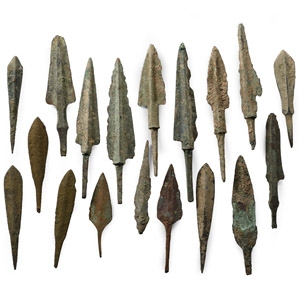
Luristan Bronze Arrowhead Collection
2nd-1st millennium B.C.Sold for (Inc. bp): £98
A group of eighteen tanged mainly triangular and leaf-shaped arrowheads. 246 grams total, 6.1-11.8 cm
From the London art market, 1990s. This lot is accompanied by an illustrated lot declaration signed by the Head of the Antiquities Department, Dr Raffaele D'Amato. -
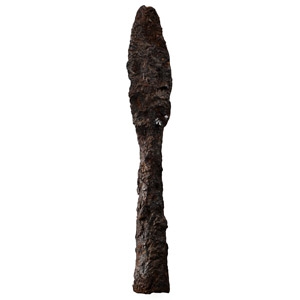
Viking Socketted Iron Spearhead
9th-11th century A.D.Sold for (Inc. bp): £39
A short, leaf-shaped blade and tapering, round-section socket, pierced for attachment to a shaft. 102 grams, 18 cm
Fair condition.
UK gallery, acquired in the 2000s. Property of an English gentleman. This lot is accompanied by an illustrated lot declaration signed by the Head of the Antiquities Department, Dr Raffaele D'Amato.
