
Loading, please wait...
LOT 1015
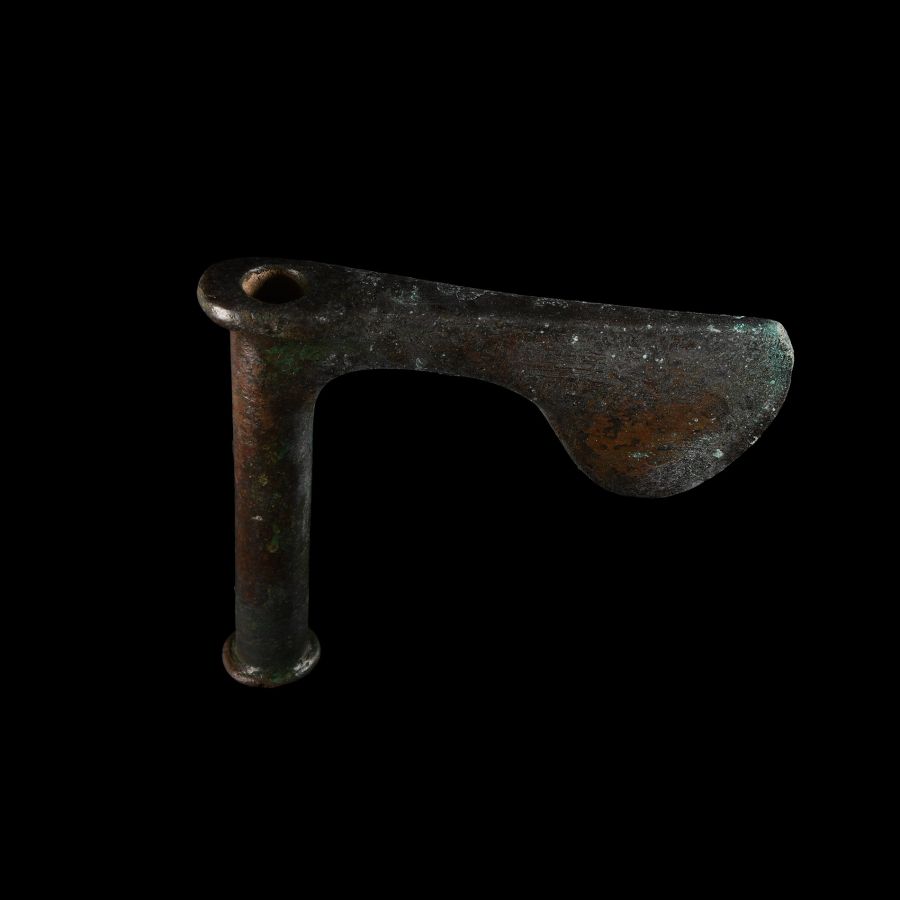
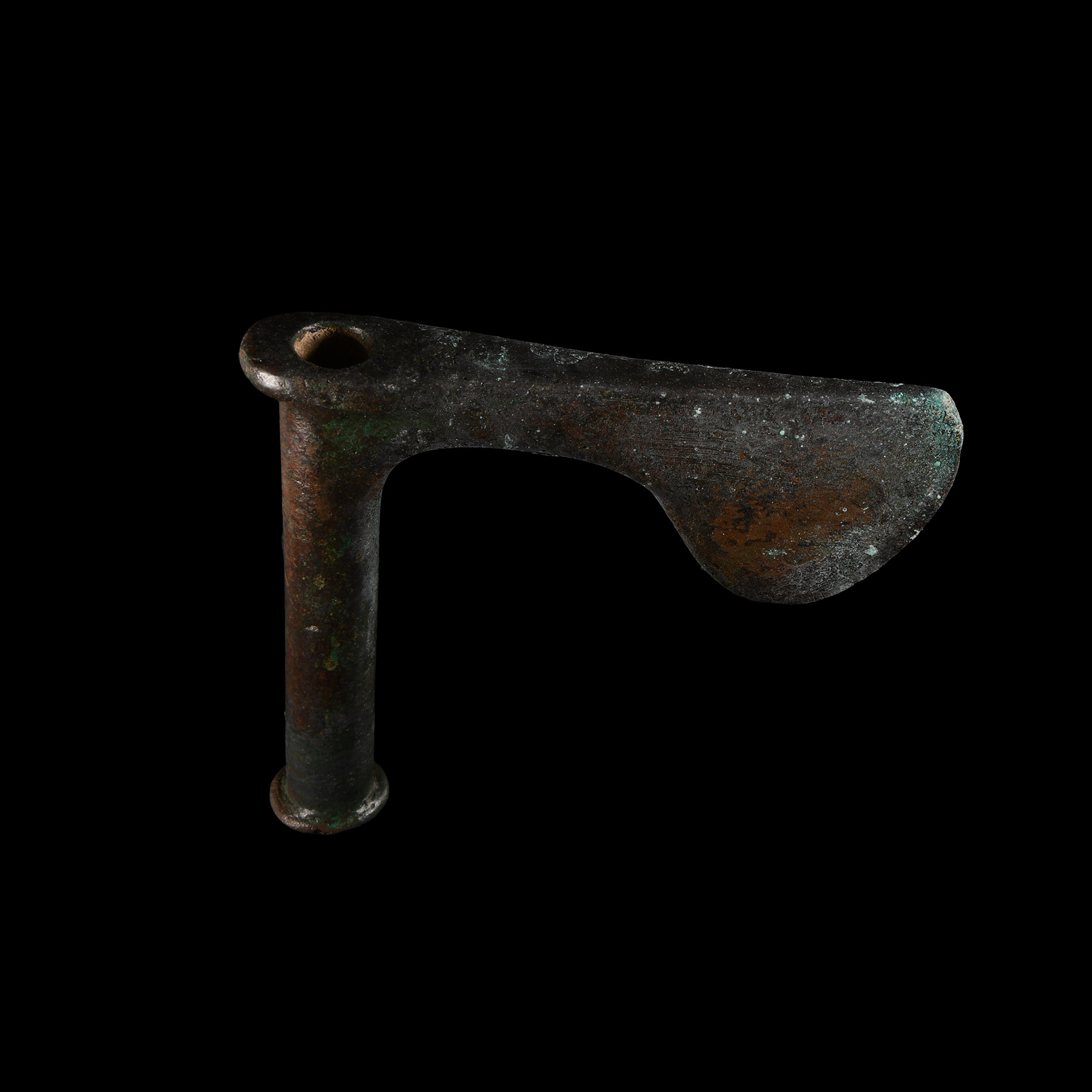
Elamite Bronze Crescentic Axehead
MID 3RD MILLENNIUM B.C.
5 in. (333 grams, 12.5 cm).
With slender tubular socket, horizontal upper cheek and curved lower one, scooped profile to blade with convex cutting edge.
ProvenanceAcquired 1980-2015.
Ex Abelita family collection.
See Gorelik, M., Weapons of Ancient East, IV millennium BC-IV century BC, Saint Petersburg (2003), pl.XIX, no.68 (Susa, Elam), for similar.
CONDITIONTimeLine Auctions follows a vetting process to ensure the authenticity and legality of all items, reinforcing our commitment to integrity and responsible trading. Each antiquity, antique, and coin lot undergoes thorough examination by a vetting committee of at least ten external specialists, professional trade association members, scientists, and archaeologists: Our Vetting Process
AUCTIONS:
TimeLine is a leading auction house specialising in antiquities, ancient art, collectables, natural history, coins, medals, and books. Our auctions offer museums, collectors, historians, and enthusiasts the opportunity to acquire unique and historically significant pieces.
LOT 1015
Elamite Bronze Crescentic Axehead
Estimate £180 - 240€210 - 280 (for guidance only)$240 - 320 (for guidance only)
-
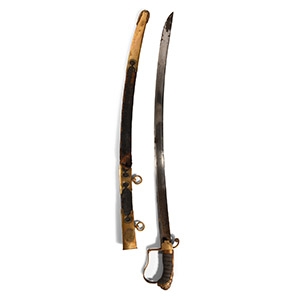
Officer's Presentation Sword with Islamic Script
Circa 1798 A.D.Sold for (Inc. bp): £780
British infantry officer's sword - 1796 pattern with lion-head pommel and knuckle-guard, short curved quillon to the rear; leather scabbard with brass fittings and escutcheon below the frog with the legend 'R. Johnston / late / Bland & Foster / Sword Cutler / & Belt Maker to his / Majesty / -68- / St. James's St/ London'; guilloche detailing to the border and to the langets; hollow-ground blade with inlaid brass Arabic script to both faces, possibly a trophy from the Battle of the Nile in August, 1798. 1.23 kg, 95 cm total
From a Suffolk, UK, private collection.
Richard Johnston took over the sword- and belt-making business from John Bland, who died in 1791, and his surviving partner, Robert Foster, who died in 1798. After Bland's death, Foster and Johnston moved their premises from 70 St. James's Street to number 68 in the same street, and continued the business until Foster's death in 1798, after which Johnston took on another shop, then displaying the address as '38 & 68 St. James's Street'. The cartouche gives the address as '68 St. James's Street', which shows that the sword was produced, finished and sold in 1798. -
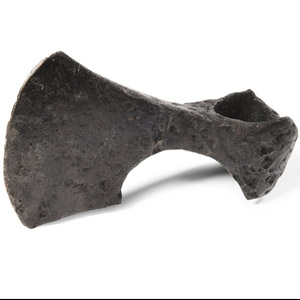
Viking Age Iron Bearded Axehead
9th century A.D.Sold for (Inc. bp): £338
Hand-forged with triangular-section narrow blade widening to a broad bevelled edge with square chin, socket with lateral flanges and rounded panel to the rear. 359 grams, 12.4 cm
From the private collection of a London gentleman, from his grandfather's collection formed before the early 1970s.
The axe seems to belong to the typology of Viking side axes of Wheeler type B (Wheeler III / Rygh 559). Usually these bearded axeheads (skeggöks) had a longer edge, designed to split tree trunks into planks and beams, or heads in two parts. Some of the bearded axes were known as halfÞynna öx, the neck on such 'half thin axe' was thinly forged, to make it lighter. -
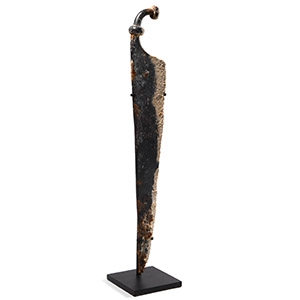
Iron Age Celtic La Tene Dagger
1st century B.C.-1st century A.D.Sold for (Inc. bp): £975
Featuring a gently curved single-edged iron blade and one-sided fuller, curved handle with knot pommel; mounted on a custom-made display stand. 525 grams total, 35 cm high including stand
Dutch art market. Private collection of K.S., Cologne, Germany, acquired 1996.
One of the military insignia of a Celtic warrior was the war-knife, usually between 33 and 35 cm long. For example, in the collection of Celtic military equipment from Galish-Lovachka, the archaeologists have found a short sword with an X-shaped handle (l = 41 cm), two middle La Tène swords (72.5 and 75 cm long), 12 large curved knives, 27 spearheads, two javelin heads, 14 arrowheads, and nine iron chain belts for hanging a sword. The war-knife was also used for hunting, as a spare weapon, or to cut the throat of an enemy in a surprise attack.
