
Loading, please wait...
LOT 0043
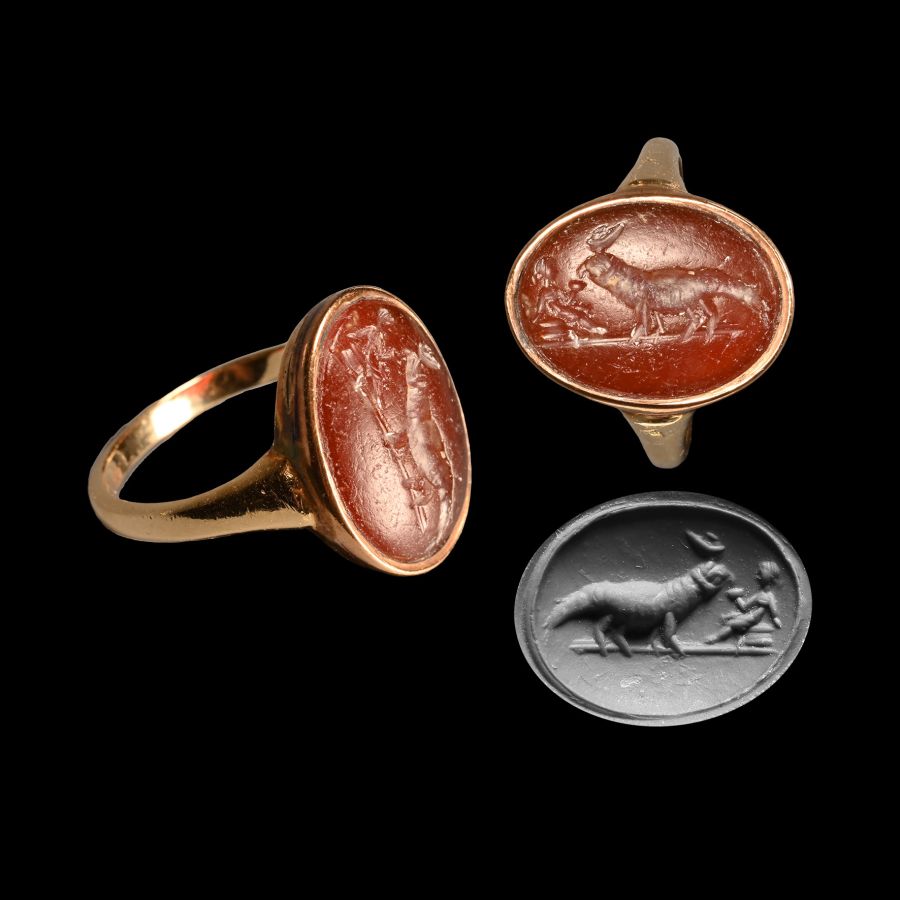
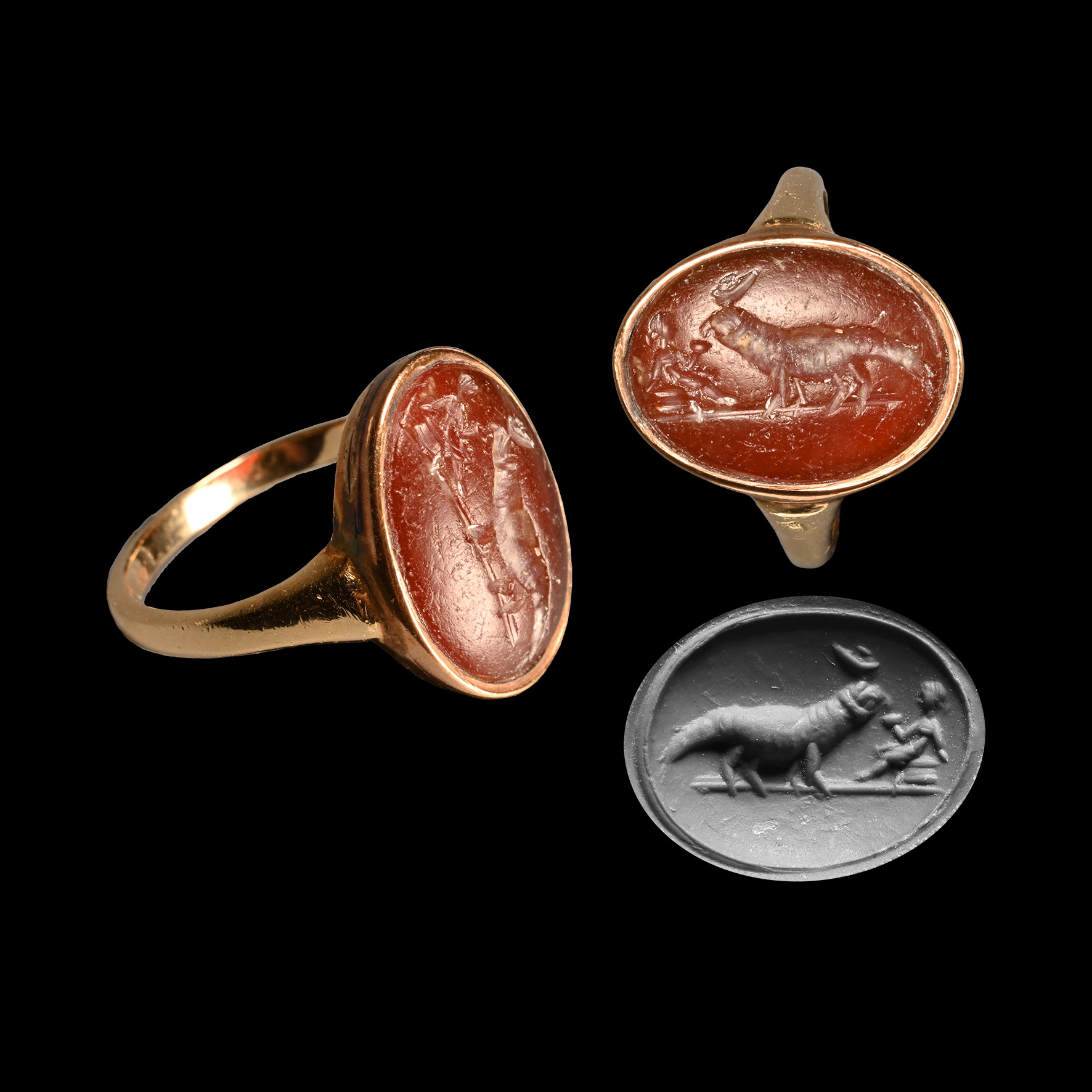
Egypto-Roman Red Carnelian Soknopaios Gemstone in Gold Ring
1ST-2ND CENTURY A.D.
1 in. (5.23 grams, 23.98 mm overall, 18.87 mm internal diameter (approximate size British Q 1/2, USA 8 1/4, Europe 18.12, Japan 17)).
The 19th century ring with D-section hoop expanding at the shoulders; the oval intaglio engraved with a seated woman offering food or drink from a cup to a creature with the body of a crocodile and a falcon head; accompanied by a custom-made display case and impression.
ProvenanceAcquired in the 1980s.
with Christie's, Ancient Jewellery, 7 December 2006, lot 277.
Accompanied by an academic report by Dr Raffaele D’Amato.
This lot has been checked against the Interpol Database of stolen works of art and is accompanied by a search certificate number no.11779-204569.
Cf. Dosoo, K., Galoppin, T., ‘Animals in Graeco-Egyptian Magical Practice’ in Dosoo, K., Coulon, C., Magic Zōon, Animal and Magica from the Antiquity to the Middle Ages, Aubervilliers, 2022, pp.203-256; for images of Soknopaios see Metropolitan Museum of Art, accession number 30.8.307; the Walters Art Museum, accession no.22.347; for magical gems with an image of a falcon-headed crocodile, see the Bibliothèque nationale de France, Cabinet des Médailles, inventory no.CBd-3289.
FootnotesAn important creator god, Soknopaios is depicted here with the crocodile body of Sobek and the falcon head of Re. It has been suggested that the falcon head of Soknopaios alludes to association with the goddess Isis's son Horus. It can also depict an image of the so-called ‘nine shaped one’ (εννεάμορφος), a figure mentioned several times in the magical rituals written in Greek but with a strong Egyptian religious background. This deity is often understood as the bios (i.e. an incarnation) of the supreme god Amun-Re, often accompanied by a surrounding ouroboros serpent.
CONDITIONTimeLine Auctions follows a vetting process to ensure the authenticity and legality of all items, reinforcing our commitment to integrity and responsible trading. Each antiquity, antique, and coin lot undergoes thorough examination by a vetting committee of at least ten external specialists, professional trade association members, scientists, and archaeologists: Our Vetting Process
AUCTIONS:
TimeLine is a leading auction house specialising in antiquities, ancient art, collectables, natural history, coins, medals, and books. Our auctions offer museums, collectors, historians, and enthusiasts the opportunity to acquire unique and historically significant pieces.
LOT 0043
Egypto-Roman Red Carnelian Soknopaios Gemstone in Gold Ring
Sold for (Inc. bp): £5,200
-
Egyptian Mounted Coptic Textile with Vines
Circa 6th-7th century A.D.Sold for (Inc. bp): £46
Composed of a clavus decorated with grape leaves and vine shoots in light yellow colour upon a purple background, with two bunches of grapes marked in green, the frame formed of a double line surrounded externally by a minute recurring spiral. 111 grams, 58 x 18.5 cm
Acquired 1970s-1996. Property of a North American collector. London collection, 2016.
Tapestry technique on natural light yellow wool upon linen. It is highly probable that this tapestry was part of a tunic decoration, a clavus, running vertically on the breast and on the back of it. -
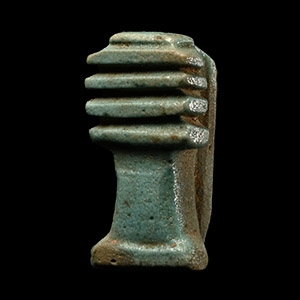
Egyptian Faience Djed Pillar Amulet
Late Period, 664-323 B.C.Sold for (Inc. bp): £91
Decorated with a blue glaze; pillar to reverse, pierced for suspension. 1.9 grams, 21 mm
From an early 20th century collection, Carnavon, North Wales, UK. -
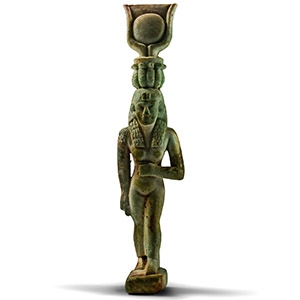
Egyptian Faience Isis Amulet
Late Period, 664-332 B.C.Sold for (Inc. bp): £975
Striding on a rectangular base, right arm held by her side, the other wrapped around her torso; wearing a modius of cobras topped by a horned sun disc; turquoise glaze; with reverse suspension loop. 4.87 grams, 52 mm
Acquired in Europe before 1998.
