
Loading, please wait...
_900x900.jpg "Egypto-Phoenician Haematite Scaraboid Seal")
_200x200.jpg "Egypto-Phoenician Haematite Scaraboid Seal")
_900x900.jpg "Egypto-Phoenician Haematite Scaraboid Seal")
_200x200.jpg "Egypto-Phoenician Haematite Scaraboid Seal")
_900x900.jpg "Egypto-Phoenician Haematite Scaraboid Seal")
_200x200.jpg "Egypto-Phoenician Haematite Scaraboid Seal")
.jpg "Egypto-Phoenician Haematite Scaraboid Seal")
.jpg "Egypto-Phoenician Haematite Scaraboid Seal")
.jpg "Egypto-Phoenician Haematite Scaraboid Seal")
LOT 0414
Egypto-Phoenician Haematite Scaraboid Seal
CIRCA 5TH CENTURY B.C.
7/8 in. (8.35 grams, 21 mm).
With rampant lion and statant winged gryphon.
ProvenanceAcquired in the mid 1980s-1990s.
Private collection, Switzerland, thence by descent.
Private collection, since the late 1990s.
Accompanied by a copy of an Art Loss Register certificate, no.3095.WW.
This lot has been checked against the Interpol Database of stolen works of art and is accompanied by a search certificate number no.12715-234628.
TimeLine Auctions follows a vetting process to ensure the authenticity and legality of all items, reinforcing our commitment to integrity and responsible trading. Each antiquity, antique, and coin lot undergoes thorough examination by a vetting committee of at least ten external specialists, professional trade association members, scientists, and archaeologists: Our Vetting Process
AUCTIONS:
TimeLine is a leading auction house specialising in antiquities, ancient art, collectables, natural history, coins, medals, and books. Our auctions offer museums, collectors, historians, and enthusiasts the opportunity to acquire unique and historically significant pieces.
LOT 0414
Egypto-Phoenician Haematite Scaraboid Seal
Estimate £1,800 - 2,400€2,090 - 2,780 (for guidance only)$2,430 - 3,240 (for guidance only)
-
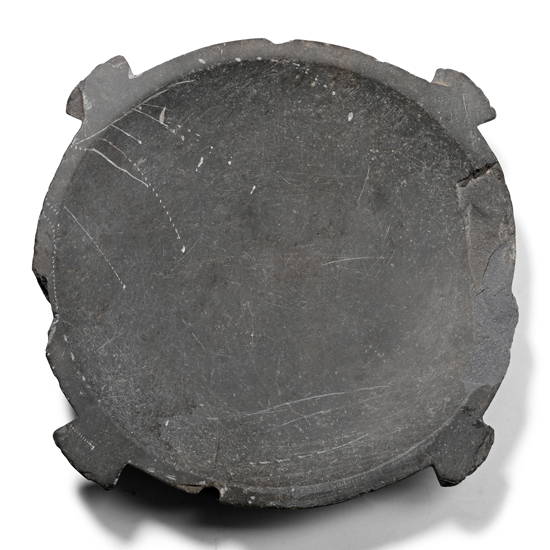
Egyptian Schist Cosmetic Mortar
Ptolemaic Period, 332-32 B.C.Estimate: £500 - 700 (‡+bp*)
Opening Bid: £278
Discoid palette with rounded underside and flat base, dished central field, flat rim with four radiating trapezoidal projections. 450 grams, 16.4 cm
Acquired in the mid 1980s-1990s. Private collection, Switzerland, thence by descent. Private collection, since the late 1990s. Accompanied by a copy of an Art Loss Register certificate no.S00038135. -
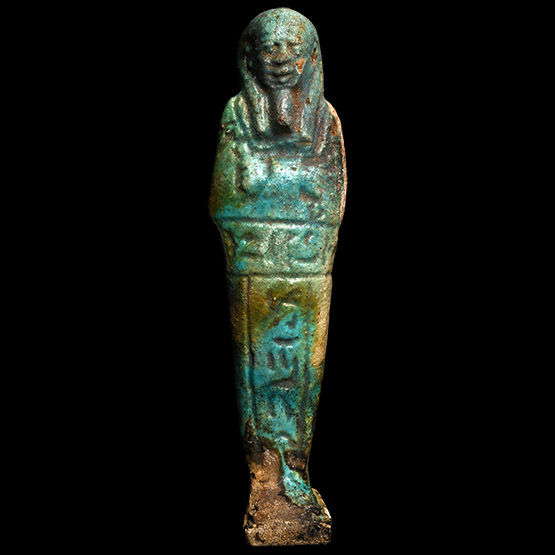
Egyptian Faience Shabti with Hieroglyphics
Late Period, 664-332 B.C.Sold for (Inc. bp): £585
Mummiform shabti wearing a tripartite wig, with arms crossed and holding a pick and hoe, seed bag suspended over the shoulder; horizontal band to the waist and vertical column to the legs, each with an impressed hieroglyphic inscription. 80 grams, 13.5 cm
Private collection, USA and Switzerland, acquired in the early 1980s; thence by descent. -
.jpg)
Large Phoenician Alabaster Alabastron with Hieroglyphic Inscription
Circa 600 B.C.Estimate: £15,000 - 20,000 (‡+bp*)
Opening Bid: £7,500
Barrel-shaped in profile with a rounded base, broad shoulder and flared mouth, two lateral integral loop handles; incised hieroglyphic legend to the shoulder. 420 grams, 37 cm
Formerly in a private collection, Beirut, Lebanon, 1990s. Swiss private collection, acquired from Mr H., Geneva, 2010. This lot has been checked against the Interpol Database of stolen works of art and is accompanied by search certificate number no.13221-249178. Accompanied by a copy of an Art Loss Register certificate, no.S00059830
In the Phoenician necropolises of Andalusia, the ashes of the deceased were enclosed in luxurious alabaster urns of Egyptian manufacture. In the Phoenician necropolis of Almuñécar, for example, some urns preserved inscriptions and emblems of various Egyptian pharaohs, who ruled the Nile region between the 16th and 8th centuries B.C. Alabaster vessels of this type, originally containing fine wines, have been discovered, albeit in smaller numbers, in the royal palaces of Assur and Samaria in the East, as part of war booty or gifts exchanged between royal houses.
