
Loading, please wait...
_900x900.jpg "Egyptian Zoomorphic Stone Scaraboid with Animal Heads and Hieroglyphs")
_200x200.jpg "Egyptian Zoomorphic Stone Scaraboid with Animal Heads and Hieroglyphs")
.jpg "Egyptian Zoomorphic Stone Scaraboid with Animal Heads and Hieroglyphs")
LOT 0432
Egyptian Zoomorphic Stone Scaraboid with Animal Heads and Hieroglyphs
LATE PERIOD, 664-332 B.C. OR LATER
1 1/2 in. (6.38 grams, 37 mm).
Lentoid in plan with addorsed goat-heads to the upper face, hieroglyphic text to the underside. [No Reserve]
ProvenanceAcquired 1970s-1996.
Property of a North American collector.
London collection, 2016.
Cf. Andrews, C., Amulets of Ancient Egypt, London, 1994, pl.44a, for type.
CONDITIONTimeLine Auctions follows a vetting process to ensure the authenticity and legality of all items, reinforcing our commitment to integrity and responsible trading. Each antiquity, antique, and coin lot undergoes thorough examination by a vetting committee of at least ten external specialists, professional trade association members, scientists, and archaeologists: Our Vetting Process
AUCTIONS:
TimeLine is a leading auction house specialising in antiquities, ancient art, collectables, natural history, coins, medals, and books. Our auctions offer museums, collectors, historians, and enthusiasts the opportunity to acquire unique and historically significant pieces.
LOT 0432
Egyptian Zoomorphic Stone Scaraboid with Animal Heads and Hieroglyphs
Sold for (Inc. bp): £156
-
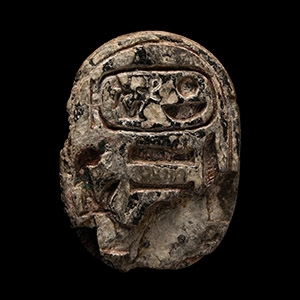
Large Egyptian Stone Hieroglyphic Scarab for Amenhotep III
New Kingdom, 1386-1349 B.C.Estimate: £1,000 - 1,400 (‡+bp*)
Opening Bid: £500
Naturalistically modelled with detailing to the upper body and legs; damaged base with the throne name 'neb-maat-re' of Amenhotep III in cartouche and the god's name Amun-Re below; pierced for suspension. 41 grams, 44 mm
Ex R. Liechti (1934-2010) Geneva, Switzerland, collection between 1950-1990s. -
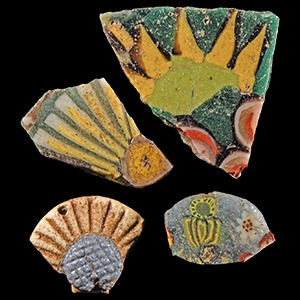
Egyptian Glass Fragment Collection
Ptolemaic Period, 332-30 B.C. or laterSold for (Inc. bp): £260
Mixed group including millefiori and modelled types. 30.2 grams total, 26-42 mm
Acquired 1970s-1996. Property of a North American collector. London collection, 2016. -
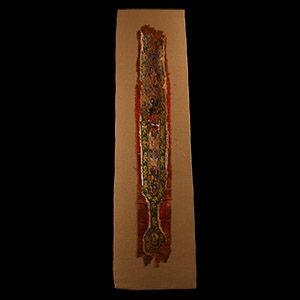
Egyptian Mounted Coptic Textile with Animals
Circa 6th-7th century A.D.Sold for (Inc. bp): £169
Comprising a clavus decorated with various bright colours (green, brown, pink, blue, yellow) with stiff animal figures (dragons and stylised eagles) and a cockerel(?) inside the orbiculus. 138 grams, 70 x 18.2 cm
Acquired 1970s-1996. Property of a North American collector. London collection, 2016.
Tabby technique on linen and wool. It is highly probable that this tapestry was part of a tunic decoration, the clavus with preserved orbiculus, running vertically on the breast and on the back of it.
