
Loading, please wait...
_900x900.jpg "Egyptian Wooden Stele for Pa-di-Amun-(em)-ipat with Ra-Horakhty")
_200x200.jpg "Egyptian Wooden Stele for Pa-di-Amun-(em)-ipat with Ra-Horakhty")
.jpg "Egyptian Wooden Stele for Pa-di-Amun-(em)-ipat with Ra-Horakhty")
LOT 0065
Egyptian Wooden Stele for Pa-di-Amun-(em)-ipat with Ra-Horakhty
LATE PERIOD-PTOLEMAIC PERIOD, 664-30 B.C.
17 3/4 in. (1.94 kg, 45 cm high).
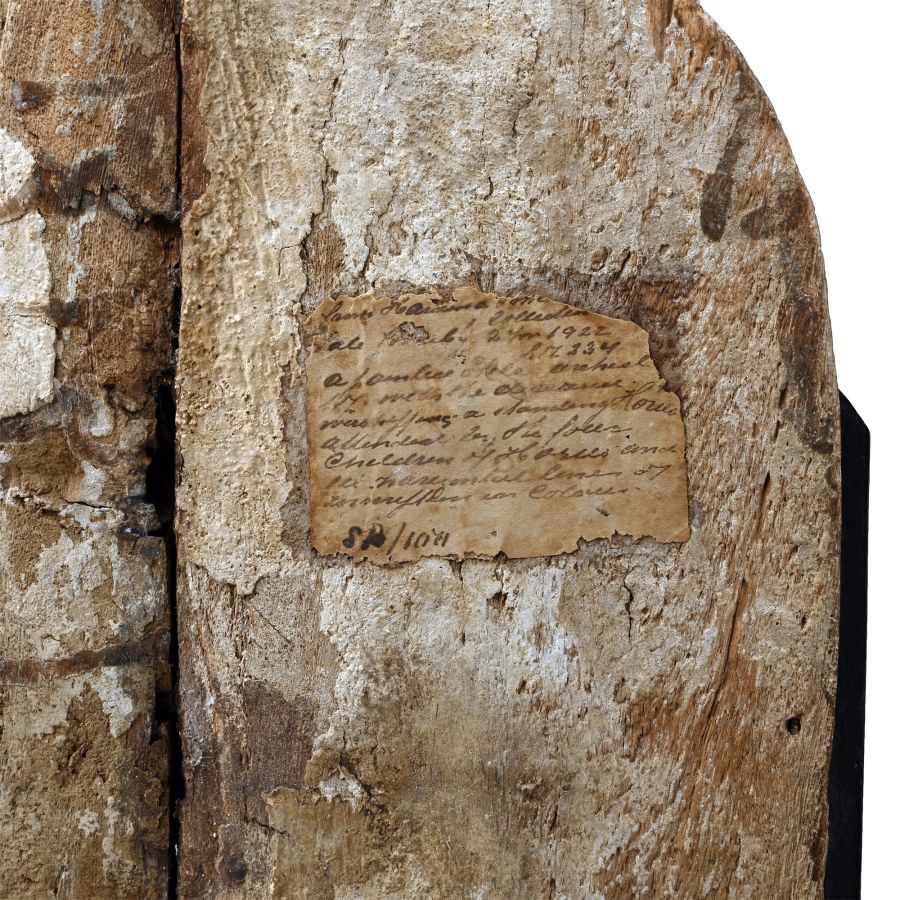
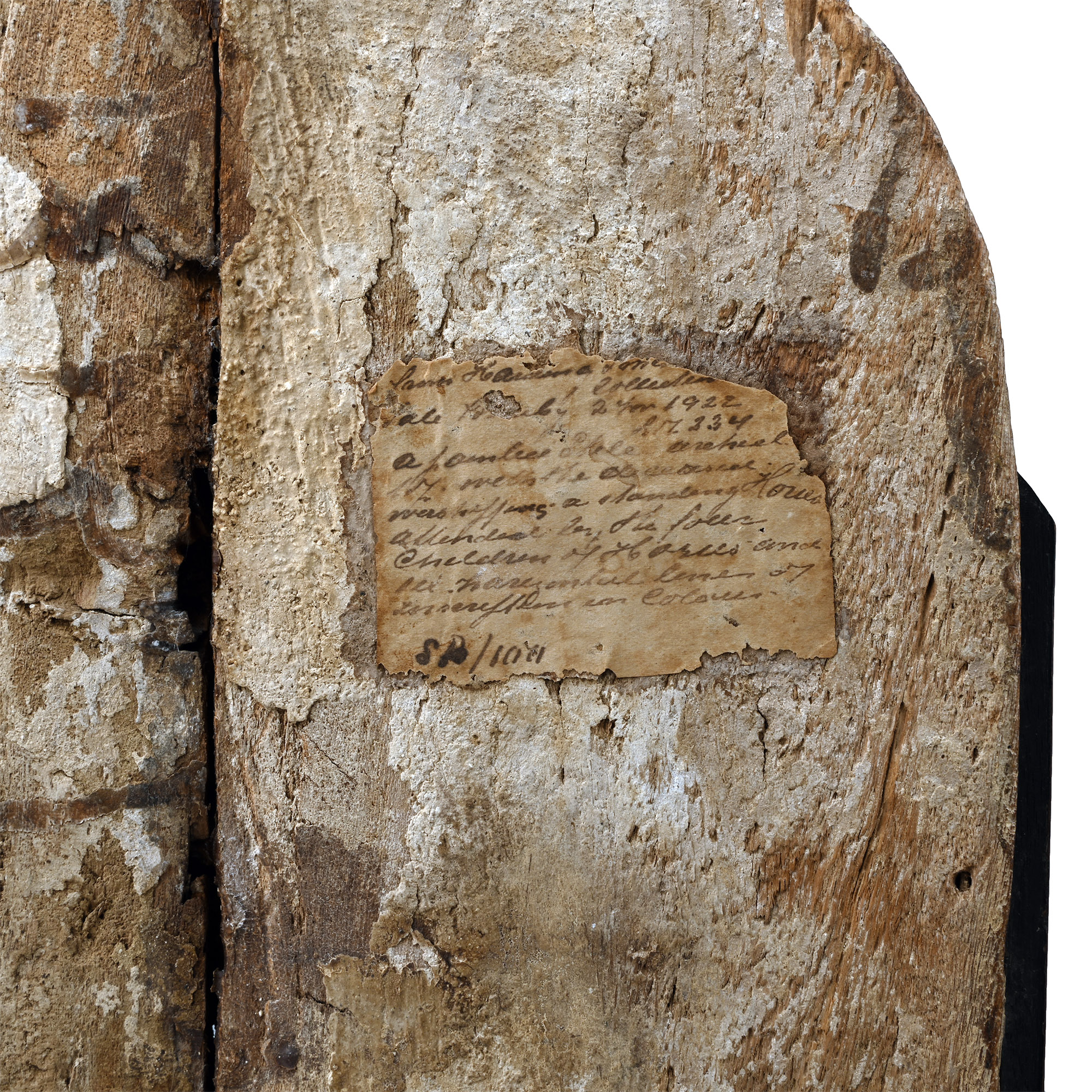
Arch-topped and composed of two vertical boards, coated with gesso and skilfully painted on one side; the lunette decorated with a winged sun-disc and two pendant uraei; the central vignette depicting the deceased worshipping the falcon-headed god Ra-Horakhty with the Four Sons of Horus standing behind, each with their name written above; the lower register with six lines of hieroglyphic text providing an offering formula for the benefit of the deceased: Transliteration of the hieroglyphs: 1) ḥtp-dı-͗nsw rꜤ-ḥr-Ꜣḫtı͗nṯr Ꜥ nb pt sḥḏ [.....] wsır͗ ẖntt [ım͗ntt?] 2) nṯr Ꜥ nb Ꜣbḏw dı⸗͗f pr.t-ḫrw t ḥnḳt kꜢ Ꜣpd [....] ḫt nb(t) (n) fr(t) wꜢbt […] 3) ḫt nbt nḏm dı⸗͗f ḥtpw ḏfꜢw [...]f ḫꜢ m t dı⸗͗f ḫꜢ m 4) ḥnḳt dı⸗͗f ẖꜢ ır͗p [...] dı⸗͗f ḫꜢ m ı͗[...] dı⸗͗f ḫꜢ ı(͗Ꜣ)r(r)t dı⸗͗f 5) m snṯr ḥr ḫꜢwt [...] ḳrs nfr ḥr ım͗nt nfr 6) n [..] wsır͗ [......] pꜢ-dı-͗ım͗n(m) ıp͗ Ꜣ.t ms (n) ḫꜢ [....] Translation: 1) An offering that the king and Ra-Horakhty, Great God, Lord of Heaven, the illuminated [...] Osiris Foremost [of the West?] 2) Great God, Lord of Abydos (that) he may give a voice-offering (of) bread, beer, oxen, and fowl […] everything good and pure […] 3) everything sweet, he gives offerings of provisions […] a thousand of bread, he gives a thousand of 4) beer, he gives a thousand of wine […], he gives a thousand of vines, he gives a thousand of 5) incense on the altar […] a good burial in the beautiful West 6) for […] the Osiris[…] Pa-di-Amun-(em)-ipat born (to) Kha[…]; on the verso, an old handwritten collection label reading: 'From Harding & Sm[ith] Collection Sale Sotheby 2 Nov 1922 L.N. 234. A families [sic] stele, arched top, with the deceased worshipping a standing Horus attended by the four Children of Horus and six horizontal lines of inscription in colour. SP/10a'; mounted in a custom-made wooden frame.
ProvenanceFrom the collection of the late W. Harding Smith (1848-1922).
with Sotheby, Wilkinson & Hodge, 34 & 35 New Bond Street, 2 November 1922, no.234.
Old handwritten label to verso reading 'From Harding & Sm[ith] Collection collection Sale Sotheby 2 Nov 1922 L.N.234...'
Accompanied by an academic report by Egyptologist Paul Whelan.
Accompanied by a copy of the 1922 Sotheby, Wilkinson & Hodge catalogue pages.
This lot has been checked against the Interpol Database of stolen works of art and is accompanied by search certificate number no.13251-253195.
Cf. Munro, P., Die spätägyptischen Totenstelen, 2 vols., Ägyptologische Forschungen 52, Glückstadt, 1973, vol.2, pl.3, fig.12, for a stela with similar format; for an example with a three-line border see British Museum EA22919; or with a plain, single-coloured band with thin outer and inner delimiting lines see Cairo Museum A9444.
FootnotesThe syncretism of two strong gods, Re and Horus, is one of the most significant events in Egyptian mythology, and it appears to have had a substantial iconographic impact on Egyptian history. Re's power was augmented by this, which consisted of a falcon-headed man crowned with a sun disc; in the mornings, Re was combined with Horus to become Re-Horakhty.
CONDITIONTimeLine Auctions follows a vetting process to ensure the authenticity and legality of all items, reinforcing our commitment to integrity and responsible trading. Each antiquity, antique, and coin lot undergoes thorough examination by a vetting committee of at least ten external specialists, professional trade association members, scientists, and archaeologists: Our Vetting Process
AUCTIONS:
TimeLine is a leading auction house specialising in antiquities, ancient art, collectables, natural history, coins, medals, and books. Our auctions offer museums, collectors, historians, and enthusiasts the opportunity to acquire unique and historically significant pieces.
LOT 0065
Egyptian Wooden Stele for Pa-di-Amun-(em)-ipat with Ra-Horakhty
Sold for (Inc. bp): £20,800
-
Egyptian Wooden Shabti Figure
New Kingdom, 19th Dynasty, circa 1292-1185 B.C.Estimate: £800 - 1,000 (+bp*)
Opening Bid: £444
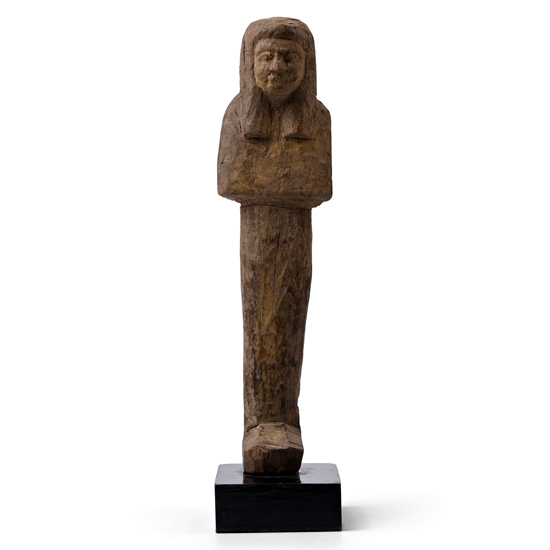
Typical mummiform figure, carved in the round with folded arms, wearing a tripartite wig; remains of gesso on the surface; mounted on a wooden base. 138 grams total, 21.9 cm including stand
Ex Budo Bleb (1940-2022) collection, Berlin, formed 1960s onwards. -
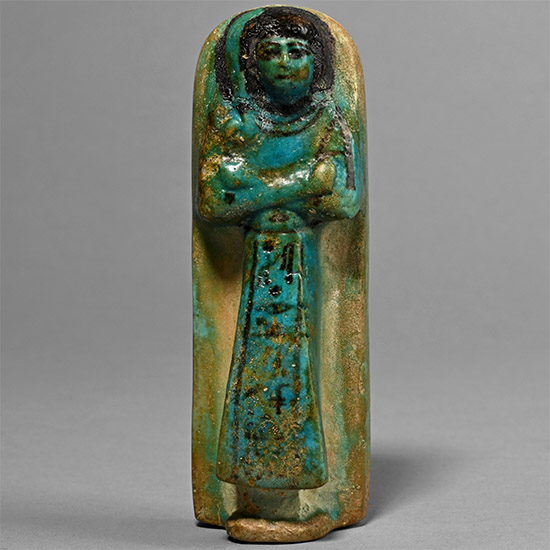
Egyptian Turquoise Faience Shabti of Prince Khaemwaset
New Kingdom, 19th Dynasty, circa 1292-1185 B.C.Sold for (Inc. bp): £6,552
Wearing daily dress and carrying agricultural implements, with dark blue details including his short wig with side-lock, designating him as a Sem-priest of Ptah at Memphis, the text on the kilt naming him as 'Sem-priest and King's son Khaemwaset'; with round-topped back support, the reverse with two columns of hieroglyphs with part of the shabti formula: "He says: O shabti, if one counts, if one is reckoned to do all the works that are to be done there in the God’s land—now indeed obstacles are implanted therewith—as a man at his duties, ‘Here I am,’ you shall say when you are counted off to cultivate the fields, transport by boat the sand of the east to the west and vice versa; ‘Here I am,’ you shall say". 284 grams, 15.1 cm
With Barakat, Beverly Hills: reputed to be from the Omar Pasha Sultan collection, (1806-1871) but unpublished in the 1929 catalogue of the collection, nor in Aubert's 1976 article on the shabtis in the collection. Bonhams, London, 1 May 2013, no.282. Accompanied by copies of the relevant Bonhams catalogue pages. Accompanied by an academic report by Egyptologist Paul Whelan. This lot has been checked against the Interpol Database of stolen works of art and is accompanied by search certificate number no.12938-243536.
Prince Khaemwaset was the fourth-ranked son of Ramesses II and the second born to Queen Isetnofret. More is known about Khaemwaset than any other son of Ramesses II, attested by over 150 objects, ranging from statues to temple reliefs. He is traditionally regarded as the “first Egyptologist” for his restoration of monuments belonging to earlier kings, including the pyramids at Giza and Saqqara. Recent reassessment, however, suggests that some of these activities involved dismantling parts of ancient structures for reuse in his father’s temple constructions. -
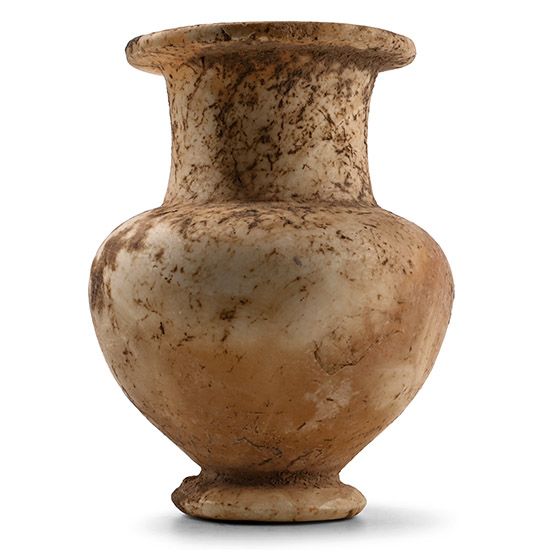
Early Phoenician Alabaster Vase
1st millennium B.C.Estimate: £4,000 - 6,000 (‡+bp*)
Opening Bid: £2,000
With bulbous body, broad flared neck, flange rim, dimple to underside of base. 769 grams, 13.1 cm
Private collection, USA and Switzerland, acquired in the late 1980s-early 1990s; by descent to the current owner. This lot has been checked against the Interpol Database of stolen works of art and is accompanied by search certificate number no.13222-249180.
