
Loading, please wait...
LOT 0498
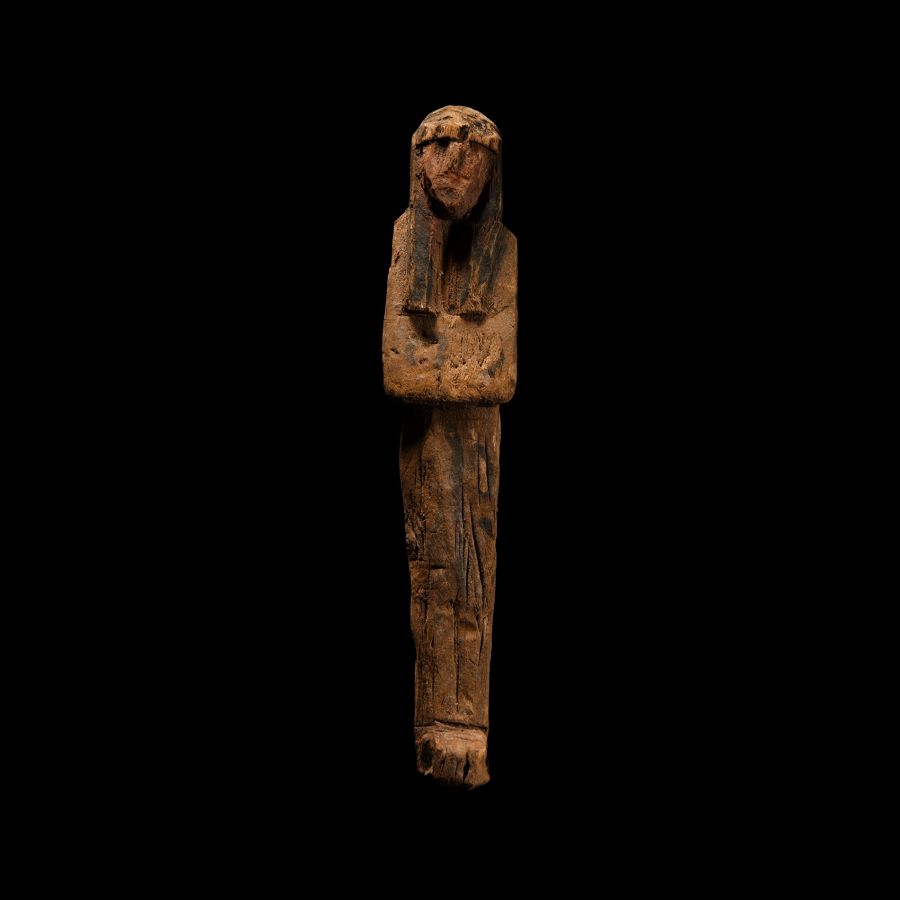
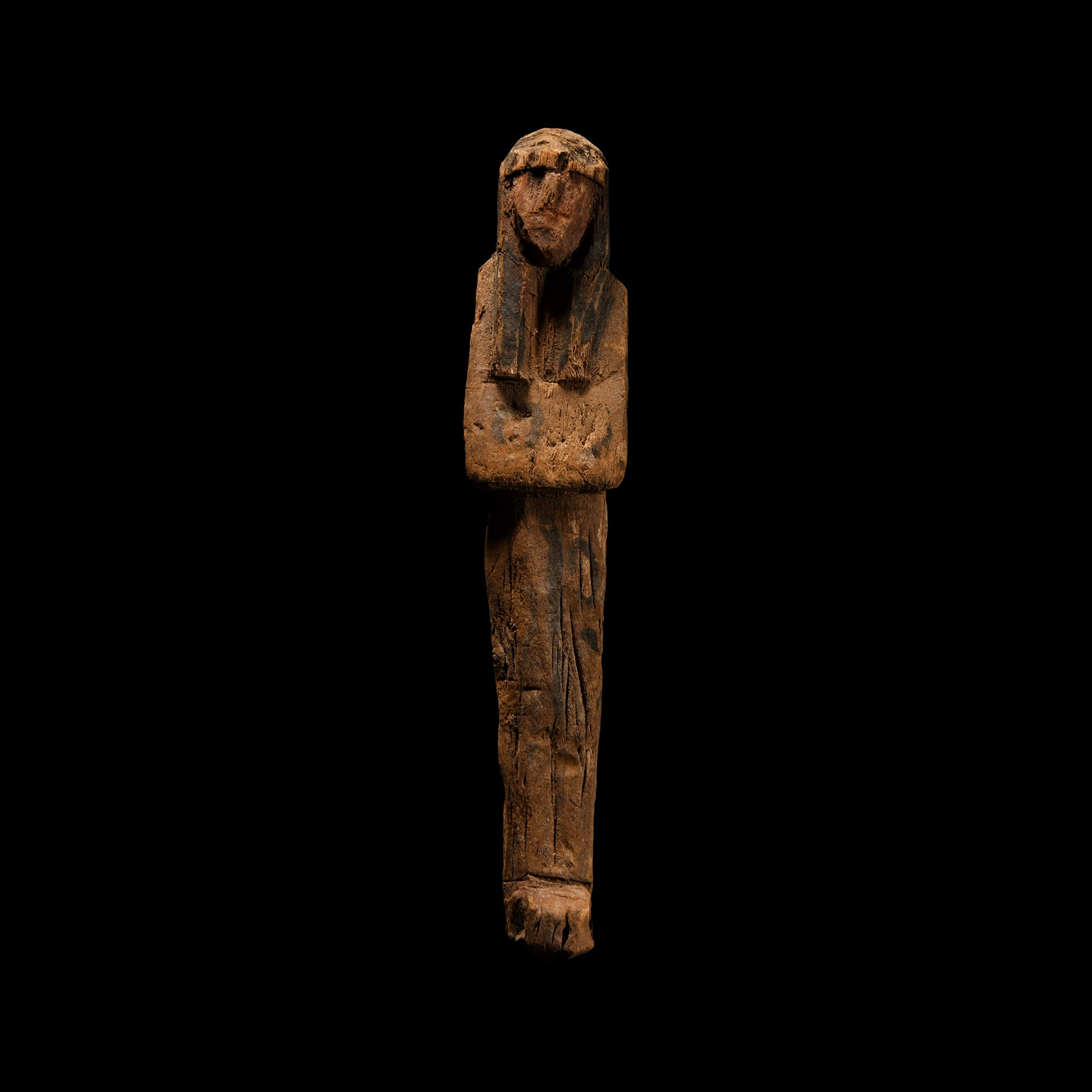
Egyptian Wooden Shabti
NEW KINGDOM, 19TH-20TH DYNASTY, CIRCA 1315-1081 B.C.
7 1/2 in. (46 grams, 19 cm high).
A carved wood shabti figure modelled mummiform with arms folded across the chest and wearing a tripartite wig, painted detailing to the front and rear of the body; remains of polychrome pigmentation.
ProvenanceAcquired early 1990s.
Ex private American collection; thence by descent.
Private Swiss collection since 1998.
Cf. Franzmeier, H., Die Gräberfelder von Sedment im Neuen Reich II, Leiden, 2017, pls.1859 and 1865, for similar wooden shabtis found in tombs at Sedment.
FootnotesMany crude wooden shabtis of this type were found at Gurob and Sedment; they range from having minimal decoration and no inscription to being entirely painted and inscribed.
CONDITIONTimeLine Auctions follows a vetting process to ensure the authenticity and legality of all items, reinforcing our commitment to integrity and responsible trading. Each antiquity, antique, and coin lot undergoes thorough examination by a vetting committee of at least ten external specialists, professional trade association members, scientists, and archaeologists: Our Vetting Process
AUCTIONS:
TimeLine is a leading auction house specialising in antiquities, ancient art, collectables, natural history, coins, medals, and books. Our auctions offer museums, collectors, historians, and enthusiasts the opportunity to acquire unique and historically significant pieces.
-
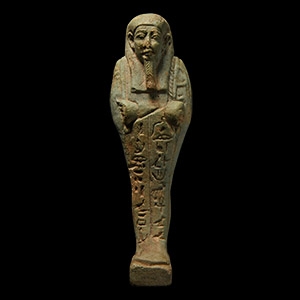
Egyptian Pale Blue Shabti for an Imy-Khent Priest
Late Period, 30th Dynasty, circa 380-343 B.C.Sold for (Inc. bp): £1,820
A pale blue glazed mummiform shabti for an Imy-Khent priest, modelled standing on a rectangular base, arms crossed over the chest and holding a pick and a hoe, seed bag over the left shoulder, wearing a tripartite wig and false beard; two vertical columns of hieroglyphs to the front of the body, plain dorsal pillar; some of the hieroglyphs spelling the owner's name are poorly rendered, but appears to be Ba-ankh-sa-sobeky. 99 grams, 13.5 cm high
From a Worcester deceased estate. Property of a Cambridgeshire gentleman. Accompanied by an academic report by Egyptologist Paul Whelan.
Although the name of the shabti’s owner and, in particular, that of his parent, are rather unclear, the titles are clearly written and inform us that Ba-ankh-sa-sobeky served as an ‘Imy-khent priest’ associated with the Delta city of Mendes, where the principal deity was the sacred ram god Ba-neb-djedet (meaning ‘Ram, lord of Djedet’). The hieroglyph of the standing ram (Ba) forms the first part of the priest’s name. From the Late Period onwards the priestly title of the nearby city of Hermopolis Parva, ‘One who Separates the Two Gods’, also appears in Mendesian title strings, perhaps indicating that Hermopolis Parva and its religious cults had come under the control of Mendes; indeed, Mendes is thought to have been the capital of Egypt during the 29th Dynasty. The crocodile god Sobek was also worshipped at Mendes in later periods and Ba-ankh-sa-sobeky’s name appears to reflect both this reptilian deity and the traditional ram god of the city. -
.jpg)
Egyptian Bronze Oxyrhynchus Fish Figure
Late Period, 664-332 B.C.Sold for (Inc. bp): £702
A bronze votive oxyrhynchus fish on a sledge base; the fish with inlaid eyes (now missing), hatched dorsal fin, hatched and engraved usekh collar, disc and horned crown fronted by sacred uraeus; suspension loop behind. 163 grams, 85 mm wide
Acquired 1980s. Private collection of L.H., Staffordshire, UK. Property of a Sussex, UK, teacher.
The oxyrhynchus fish was sacred to the goddess Hathor, and was often depicted wearing her crown on its head, an image that may have reproduced an actual temple cult statue. It was also connected to the myth of god Osiris, believed to have eaten his penis after god Seth had dismembered and scattered the god's body. The fish was worshipped under the name Medjed. -
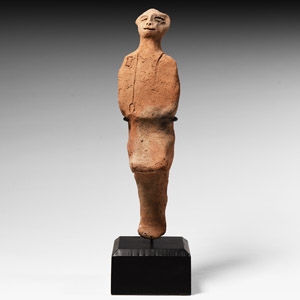
Egyptian Terracotta Overseer Shabti
Ptolemaic Period, circa 3rd century B.C. or earlierSold for (Inc. bp): £826
A rare example of a terracotta shabti depicting an overseer wearing a civil kilt, incised whip over his right shoulder; stylised facial features with pinched profile and incised eyes, nostrils and mouth; incised stripe to the left shoulder; accompanied by a custom-made stand. 303 grams, 22.5 cm (465 grams total, 28 cm including stand)
Fine condition.
Acquired 1979-1999. London collection of the late Mr S.M., thence by descent. Accompanied by a copy of a previous cataloguing slip. Accompanied by an original thermoluminescence analysis report no.N122j43, from Oxford Authentication.
Many crude clay shabtis are known from provincial sites such as Deir Rifeh and Abydos, with dates ranging from the Late New Kingdom - Ptolemaic Period. This overseer figure would favour a dating closer to the earlier date, when overseer shabtis were a common feature.
