
Loading, please wait...
LOT 0025
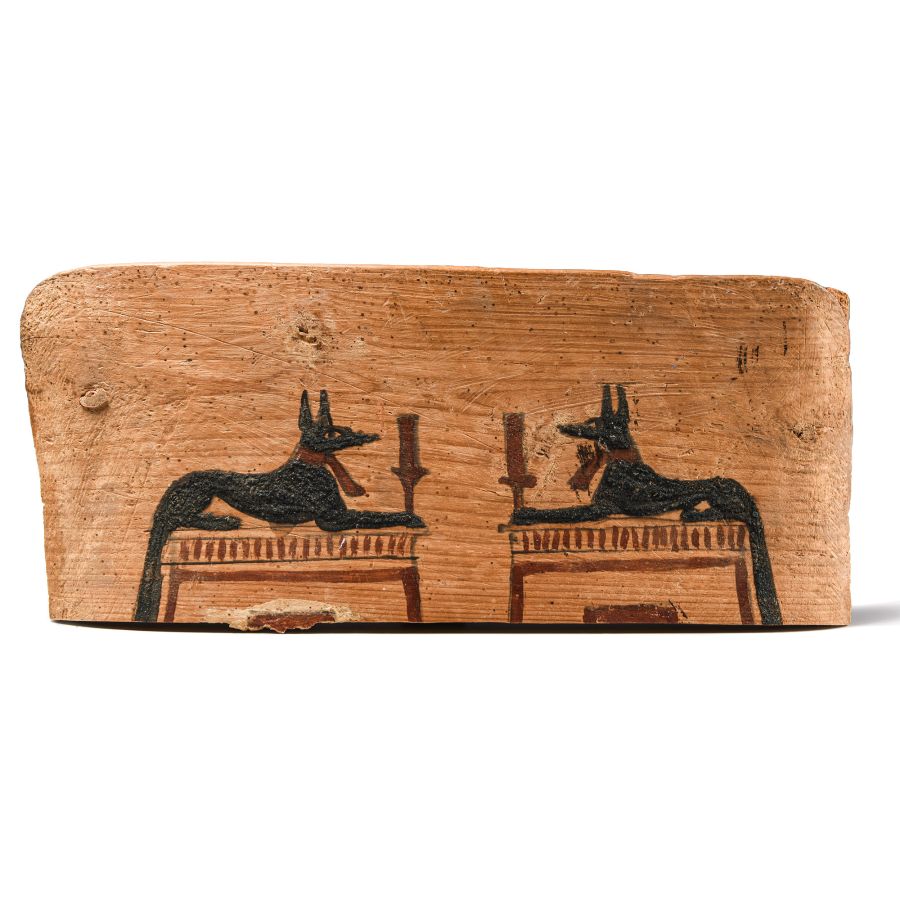
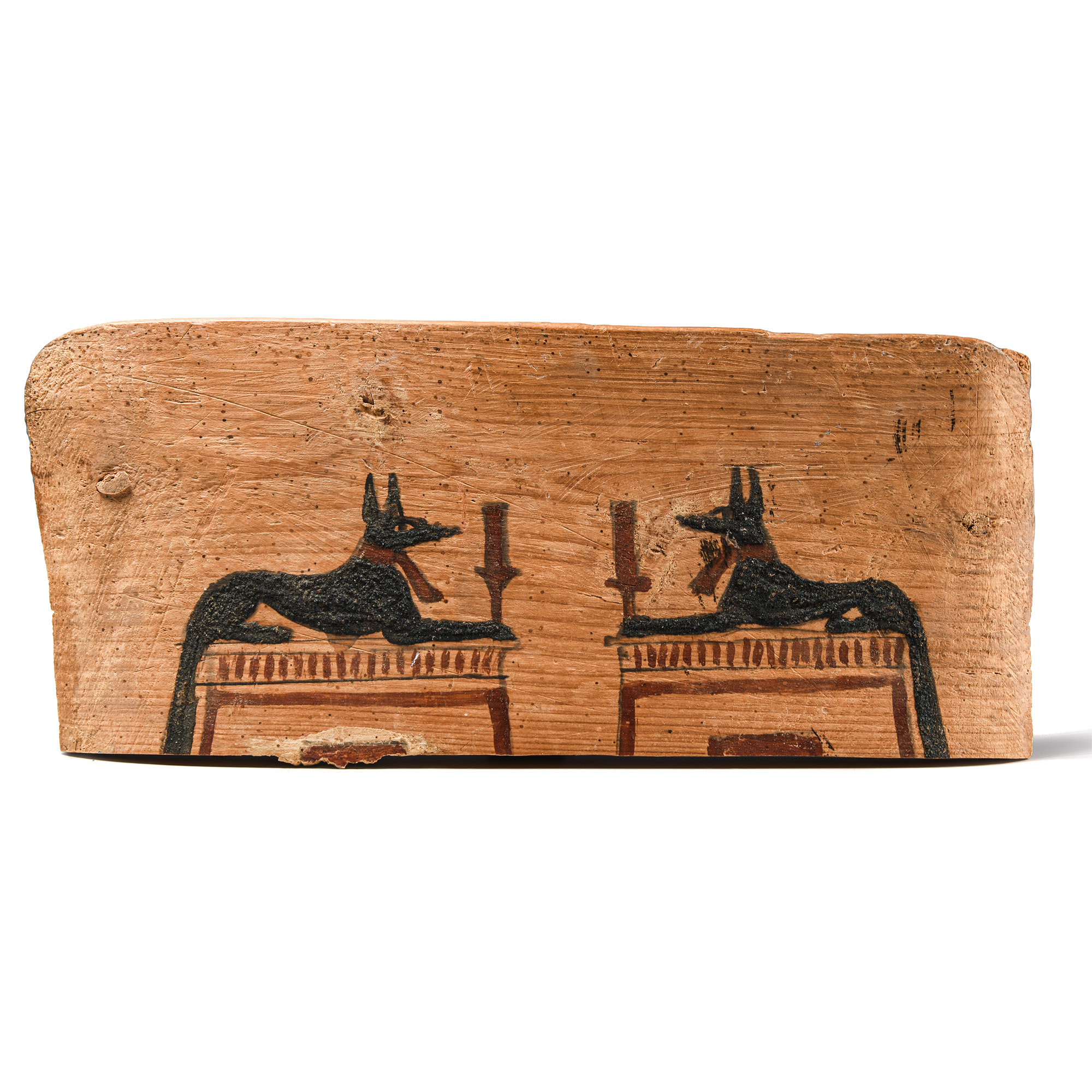
Egyptian Wooden Shabti Box Lid
PTOLEMAIC PERIOD, 332-30 B.C.
10 1/2 in. (268 grams, 26.5 cm wide).
Rectangular lid fragment with rounded upper corners, plano-convex in section; painted image of two jackals representing Anubis, the god of embalming, crouching above rectangular frames, probably tombs, with a sceptre held in its forepaws; remains of fixing pegs to the reverse.
ProvenanceJ.H.H. Claessen (1926-2006), Bladel, Netherlands.
Acquired by the present owner from the above.
This lot has been checked against the Interpol Database of stolen works of art and is accompanied by search certificate no.11944-209616.
Cf. wooden shabti-box with image of Anubis in the collection of the British Museum under accession no.1868,1102.90.
CONDITIONTimeLine Auctions follows a vetting process to ensure the authenticity and legality of all items, reinforcing our commitment to integrity and responsible trading. Each antiquity, antique, and coin lot undergoes thorough examination by a vetting committee of at least ten external specialists, professional trade association members, scientists, and archaeologists: Our Vetting Process
AUCTIONS:
TimeLine is a leading auction house specialising in antiquities, ancient art, collectables, natural history, coins, medals, and books. Our auctions offer museums, collectors, historians, and enthusiasts the opportunity to acquire unique and historically significant pieces.
LOT 0025
Egyptian Wooden Shabti Box Lid
Estimate £2,000 - 3,000€2,320 - 3,480 (for guidance only)$2,700 - 4,050 (for guidance only)
-
.jpg)
Egyptian Banded Alabaster Alabastron
Late Period, 664-332 B.C.Sold for (Inc. bp): £780
With a tapering honey-coloured piriform body and rimmed mouth, incised circumferential line on the shoulder; accompanied by a display stand. 322 grams, 14 cm high including stand
Ex Charlie Chaplin collection. Private New York State collection, U.S.A. Acquired from a North American auction 27 October 2009. Private collection of Professor Kenneth Graham, London, UK. Accompanied by the original catalogue page. -
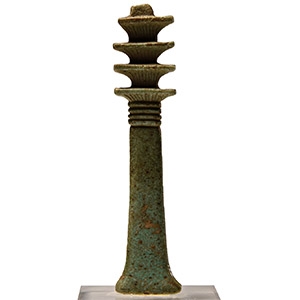
Large Egyptian Faience Djed Pillar Amulet
Late Period, 664-332 B.C.Sold for (Inc. bp): £845
Olive-green glazed composition amulet with ribbed panel, flared base; mounted on a custom-made stand. 78 grams total, 12.5 cm high including stand
Ex Phillipps collection, with old labels to verso. Private collection of Mr T.H., Norfolk, UK.
The djed pillar signifies the concepts of 'permanence' and 'stability' and was a common funerary amulet from the Old Kingdom onwards. It was first associated with the gods Ptah and Sokar, but later became a symbol of Osiris, representing the god's backbone. In this context, the djed pillar appears in Chapter 155 of the Book of the Dead, concerned with the resurrection of the deceased. -
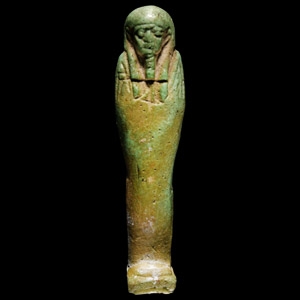
Egyptian Green Faience Shabti for Aames
Late Period, 664-332 B.C.Sold for (Inc. bp): £326
Blue-green composition with detailed face, dorsal pillar with hieroglyphic text with name of the owner, Aa-mes and his mother; repaired. 31 grams, 95 mm high
Ex TimesAncient, London, UK, item no.J167. Private collection of Mr T.H., Norfolk, UK. Accompanied by a previous dealer's certificate of authenticity.
