
Loading, please wait...
_900x900.jpg "Egyptian Wooden Mummy Mask")
_200x200.jpg "Egyptian Wooden Mummy Mask")
.jpg "Egyptian Wooden Mummy Mask")
LOT 0039
Egyptian Wooden Mummy Mask
LATE PERIOD, 664-332 B.C.
15 1/4 in. (4.85 kg total, 38.8 cm high including stand).
Columnar in form with carved facial detailing, thick block of hair, full lips; pierced to reverse for attachment.
ProvenanceEnglish private collection, formed in the early 20th century.
Acquired on the English art market.
Cf. Dawson, J., Strudwick, H. (eds.), Death on the Nile: Uncovering the Afterlife of Ancient Egypt, London, 2016, p. 115, fig. 84, for a similar anthropoid coffin face with a similar dark finish in the Fitzwilliam Museum, Cambridge.
CONDITIONTimeLine Auctions follows a vetting process to ensure the authenticity and legality of all items, reinforcing our commitment to integrity and responsible trading. Each antiquity, antique, and coin lot undergoes thorough examination by a vetting committee of at least ten external specialists, professional trade association members, scientists, and archaeologists: Our Vetting Process
AUCTIONS:
TimeLine is a leading auction house specialising in antiquities, ancient art, collectables, natural history, coins, medals, and books. Our auctions offer museums, collectors, historians, and enthusiasts the opportunity to acquire unique and historically significant pieces.
-
.jpg)
Egyptian Faience Amulet of Tawaret
664-332 B.C.Estimate: £350 - 450 (‡+bp*)
Opening Bid: £175
Modelled in the round, with a dorsal pillar and a loop at the shoulder, the goddess is in hippopotamus form, with a human torso and arms and a crocodile tail. 7.9 grams, 50 mm
Private collection, Carouge, Switzerland, assembled in the 1980s-1990s. Thence by descent to the collection of Mr S.P., since 2020. -
.jpg)
Egyptian Bronze Osiris Statuette
Late Period, 664-332 B.C.Sold for (Inc. bp): £1,235
Standing figure in mummiform stance, wearing the conical Atef crown with flanking ostrich plumes and frontal uraeus, holding the crook (heka) and flail (nekhakha) regalia; mounted on a display stand. 185 grams total, 15.4 cm including stand
Property of a deceased gentleman's collection, 1980s. Ex John Nicholson Auction, Haslemere, Surrey, UK. -
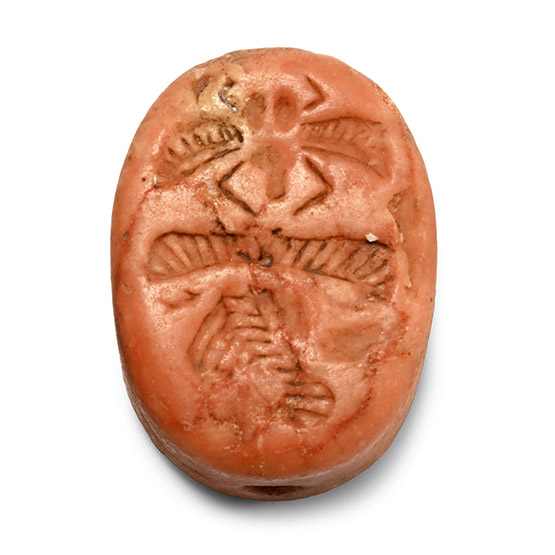
Phoenicio-Egyptian Orange Stone Scaraboid
1st millennium B.C.Estimate: £350 - 450 (+bp*)
Opening Bid: £194
Ellipsoid in plan with frieze comprising a large Maat feather, a winged sun disc, and a winged Khepri beetle. 13 grams, 27 mm
Ex collection of the late Mr S. M., London, UK, 1970-1990s.
