
Loading, please wait...
LOT 0009
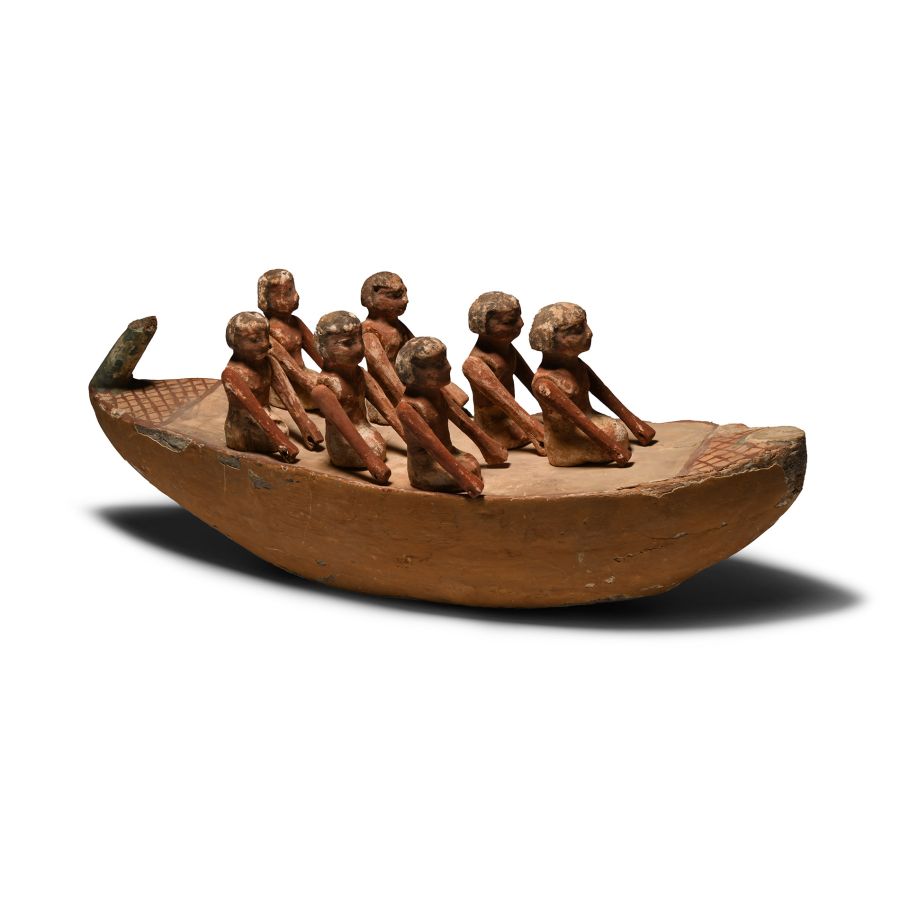
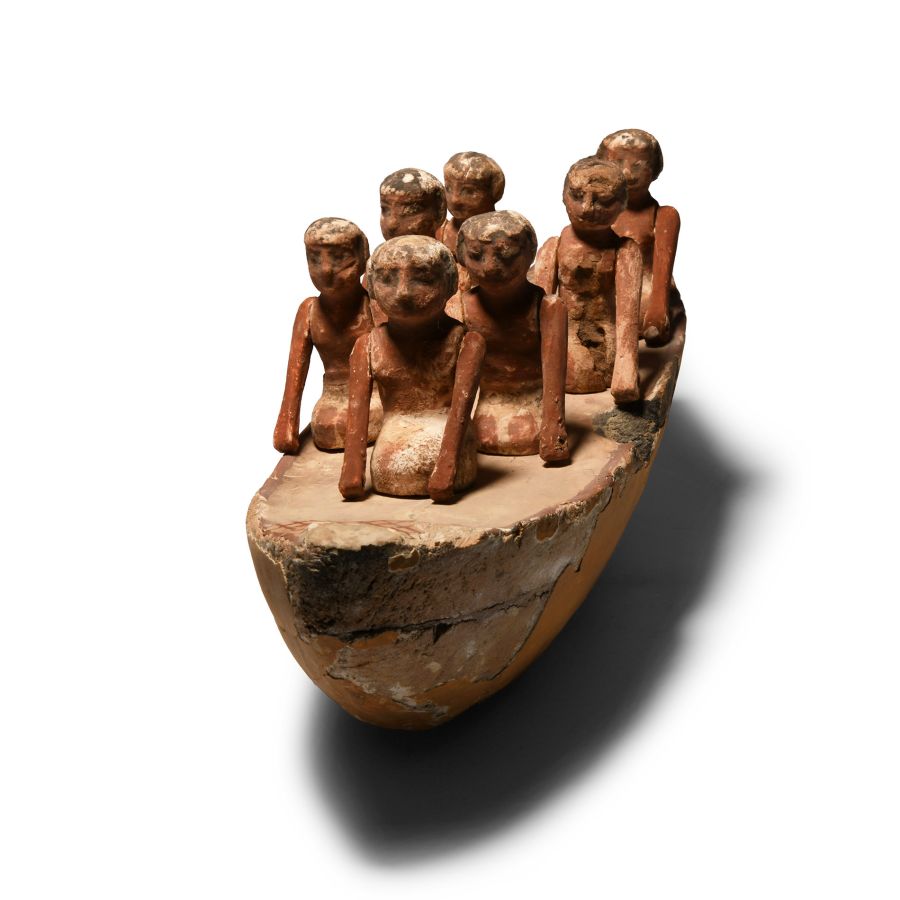
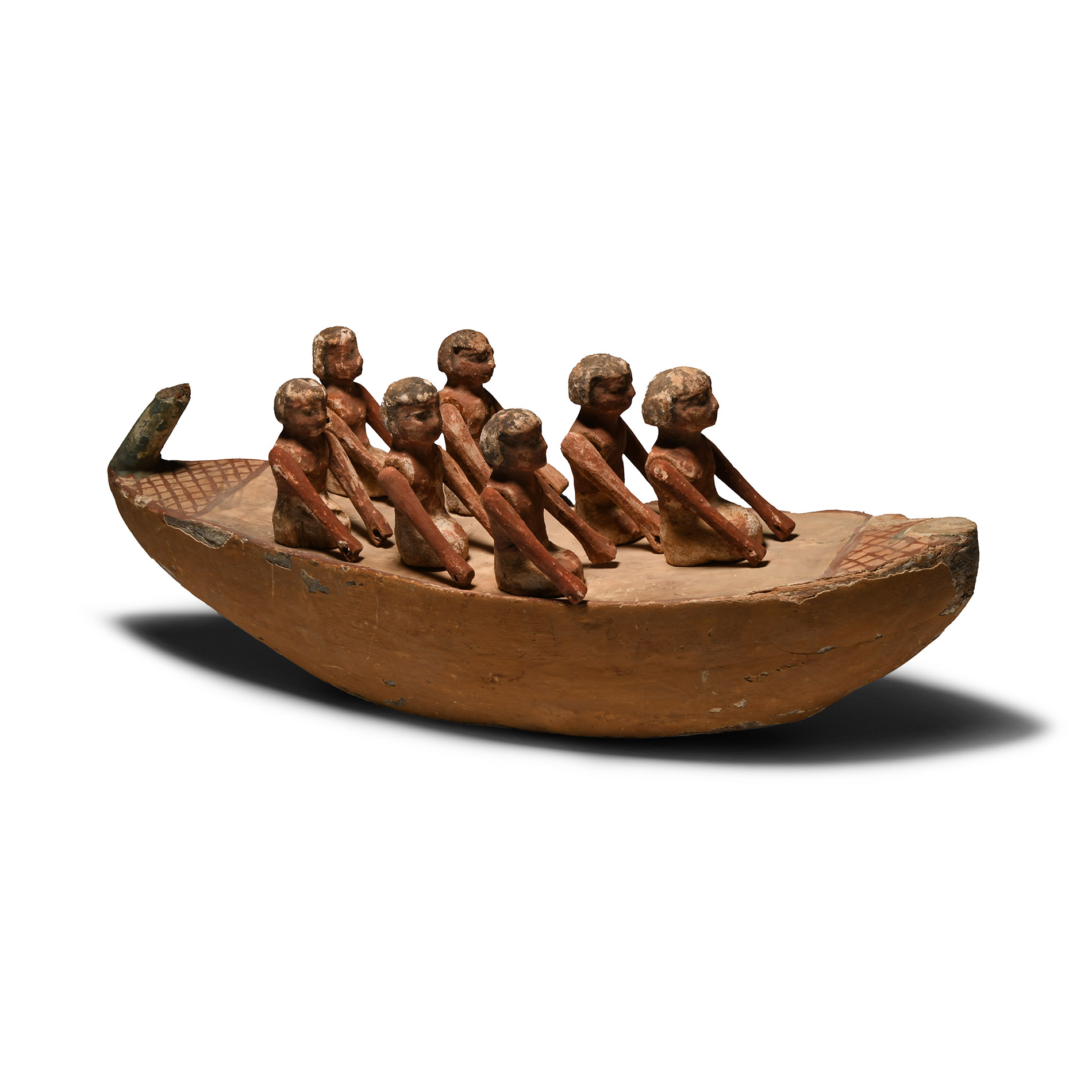
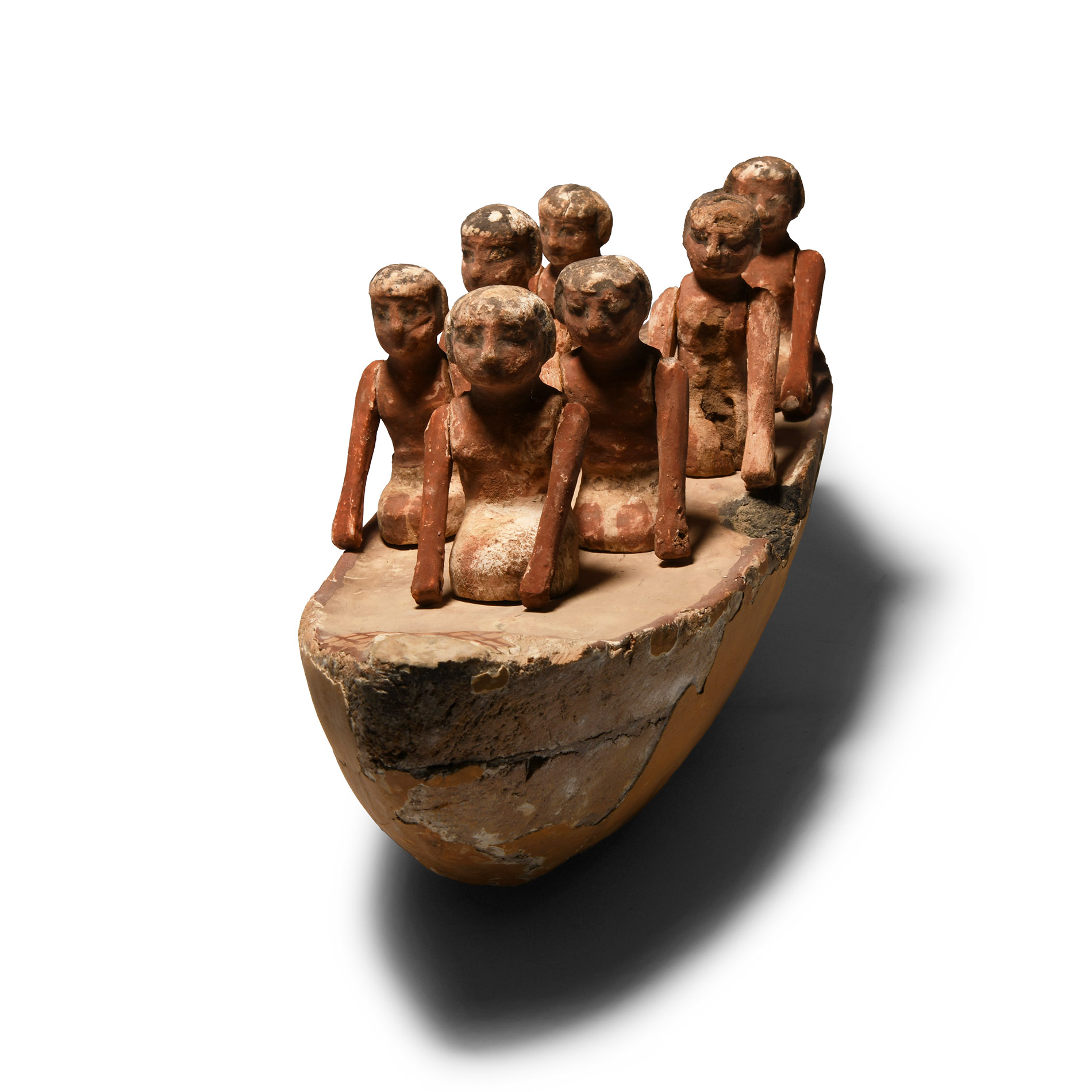
Egyptian Wooden Model Boat with Oarsmen
MIDDLE KINGDOM, LATE 11TH-EARLY 12TH DYNASTY, 2010-1961 B.C.
16 3/8 in. (1.3 kg total, 41.5 cm wide).
Comprising a cream-coloured crescent-shaped boat manned by a crew of seven oarsmen, each with a short black wig, their bodies painted in reddish-brown and wearing cream-coloured kilts; all with pivoting arms and with hands drilled to accept oars (now missing); an outline around the boat's deck and a net pattern at the prow and stern in red; a portion of an inward slanting stern post remains, with traces of another at the prow; the oarsmen re-affixed.
ProvenanceAcquired in the 1960s.
From the collection of the late Egyptologist Surgeon Commander P.H.K. Gray RN.
From a Surrey, UK, collection.
Accompanied by an academic report by Egyptologist Paul Whelan.
This lot has been checked against the Interpol Database of stolen works of art and is accompanied by search certificate no.11943-209563.
Cf. Freed, R.E. et al., The Secrets of Tomb 10A - Egypt 2000 BC, p.167, fig.127, for a similar example from the tomb of Djehuty-nakht at Deir el-Bersha.
FootnotesModels of various boat types were sometimes provided for the same burial. For the different types see Winlock, H.E., Models of Daily Life in Ancient Egypt from the Tomb of Meket-Re' at Thebes, Cambridge MA, 1955, pp.92-103.
CONDITIONTimeLine Auctions follows a vetting process to ensure the authenticity and legality of all items, reinforcing our commitment to integrity and responsible trading. Each antiquity, antique, and coin lot undergoes thorough examination by a vetting committee of at least ten external specialists, professional trade association members, scientists, and archaeologists: Our Vetting Process
AUCTIONS:
TimeLine is a leading auction house specialising in antiquities, ancient art, collectables, natural history, coins, medals, and books. Our auctions offer museums, collectors, historians, and enthusiasts the opportunity to acquire unique and historically significant pieces.
LOT 0009
Egyptian Wooden Model Boat with Oarsmen
Estimate £15,000 - 20,000€17,400 - 23,200 (for guidance only)$20,250 - 27,000 (for guidance only)
-
.jpg)
Egyptian Multi-Stranded Faience Mummy Bead Necklace
Late Period, 664-525 B.C.Sold for (Inc. bp): £156
Composed of polychrome composition beads of mainly annular and tubular types. 29.3 grams, 75 cm long
Acquired before 1979. From the private collection of Mr F. A., South Kensington, London, UK; thence by descent 2014. -
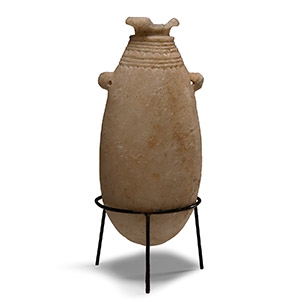
Egyptian Decorated Alabaster Alabastron
Circa 500 B.C.Sold for (Inc. bp): £390
Lentoid in section with pierced lateral lugs at the shoulder, circumferential banding at the neck with dentilled detailing; supplied with a custom-made stand. 281 grams total, 15 cm high including stand
Private collection, Germany, 1990s-2000s. -
.jpg)
Egyptian Bronze Sistrum Handle Finial
Late Period, 664-332 B.C.Estimate: £1,000 - 1,400 (+bp*)
Opening Bid: £500
The bifacial upper part of a handle featuring Hathor, depicted with cow ears and wearing a heavy wig with characteristically curled lappet ends and a broad collar; on either side a uraeus, one of which is wearing the crown of Lower Egypt, the other the Upper Egyptian crown; remains of the sistrum cradle above. 146 grams total, 10.7 cm including stand
with Galerie Gunter Phuze, Kunst der Antike 4, Freiburg, 1982, no.335. German private collection H. W. (1931-2018), acquired 1982. Accompanied by a copy of an IADAA Interpol search certificate. Accompanied by copies of the relevant Galerie Gunter catalogue pages.
The sistrum was a rattle-like instrument played exclusively by women in religious ceremonies. The sound produced by the sistrum was believed to drive away evil and soothe a god's anger. Hathor is the daughter of the sun god Re, and in her role as a mother goddess is often depicted as a cow or with bovine characteristics as here. Hathor is also associated with love, music and dancing, and the sistrum is one of her sacred symbols.
