
Loading, please wait...
LOT 0004
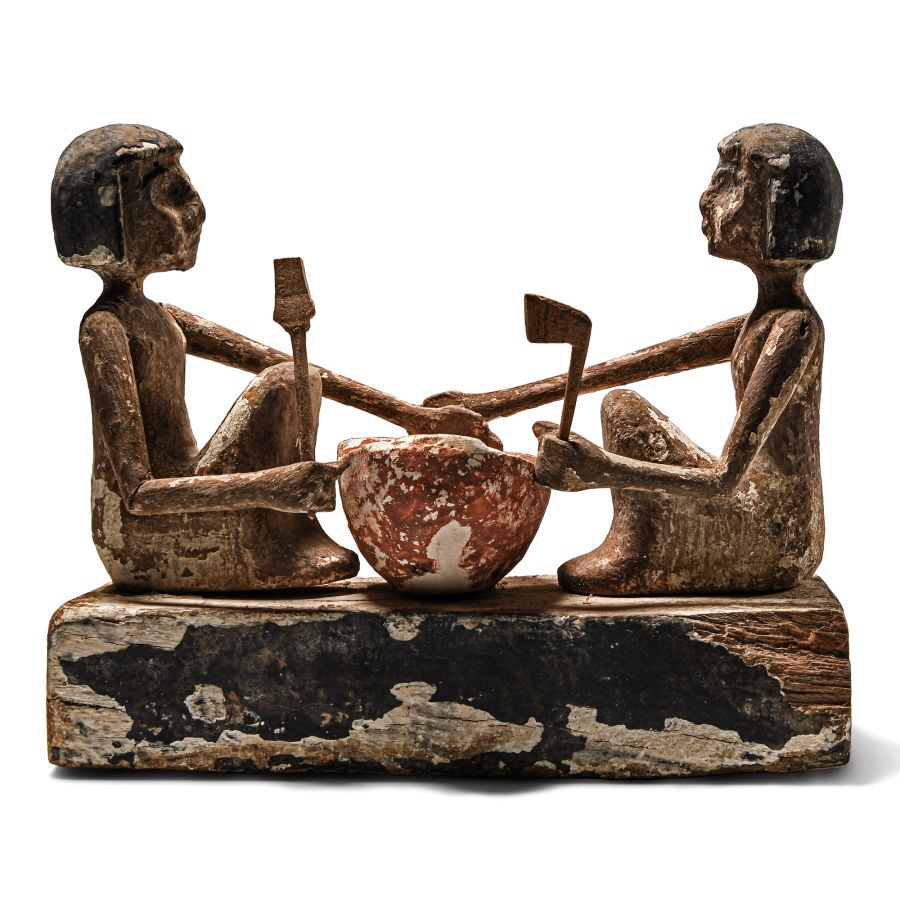
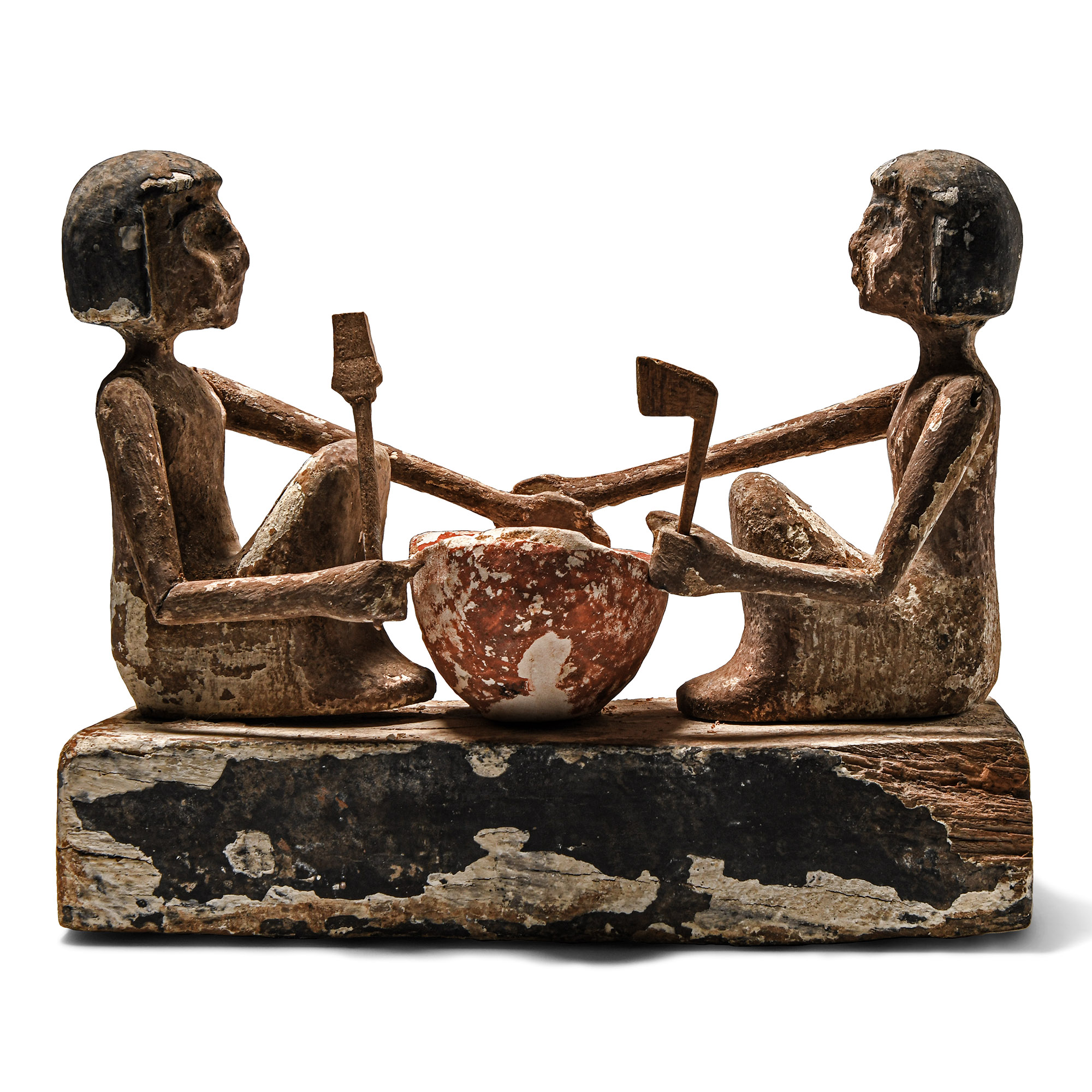
Egyptian Wooden Diorama with Model Makers
11TH-12TH DYNASTY, 2023-1862 B.C.
7 1/8 in. (436 grams, 18 cm).
Rectangular wooden base supporting two opposed crouching figures each holding a tool (axe, chisel) in one hand, working on a model boat; the figures wearing white linen kilts and with carefully painted hair and facial features.
ProvenanceAcquired in the 1960s.
From the collection of the late Egyptologist Surgeon Commander PHK Gray RN.
From a Surrey, UK, collection.
This lot has been checked against the Interpol Database of stolen works of art and is accompanied by search certificate number no.11832-207092.
Cf. Taylor, J.H., Death and the Afterlife in Ancient Egypt, London, 2001, pp.99-103, for discussion.
FootnotesCrafted for the tomb to accompany the deceased and provide for him in the afterlife.
CONDITIONTimeLine Auctions follows a vetting process to ensure the authenticity and legality of all items, reinforcing our commitment to integrity and responsible trading. Each antiquity, antique, and coin lot undergoes thorough examination by a vetting committee of at least ten external specialists, professional trade association members, scientists, and archaeologists: Our Vetting Process
AUCTIONS:
TimeLine is a leading auction house specialising in antiquities, ancient art, collectables, natural history, coins, medals, and books. Our auctions offer museums, collectors, historians, and enthusiasts the opportunity to acquire unique and historically significant pieces.
-
Egyptian Mounted Coptic Textile with Crenellated Blossoms
Circa 5th-7th century A.D.Sold for (Inc. bp): £78
Part of a tunic, the rectangular segment in yellow and green linen and wool, the central part decorated with interlaced geometric motifs, surrounded by an edge of similar motifs and border edged of crenellated blossoms. 264 grams, 64 x 37 cm
Acquired 1970s-1996. Property of a North American collector. London collection, 2016.
Among the many fragments from wool tunics are several long strips that match to form nearly full-length central pectoral clavi. They are patterned with a profusion of small figures or interlaced abstract designs, birds, plants and animals with a contrasting border filled with geometric motifs. -
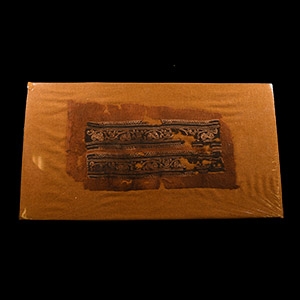
Egyptian Mounted Coptic Textile with Hares
Circa 5th-6th century A.D.Sold for (Inc. bp): £78
Comprising a double band for sleeve (segmenta), decorated with vegetal and animal patterns, forming two narrow bands with a vertical succession of stylised spirals of foliage, alternating figures of hares. 94 grams, 43 x 23 cm
Acquired 1970s-1996. Property of a North American collector. London collection, 2016.
Tapestry technique of wool on linen. It is highly probable that this tapestry was part of a tunic decoration, a double segmentum, applied on the wrists of the garment and decorating the lower part of the sleeves. -
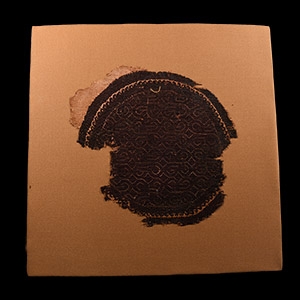
Egyptian Mounted Coptic Textile
Circa 5th-7th century A.D.Sold for (Inc. bp): £72
Composed of a medallion (orbiculus) decorated with geometric interlaced patterns on a purple background, framed by a minute recurring spiral, surrounded by an external circle. 149 grams, 36.5 x 36.5 cm
Acquired 1970s-1996. Property of a North American collector. London collection, 2016.
Tapestry technique on natural linen. It is highly probable that this tapestry was part of a tunic decoration, an orbiculus, medallion in purple applied to the shoulders and the lower part of the garment, front and back.
