
Loading, please wait...
_900x900.jpg "Egyptian Wooden Cow Giving Birth Diorama with Two Figures")
_200x200.jpg "Egyptian Wooden Cow Giving Birth Diorama with Two Figures")
.jpg "Egyptian Wooden Cow Giving Birth Diorama with Two Figures")
LOT 0014
Egyptian Wooden Cow Giving Birth Diorama with Two Figures
MIDDLE KINGDOM, 11TH-12TH DYNASTY, 2023-1862 B.C.
3 3/4 - 6 1/4 in. (113 grams total, 9.5-16 cm).
Comprising three figures to represent a calving scene: a standing cow or other quadruped giving birth to its young, its head, neck and forelegs emerging from the mother's rear, both with a black and white speckled coat; a standing male figure with articulated arms and pierced hands, wearing a kilt and cropped wig and with stylised facial detailing; a kneeling figure also with articulated arms, open-palm hands, wearing a kilt and cropped wig, stylised facial features; extensive remains of polychrome pigment. [3]
ProvenanceFrom an early 20th century Home Counties collection.
This lot has been checked against the Interpol Database of stolen works of art and is accompanied by search certificate no.11597-199209.
This lot has been cleared against the Art Loss Register database, and is accompanied by an illustrated lot declaration signed by the Head of the Antiquities Department, Dr Raffaele D’Amato.
Cf. Barker, G., Preparing for Eternity: Funerary models and wall scenes from the Egyptian Old and Middle Kingdoms, Oxford, 2022, p.113 figure 4.2, for a near-identical calving cow figure, possibly from Meir (now in the Royal Ontario Museum, Toronto, inv. no. 910.18.16.1-3); cf. The Metropolitan Museum, New York, accession numbers 2021.41.170 and 11.150.5, for similar human and animal figures of this date.
FootnotesSuch models would have been deposited in tombs; the purpose of such a scene was probably to evoke the season of spring, when calves were born, and the floodplain where farmers lived and raised their livestock.
CONDITIONTimeLine Auctions follows a vetting process to ensure the authenticity and legality of all items, reinforcing our commitment to integrity and responsible trading. Each antiquity, antique, and coin lot undergoes thorough examination by a vetting committee of at least ten external specialists, professional trade association members, scientists, and archaeologists: Our Vetting Process
AUCTIONS:
TimeLine is a leading auction house specialising in antiquities, ancient art, collectables, natural history, coins, medals, and books. Our auctions offer museums, collectors, historians, and enthusiasts the opportunity to acquire unique and historically significant pieces.
LOT 0014
Egyptian Wooden Cow Giving Birth Diorama with Two Figures
Sold for (Inc. bp): £3,380
-
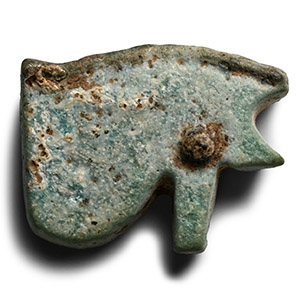
Egyptian Glazed Faience Horus Eye Amulet
Ptolemaic Period, 332-30 B.C.Sold for (Inc. bp): £59
Wedjat bead or amulet with applied black detailing to the pupil and brow. 1.18 grams, 17 mm
Mr F.D. collection, acquired on the European art market, 1975 to present. This lot is accompanied by an illustrated lot declaration signed by the Head of the Antiquities Department, Dr Raffaele D’Amato.
The wedjat-eye amulet is a representation of the healed eye of the god Horus, featuring both human and falcon elements. The name wedjat in ancient Egyptian means ‘the one that is sound.’ According to Egyptian mythology, Horus' eye was wounded or taken by the god Seth and restored by Thoth. The wedjat-eye amulet was thought to protect its wearer and bestow the power of recovery and regeneration onto them. It was very popular and used by both the living and the dead. -
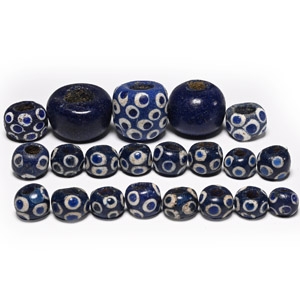
Phoenician Blue Glass Bead Group
6th-3rd century B.C. or laterSold for (Inc. bp): £624
Including drum-shaped types with marvered eye-motifs. 65 grams total, 10-25 mm
UK gallery, early 2000s. This lot is accompanied by an illustrated lot declaration signed by the Head of the Antiquities Department, Dr Raffaele D’Amato.
The category belongs to the cylindrical turquoise eye beads with dark blue and white decorations. Pre-Roman glass beads of this type, generally dated to the Iron Age (end of the ninth century B.C. to 218 B.C.), have been found in significant amounts in the Iberian Peninsula and the Balearic Islands, especially in Phoenician and Punic burial contexts. -
.jpg)
Egyptian Gold Mounted Scarab Bead
Middle Kingdom-Second Intermediate Period, circa 1900-1560 B.C.Estimate: £400 - 600 (+bp*)
Opening Bid: £200
Comprising a faience scarab with a scroll-work border framing the vertically arranged hieroglyphs: kheper beetle, nwb sign for gold, and two nfr signs flanking an ankh sign, set in a gold funda with tubular collars. 3.36 grams, 20 mm
From an early 20th century Home Counties, UK, collection. This lot is accompanied by an illustrated lot declaration signed by the Head of the Antiquities Department, Dr Raffaele D’Amato.
