
Loading, please wait...
LOT 0021
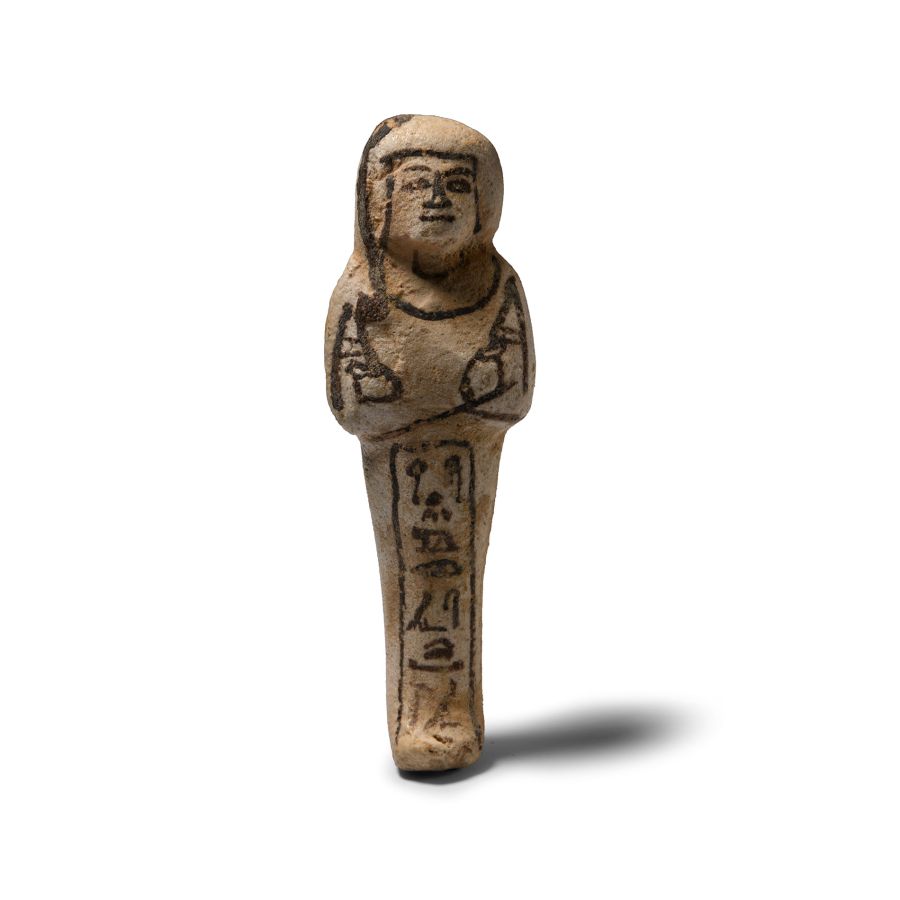
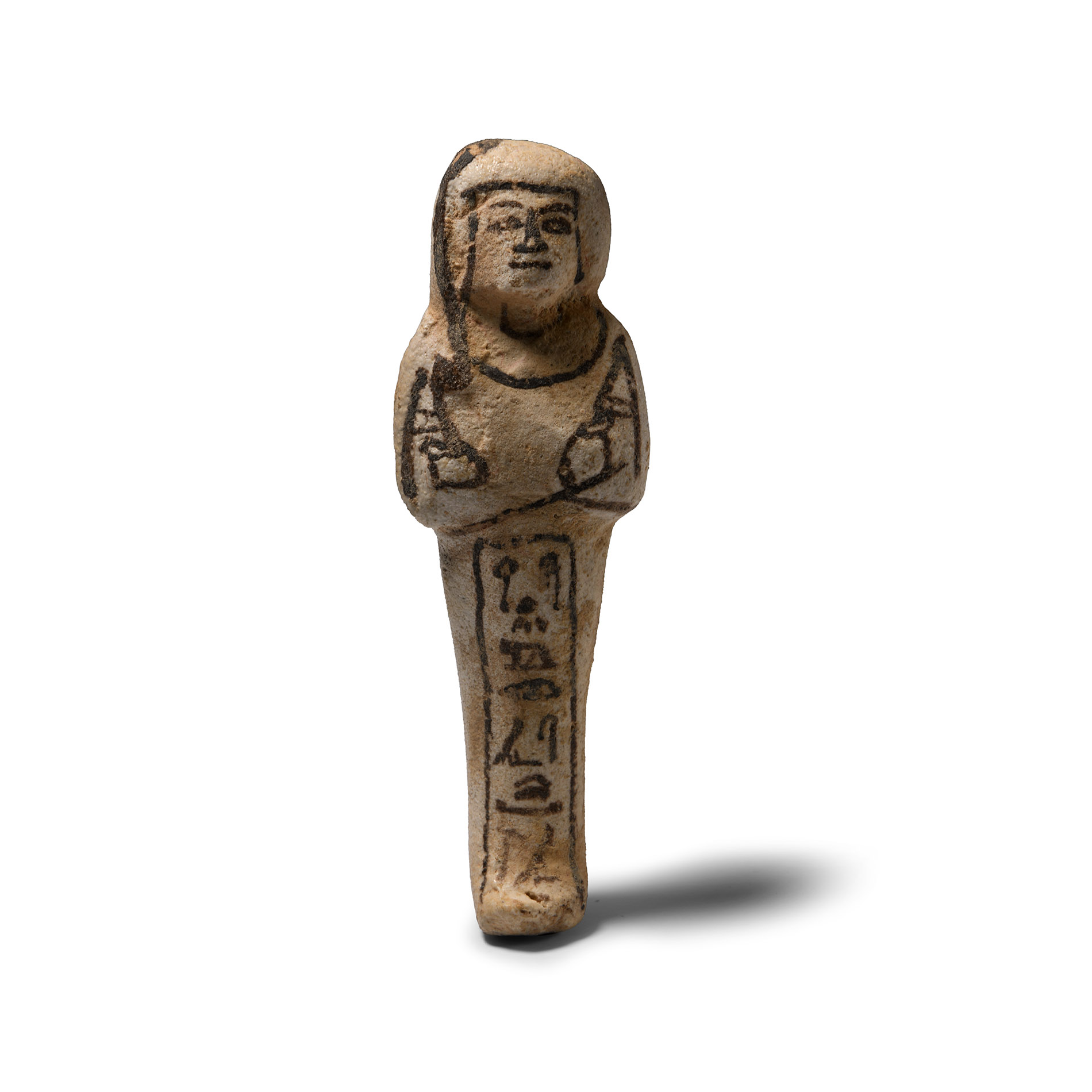
Egyptian White Faience Shabti for Khaemwaset
RAMESSIDE PERIOD, 19TH-20TH DYNASTY, 1305-1080 B.C.
5 1/4 in. (87 grams, 13.3 cm high).
With black applied detailing to the face, arms, tools and block of hieroglyphic text to the lower body giving the dedication 'The illuminated one, the Osiris, Sem-(priest), Khaemwaset, true of voice.'
ProvenanceAcquired from Alex Malloy, New York, U.S.A., 1970-1980s.
Ex U.S.A. collection.
Accompanied by an old certificate of authenticity ($2900.00).
Cf. similar item in the British Museum, London, under accession no.1868,0709.8.
FootnotesAlthough lacking the title 'King's son', this shabti is probably for Prince Khaemwaset, offspring of Ramesses II, who was Sem-priest in the temple of Ptah at Memphis.
CONDITIONTimeLine Auctions follows a vetting process to ensure the authenticity and legality of all items, reinforcing our commitment to integrity and responsible trading. Each antiquity, antique, and coin lot undergoes thorough examination by a vetting committee of at least ten external specialists, professional trade association members, scientists, and archaeologists: Our Vetting Process
AUCTIONS:
TimeLine is a leading auction house specialising in antiquities, ancient art, collectables, natural history, coins, medals, and books. Our auctions offer museums, collectors, historians, and enthusiasts the opportunity to acquire unique and historically significant pieces.
LOT 0021
Egyptian White Faience Shabti for Khaemwaset
Estimate £1,500 - 2,000€1,740 - 2,320 (for guidance only)$2,030 - 2,700 (for guidance only)
-
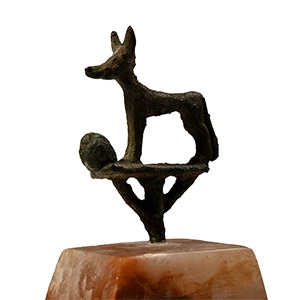
Egyptian Bronze Anubis Finial
Late Period-Ptolemaic Period, 664-30 B.C.Sold for (Inc. bp): £572
Standing before an enigmatic balloon-like object on a rectangular base with two supports flanking a short shank; mounted on a custom-made stand. 377 grams total, 12.5 cm high including stand
Believed to have been collected (1899-1914) and in an early 20th century collection, with some references to Psamtik I, and a German funded expedition. Ex Ludwig Borchardt, Heliop. Private collection of Mr T.H., Norfolk, UK. Accompanied by a handwritten note from Ludwig Borchardt.
Wepwawet, the canine god, is strongly linked with Abydos and kingship. His name means 'Opener of the Ways' and may have had military connotations as someone who clears the path for his king. In funerary texts, Wepwawet guided the dead through the Underworld. The image of the god on a standard, as seen in this example, was carried in processions associated with Osiris and kingship. The balloon-like object, known as shed-shed, is mysterious but may have symbolised the royal placenta, which was considered the king's 'double'. -
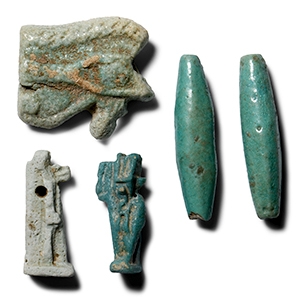
Egyptian Faience Amulet Collection
Late Period, 664-332 B.C.Sold for (Inc. bp): £286
Comprising: two biconical beads; a Wedjat eye amulet with low-relief detailing; a standing Anubis amulet, pierced through the dorsal pillar; and an Amun-Min amulet, pierced behind the headdress for suspension. 8.6 grams total, 23-30 mm
UK private collection. Acquired from Helios Gallery, Wiltshire, UK, 2011. Property of a Nottinghamshire gentleman. -
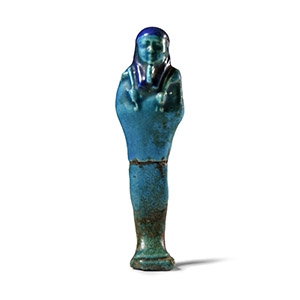
Egyptian Blue Faience Shabti
Early Ptolemaic Period, circa 3rd century B.C.Estimate: £800 - 1,000 (‡+bp*)
Opening Bid: £400
With a thick and lustrous turquoise glaze, sporting a tripartite wig highlighted in darker blue glaze, and a long beard; holding a pick, hoe and a cord for a seed bag hanging over the left shoulder; raised dorsal pillar and an integral plinth; repaired. 44 grams, 11.5 cm high
Ex collection of Jacques René Fiechter, Switzerland (1920-1950). with Auction Martin, Egyptian Collection André Bircher, 1949. Accompanied by an academic report by Egyptologist Paul Whelan.
The lack of inscription hinders positive identification, but the shabti’s proportions, elegant modelling, and lustrous glaze closely match others considered to have come from an area of the extensive necropolis at Abydos, labelled “Cemetery G” by its excavator Flinders Petrie, where hundreds of blue lustrous-glazed shabtis of varying qualities were recovered. This figure is closest in style to those belonging to Petosiris, son of Djed-hor. Both were buried with similar blue lustrous-glazed shabtis that were mostly plain although a few were inscribed with an inscription.
