
Loading, please wait...
LOT 0523
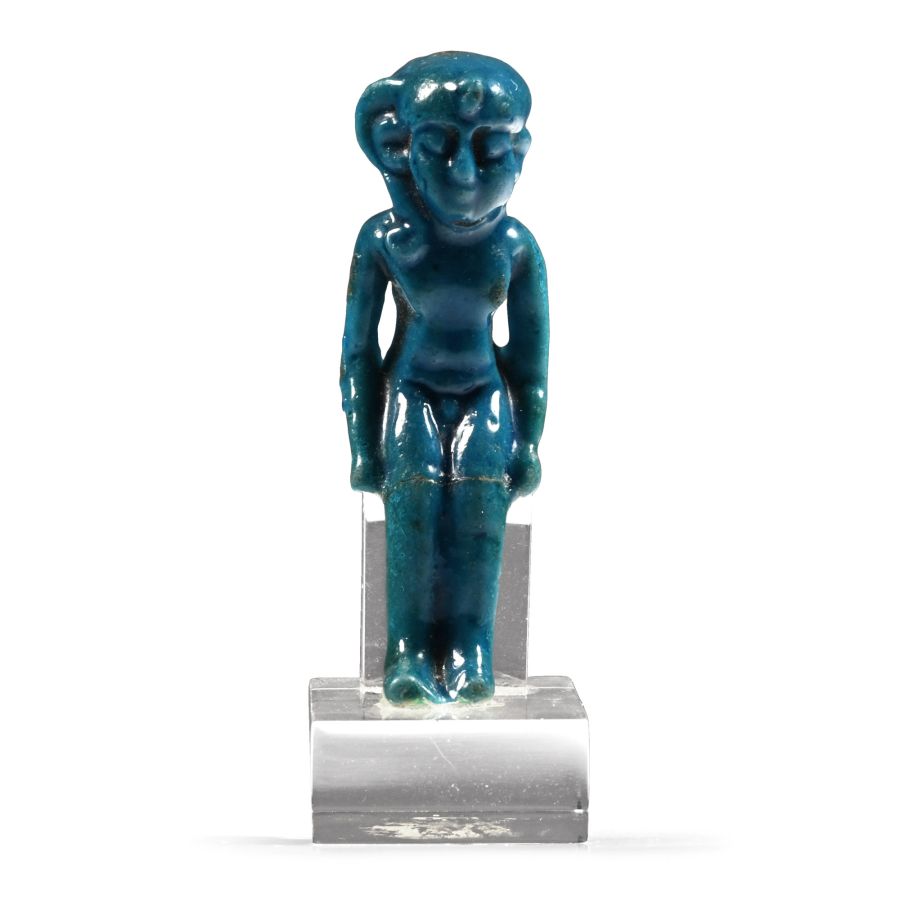
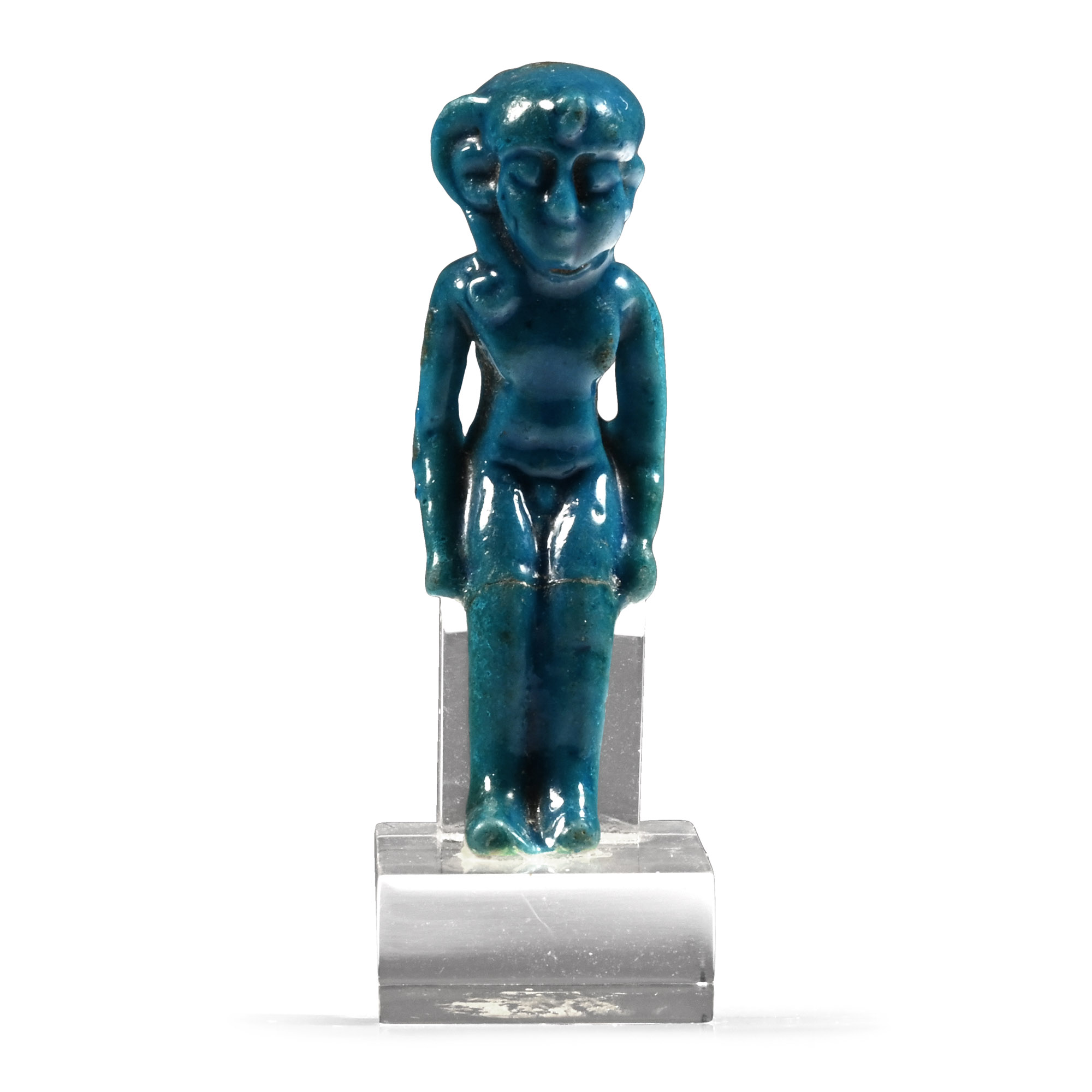
Egyptian Turquoise Glazed Seated Harpocrates
LATE PERIOD, 26TH DYNASTY, CIRCA 664-525 B.C.
2 in. (10 grams total, 52 mm including stand).
The god in a semi-seated pose with sidelock and uraeus; mounted on a custom-made stand.
ProvenanceCollection de Son Excellence Mandou Riaz (1895-1963).
Archéologie, François de Ricqlès, Paris, 11-12 November 2001, no.186.
Private collection, London, UK, acquired from the above sale.
Accompanied by a copy of the François de Ricqlès invoice.
This lot is accompanied by an illustrated lot declaration signed by the Head of the Antiquities Department, Dr Raffaele D'Amato.
Cf. Daressy, G., Catalogue général des antiquités égyptiennes du Musée du Caire N° 38001-39384 Statues de divinités, Cairo, 1906, pl. X, for bronze examples of Harpocrates in a similar semi-seated pose.
FootnotesWhile the semi-seated pose of the figurine may imply that it was part of a composite statuette, possibly featuring a separately modelled throne or seated on the lap of his mother, Isis, independent amulets with suspension loops depicting the god in this pose are also prevalent.
Harpocrates is the Greek rendering of the Egyptian Hor-pa-khered, which translates as ‘Horus the Child’. This designation refers to Horus as the divine infant of Isis and Osiris. Wearing the amulet of Harpocrates could grant the wearer the same protection that Isis provided to her beloved son.
TimeLine Auctions follows a vetting process to ensure the authenticity and legality of all items, reinforcing our commitment to integrity and responsible trading. Each antiquity, antique, and coin lot undergoes thorough examination by a vetting committee of at least ten external specialists, professional trade association members, scientists, and archaeologists: Our Vetting Process
AUCTIONS:
TimeLine is a leading auction house specialising in antiquities, ancient art, collectables, natural history, coins, medals, and books. Our auctions offer museums, collectors, historians, and enthusiasts the opportunity to acquire unique and historically significant pieces.
LOT 0523
Egyptian Turquoise Glazed Seated Harpocrates
Estimate £400 - 600€460 - 700 (for guidance only)$540 - 810 (for guidance only)
-
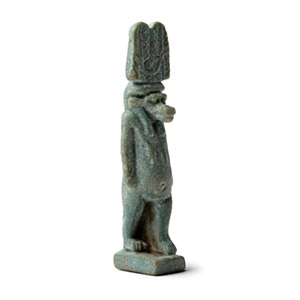
Egyptian Blue Faience Amulet Representing Taweret
Late Period, 664-332 B.C.Estimate: £200 - 300 (‡+bp*)
Opening Bid: £100
Modelled standing on a rectangular base in hippopotamus-headed form with dorsal pillar, pierced for suspension at the rear of the two-feather headdress. 5.18 grams, 52 mm
Collection of an amateur, Carouge, Switzerland, assembled in the 1980s-1990s. Thence by descent to the collection of Mr S.P., since 2020. This lot is accompanied by an illustrated lot declaration signed by the Head of the Antiquities Department, Dr Raffaele D'Amato. -
.jpg)
Egyptian Faience Ibis Amulet
Late Period, 664-332 B.C.Estimate: £150 - 200 (+bp*)
Opening Bid: £75
Flat rectangular base with crouching ibis in profile with curved beak resting on an object (possibly a diminutive seated figure of Maat), details to the feathered body, pale green glaze. 1.56 grams, 26 mm
From an early 20th century collection. This lot is accompanied by an illustrated lot declaration signed by the Head of the Antiquities Department, Dr Raffaele D'Amato. -
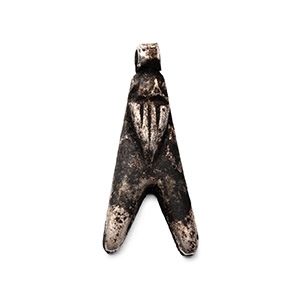
Egyptian Silver Fly Amulet
Late-Ptolemaic Period, 664-30 B.C.Sold for (Inc. bp): £78
With linear detailing to wings, raised eyes, pierced for suspension. 0.84 grams, 19 mm
Ex London, UK, art market, 1990s. This lot is accompanied by an illustrated lot declaration signed by the Head of the Antiquities Department, Dr Raffaele D'Amato.
Although flies might seem like mere nuisances—often shown being swatted by pharaohs or officials—ancient Egyptians admired them for their speed, agility, and persistence. Fly-shaped amulets, first appearing in Naqada II burials around 3200 B.C., became especially popular in the New Kingdom. Made from materials like gold, silver, faience, lapis lazuli, and bone, they served apotropaic purposes, protecting against bites and warding off pests. Some may have also symbolised fertility. Gold fly pendants were even awarded by pharaohs to honour soldiers’ bravery and tenacity.
