
Loading, please wait...
LOT 0023
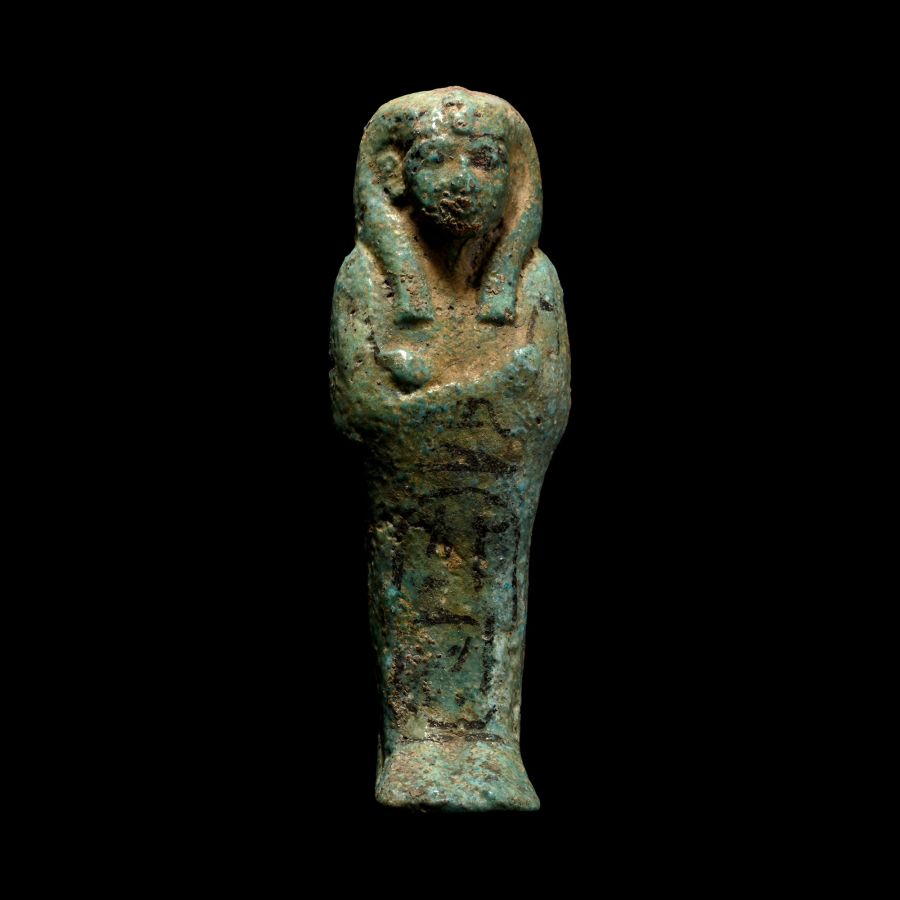
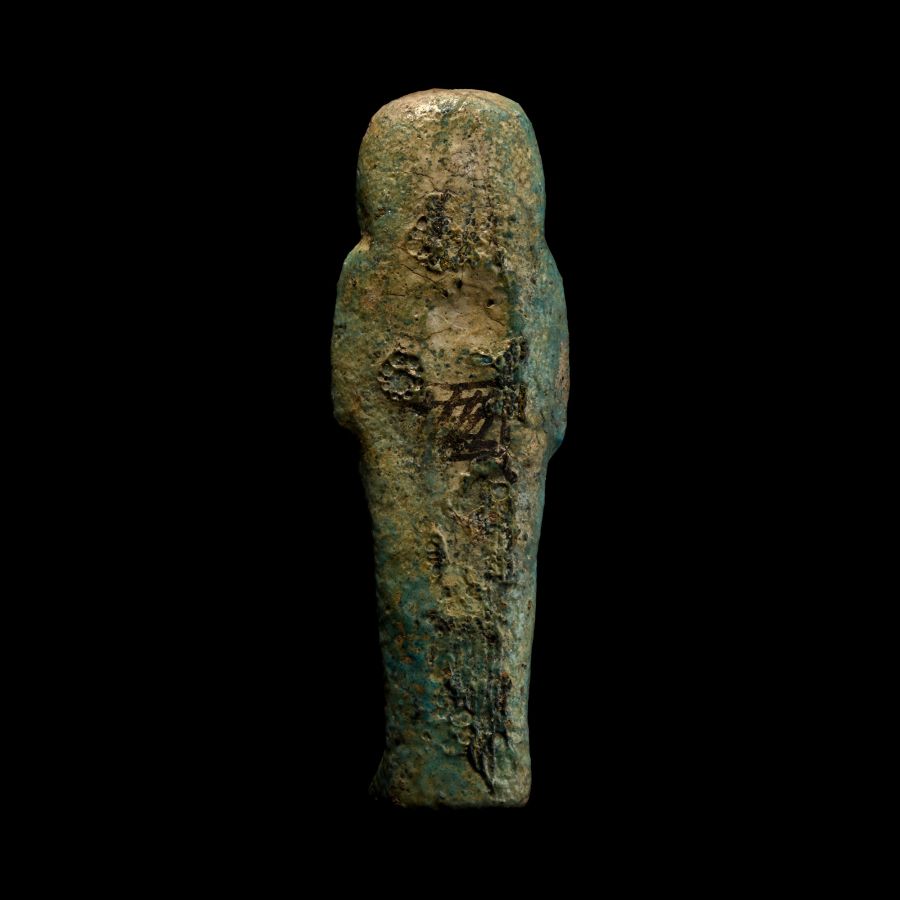
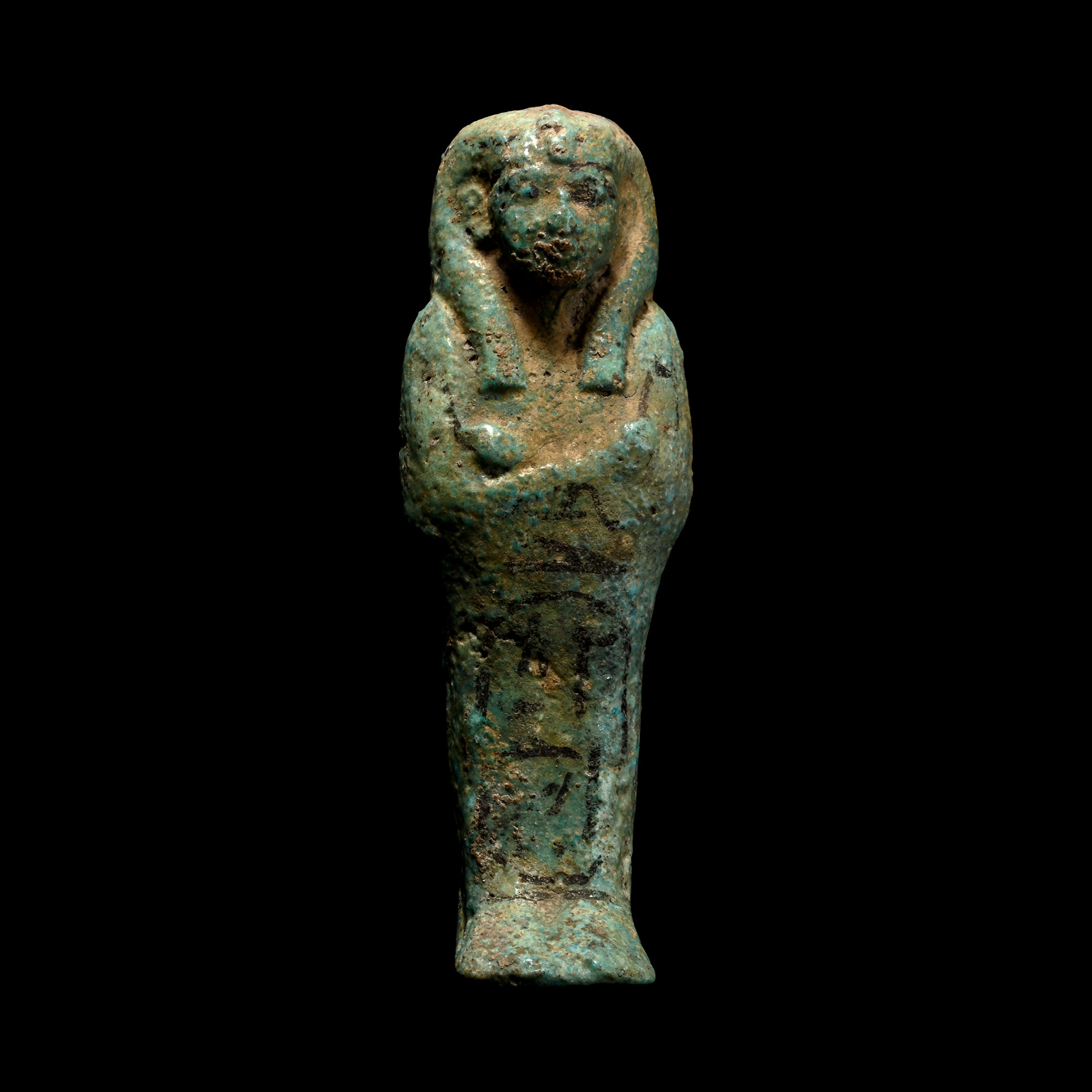
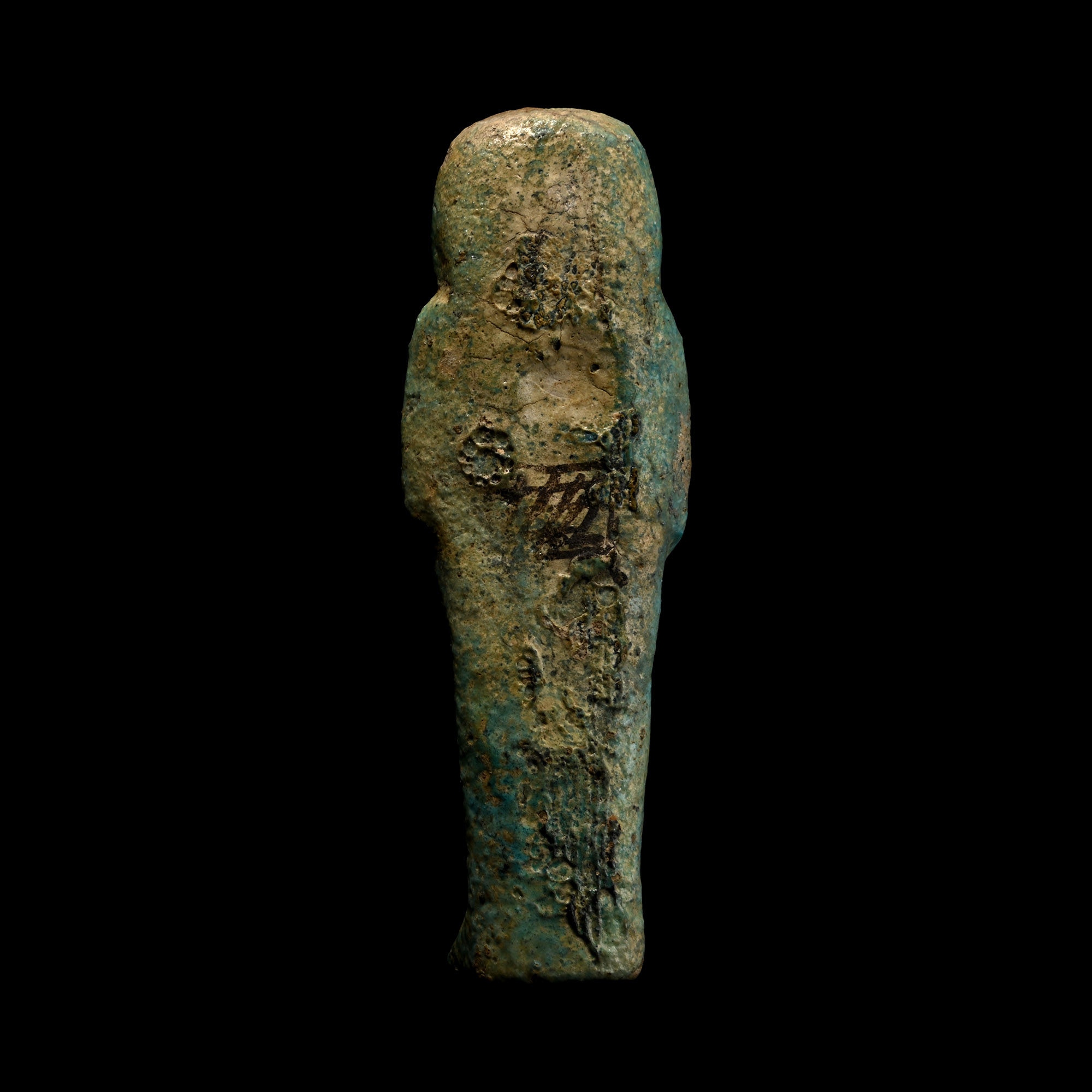
Egyptian Turquoise Blue Glazed Faience Shabti with Cartouche of Kedmerut
THIRD INTERMEDIATE PERIOD, 22ND DYNASTY, CIRCA 825-777 B.C.
3 7/8 in. (60.8 grams, 99 mm).
Mummiform shabti wearing a lappet wig, bearing a faintly modelled royal uraeus on the brow, with arms crossed and hands holding black-painted hoes, a black-painted seed belt across the back, black detailing on the face, and hieroglyphic text on the lower body giving the introduction 'The Osiris' followed by Kedmerut's name within a cartouche. [No Reserve]
ProvenanceFrom the private collection of Peter Clayton, FCILIP, Dip, Arch, FSA, FRNS, Hemel Hempstead, Hertfordshire, UK; formed since the late 1950s.
LiteratureCf. Janes, G., The Shabti Collections 6: A Selection from the World Museum, Liverpool, Lymm, 2016, 233-234, nos 161a-c, for similar examples of her shabtis.
FootnotesKedmerut was the 23rd Divine Adoratrice of Amun, a title originally bestowed on the daughters of Amun’s chief priests during Hatshepsut’s reign (1473–1458 BC). By the Third Intermediate Period, these priestly women also held the title ‘God’s Wife of Amun’ and wielded considerable power, effectively ruling Upper Egypt as sovereigns. Indeed, Kedmerut’s shabti bears a uraeus on its forehead, symbolising kingship.
CONDITIONTimeLine Auctions follows a vetting process to ensure the authenticity and legality of all items, reinforcing our commitment to integrity and responsible trading. Each antiquity, antique, and coin lot undergoes thorough examination by a vetting committee of at least ten external specialists, professional trade association members, scientists, and archaeologists: Our Vetting Process
AUCTIONS:
TimeLine is a leading auction house specialising in antiquities, ancient art, collectables, natural history, coins, medals, and books. Our auctions offer museums, collectors, historians, and enthusiasts the opportunity to acquire unique and historically significant pieces.
LOT 0023
Egyptian Turquoise Blue Glazed Faience Shabti with Cartouche of Kedmerut
Estimate £500 - 700€580 - 810 (for guidance only)$680 - 950 (for guidance only)
-
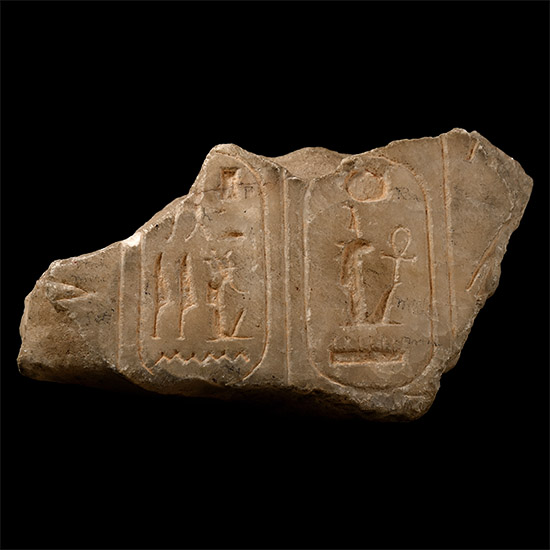
Egyptian Alabaster Fragment with Pharaoh Seti I's Cartouches
New Kingdom, 19th Dynasty, circa 1278 B.C.Estimate: £2,000 - 3,000 (+bp*)
Bids: 13 | Current Bid: £550
Thick section of alabaster with traces of four columns of hieroglyphs, including two partially preserved cartouches, one containing the birth name and epithet of Seti I, Seti mery-en-Ptah ('Seti, beloved of Ptah'), and the other his throne name, Men-Maat-Re ('Eternal is the justice of Re'). 526 grams, 13.8 cm
Received by gift from archaeologist Cyril Aldred, September 1964. From the private collection of Peter Clayton, FCILIP, Dip, Arch, FSA, FRNS, Hemel Hempstead, Hertfordshire, UK; formed since the late 1950s. Accompanied by an old handwritten information card by Peter Clayton, collection no.123. This lot has been checked against the Interpol Database of stolen works of art and is accompanied by search certificate no.13494-262900.
Peter Clayton's card suggests that the fragment may come from Seti's alabaster sarcophagus, the elaborately decorated lower half of which is in the John Soane Museum, London. The fragment may belong to the lid, which plunderers smashed in antiquity and which survives only in a relatively small number of fragments. -
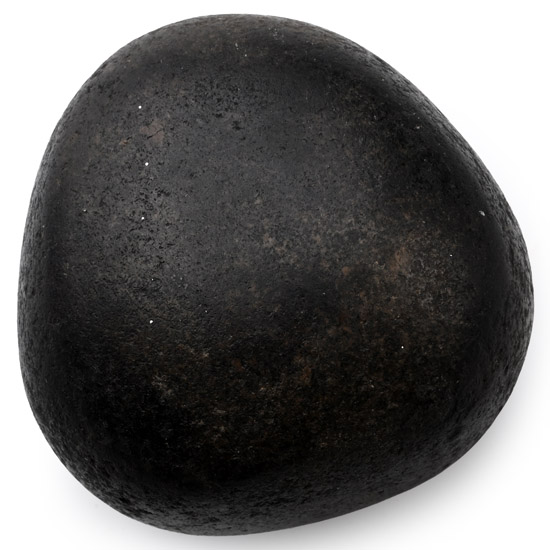
Egyptian Polished Diorite Hammerstone
Early Dynastic Period, circa 3,000 B.C.Estimate: £50 - 70 (+bp*)
Opening Bid: £5
Triangular in plan with rounded edges; with a handwritten label reading 'Polished diorite hammerstone. Egyptian, early Dynastic, c. 3000 BC'. 248 grams, 55 mm wide
From the collection of A.D.Passmore (1879-1958), his collection of flints from the area of Stonehenge was donated to the Ashmolean Museum in the 1950s. From the private collection of Peter Clayton, FCILIP, Dip, Arch, FSA, FRNS, Hemel Hempstead, Hertfordshire, UK; formed since the late 1950s. Accompanied by a copy of an old handwritten information card by Peter Clayton. -
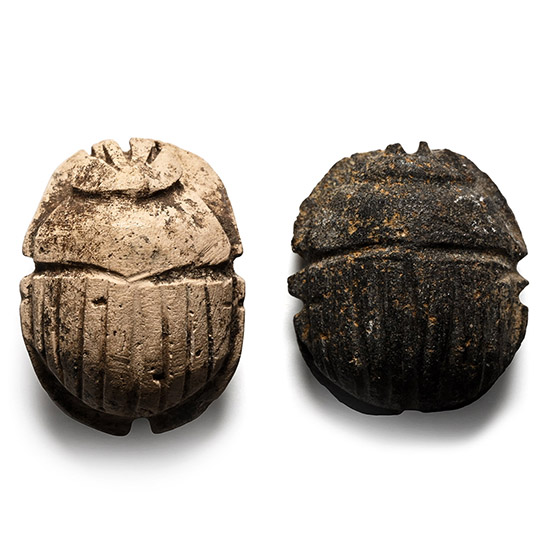
Egyptian Heart Scarab Group
Late Period, 664-332 B.C.Estimate: £120 - 170 (+bp*)
Opening Bid: £60
Comprising two naturalistically modelled scarabs with striated wing cases and ribbed undersides. 7.5 grams total, 18-20 mm
From the collection of a gentleman, acquired on the London art market in the 1990s.
The scarab amulet was a powerful symbol of rebirth, transformation, and protection in ancient Egypt. Modeled after the beetle associated with the sun god Khepri, it represented the cycle of life and regeneration. From the Middle Kingdom (c. 2050 BCE) onwards, scarabs served as funerary amulets, personal charms, and seals—often inscribed with prayers or names—reflecting both spiritual beliefs and daily life.
