
Loading, please wait...
LOT 0704
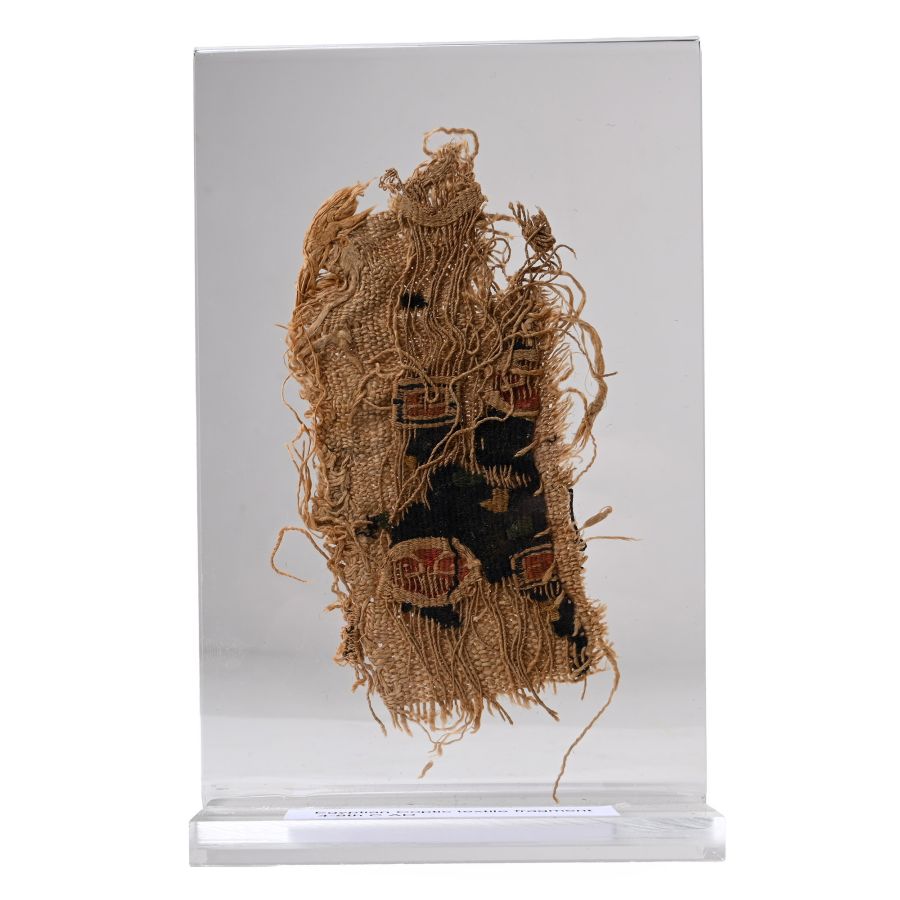
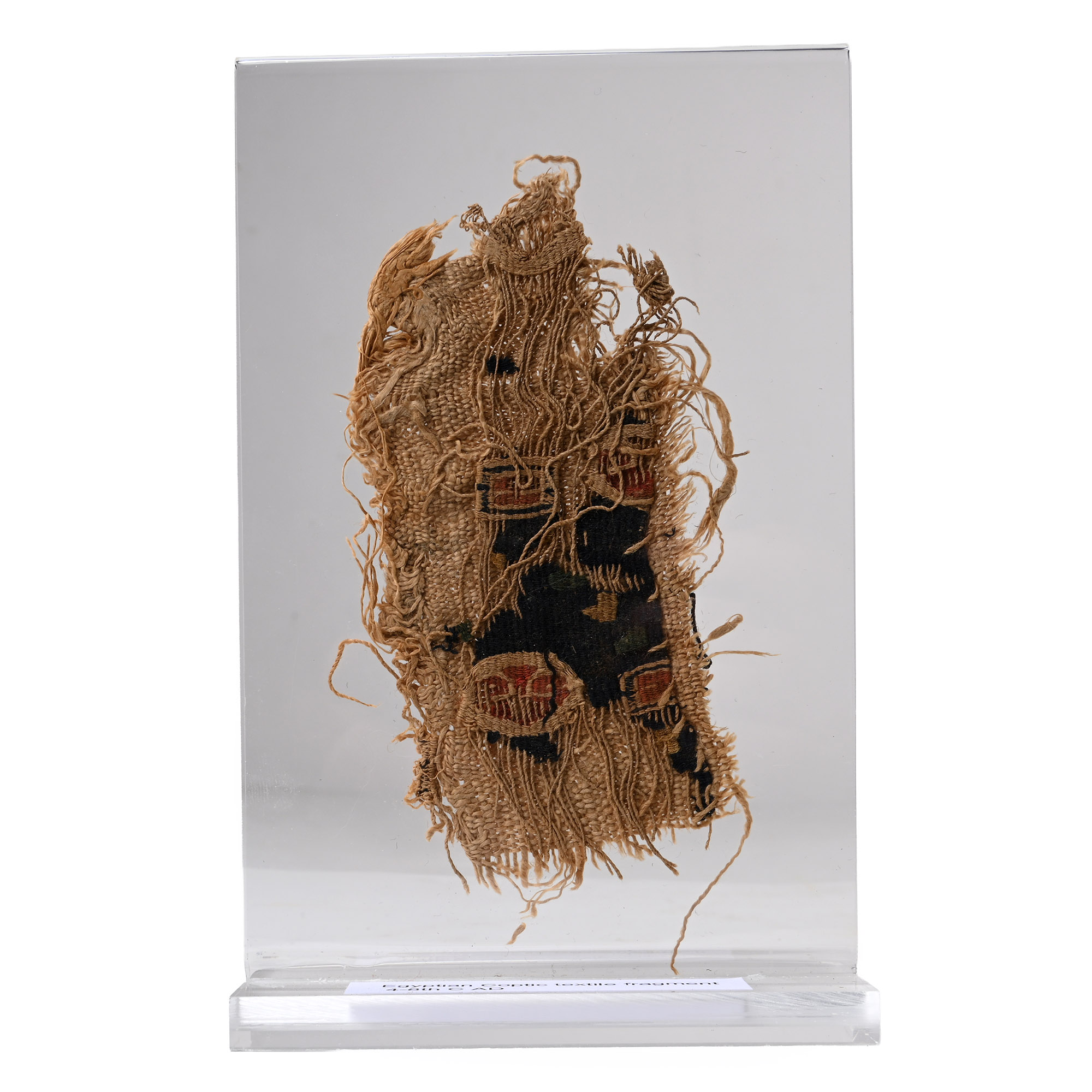
Egyptian Textile Fragment in Display Stand
COPTIC, CIRCA 6TH-8TH CENTURY A.D.
6 1/4 in. (83 grams total, 16 cm including stand).
Open-structured fragment of a decorative garment ornament (likely a tabula or portion of clavus band); mounted in a protective acrylic display. [No Reserve]
Provenancewith a privately curated collection, 1980s-early 2000s.
From the private collection and estate of Christine Simons (1943-2025), West Midlands, UK.
TimeLine Auctions follows a vetting process to ensure the authenticity and legality of all items, reinforcing our commitment to integrity and responsible trading. Each antiquity, antique, and coin lot undergoes thorough examination by a vetting committee of at least ten external specialists, professional trade association members, scientists, and archaeologists: Our Vetting Process
AUCTIONS:
TimeLine is a leading auction house specialising in antiquities, ancient art, collectables, natural history, coins, medals, and books. Our auctions offer museums, collectors, historians, and enthusiasts the opportunity to acquire unique and historically significant pieces.
LOT 0704
Egyptian Textile Fragment in Display Stand
Estimate £50 - 70€58 - 81 (for guidance only)$68 - 95 (for guidance only)
Opening Bid
£5 (EUR 6; USD 7) +BP*
-
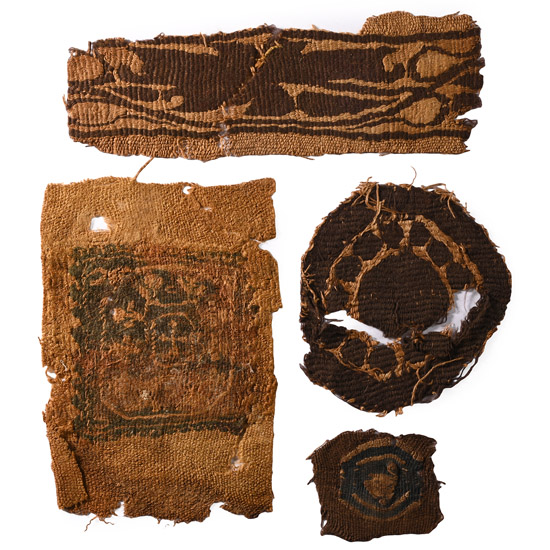
Egyptian Coptic Tunic Textile Fragments of Orbiculi, Segementa and Tablia with Animals, Geometric and Cross Decoration
Circa 4th-7th century A.D.Estimate: £80 - 100 (+bp*)
Opening Bid: £5
Comprising: an orbiculus in purple wool and coarse linen, S-torsion; a tabula in purple wool and coarse linen, on a brown linen background, S-torsion, embroidered with a central cross, the borders decorated with meanders; a broad segmentum in purple wool and coarse linen, on a brown linen background, S-torsion; a small orbiculus with vegetal ornaments. 11 grams total, 5.2-18.5 cm
Acquired 1970s-1996. Property of a North American collector. London collection, 2016.
The tabula, or tablion, was a square embroidery decorating tunics or mantles. The Christian elements, like the cross at the centre of our tabula, began to decorate garments from the 4th century onwards. -
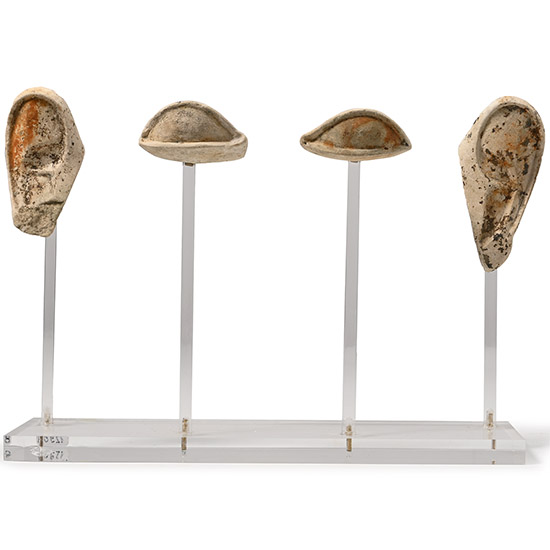
Egyptian Limestone Pair of Eyes and Ears
Late Period, 664-332 B.C.Estimate: £500 - 700 (‡+bp*)
Opening Bid: £250
A pair of narrow, almond-shaped eyes with elegantly curved, slightly set-off lids; the eyeballs are slightly convex; the reverse is smoothed; the tip and part of the surface of one earlobe are missing; traces of black paint and a reddish-yellow colour (paint or iron oxide deposits); originally served as inlays for a coffin mask. 234 grams total, 21.5 cm wide including stand
Israeli art market, 2015, from Mr I.H., a licensed art dealer from Jerusalem. -
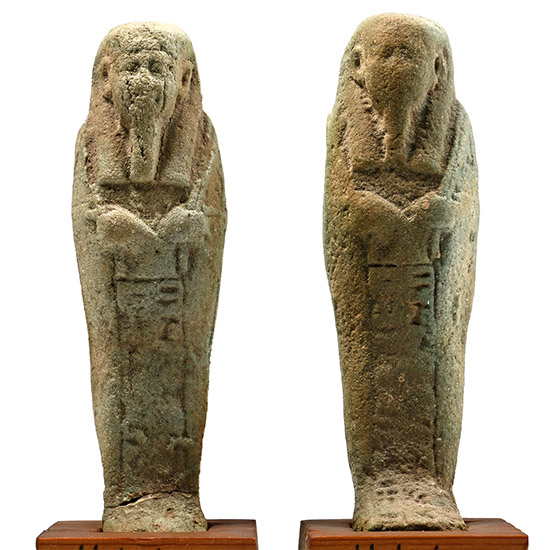
Egyptian Blue Faience Palestinian Shabti Pair
Late Period, 664-332 B.C.Estimate: £400 - 600 (+bp*)
Opening Bid: £5
Two mummiform figures, produced from the same mould, wearing lappet wigs, with arms crossed and hands holding agricultural implements; illegible hieroglyphic text on the lower body; display stand marked 'Ushabti Palestinian 1000-800 B.C.'. 120 grams total, 11.5-11.6 cm
Acquired near the British Museum, circa 1949, at 3 shillings each. From the private collection of Peter Clayton, FCILIP, Dip, Arch, FSA, FRNS, Hemel Hempstead, Hertfordshire, UK; formed since the late 1950s. Accompanied by an old handwritten information card by Peter Clayton, collection nos.7,7a.
