
Loading, please wait...
LOT 0025
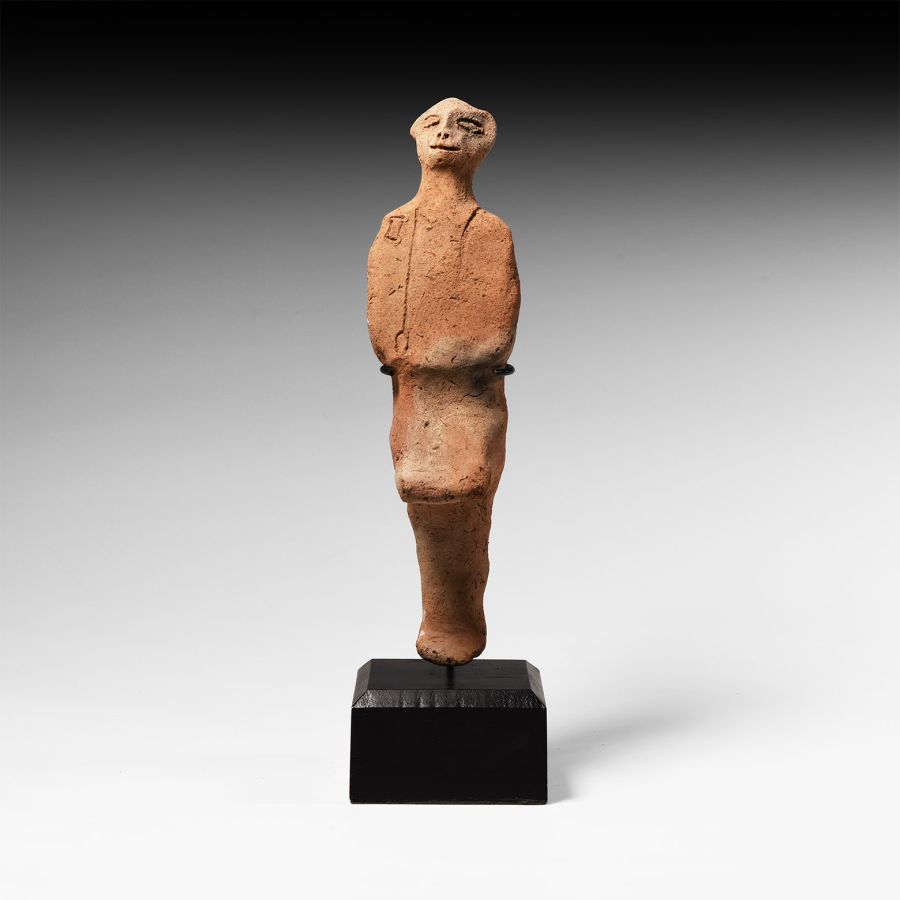
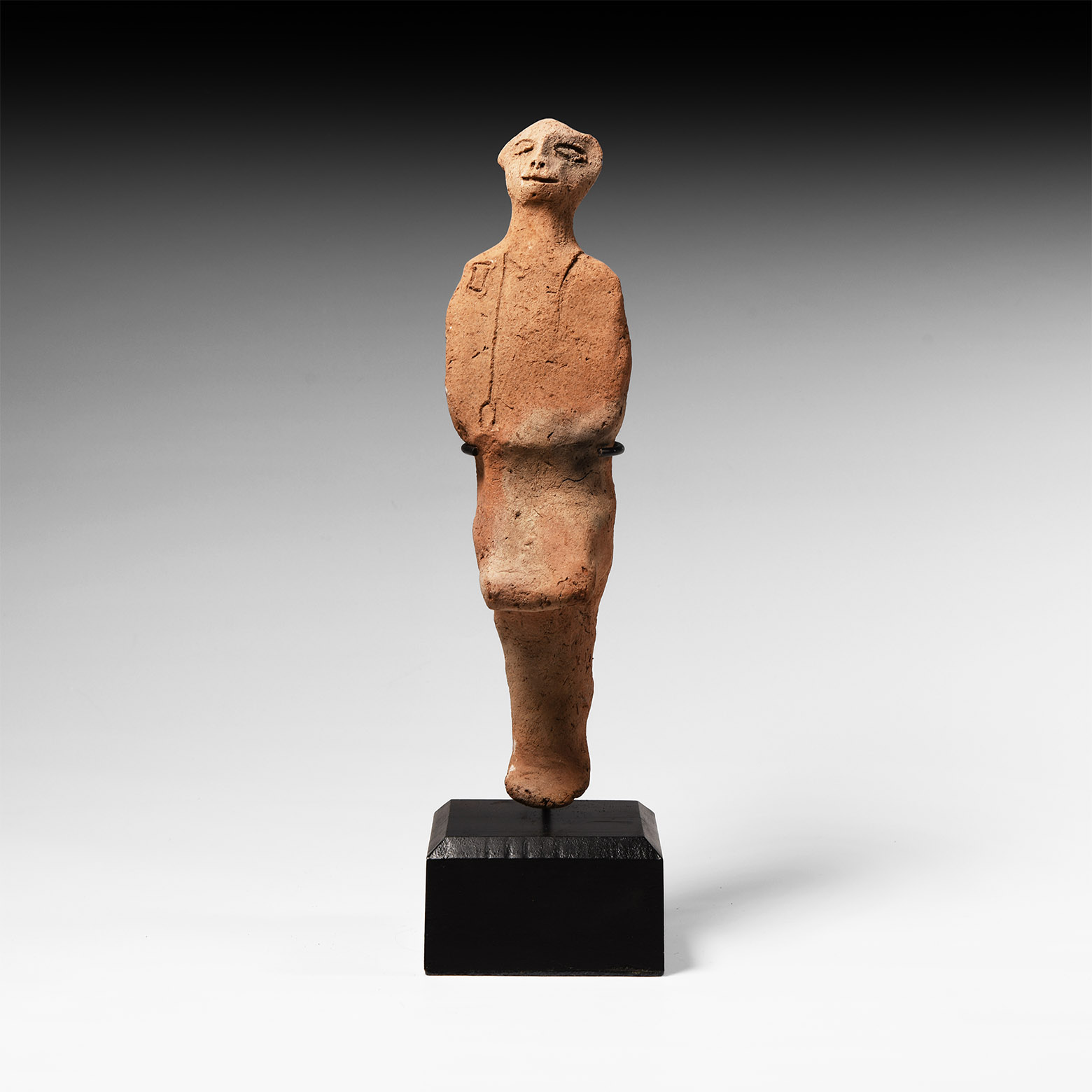
Egyptian Terracotta Overseer Shabti
PTOLEMAIC PERIOD, CIRCA 3RD CENTURY B.C. OR EARLIER
8 7/8 in. (11 in.) (303 grams, 22.5 cm (465 grams total, 28 cm including stand)).
A rare example of a terracotta shabti depicting an overseer wearing a civil kilt, incised whip over his right shoulder; stylised facial features with pinched profile and incised eyes, nostrils and mouth; incised stripe to the left shoulder; accompanied by a custom-made stand.
ProvenanceAcquired 1979-1999.
London collection of the late Mr S.M., thence by descent.
Accompanied by a copy of a previous cataloguing slip.
Accompanied by an original thermoluminescence analysis report no.N122j43, from Oxford Authentication.
Cf. Petrie, W.M.F., Gizeh and Rifeh, London, 1907, pl. XXVIIC, for numerous examples of crude terracotta worker and overseer shabtis of the late New Kingdom from Deir Rifeh; Janes, G., The Shabti Collections 6. A Selection from the World Museum Liverpool, Lymm, 2016, pp.516-517, nos. 271 a-c, for examples of crude mud worker shabtis of the early Ptolemaic period found at Abydos holding a stylised implement.
FootnotesMany crude clay shabtis are known from provincial sites such as Deir Rifeh and Abydos, with dates ranging from the Late New Kingdom - Ptolemaic Period. This overseer figure would favour a dating closer to the earlier date, when overseer shabtis were a common feature.
CONDITIONTimeLine Auctions follows a vetting process to ensure the authenticity and legality of all items, reinforcing our commitment to integrity and responsible trading. Each antiquity, antique, and coin lot undergoes thorough examination by a vetting committee of at least ten external specialists, professional trade association members, scientists, and archaeologists: Our Vetting Process
AUCTIONS:
TimeLine is a leading auction house specialising in antiquities, ancient art, collectables, natural history, coins, medals, and books. Our auctions offer museums, collectors, historians, and enthusiasts the opportunity to acquire unique and historically significant pieces.
-
Egyptian Terracotta Overseer Shabti
Ptolemaic Period, circa 3rd century B.C. or earlierSold for (Inc. bp): £826
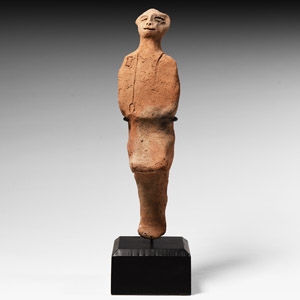
A rare example of a terracotta shabti depicting an overseer wearing a civil kilt, incised whip over his right shoulder; stylised facial features with pinched profile and incised eyes, nostrils and mouth; incised stripe to the left shoulder; accompanied by a custom-made stand. 303 grams, 22.5 cm (465 grams total, 28 cm including stand)
Fine condition.
Acquired 1979-1999. London collection of the late Mr S.M., thence by descent. Accompanied by a copy of a previous cataloguing slip. Accompanied by an original thermoluminescence analysis report no.N122j43, from Oxford Authentication.
Many crude clay shabtis are known from provincial sites such as Deir Rifeh and Abydos, with dates ranging from the Late New Kingdom - Ptolemaic Period. This overseer figure would favour a dating closer to the earlier date, when overseer shabtis were a common feature. -
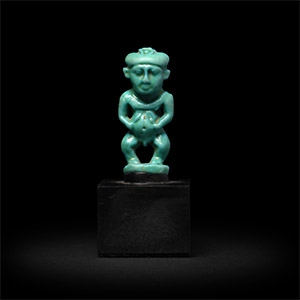
Egyptian Faience Ptah Amulet
Ptolemaic Period, 4th-3rd century B.C.Estimate: £1,200 - 1,700 (‡+bp*)
Opening Bid: £600
A blue-glazed faience amulet of the creator god Ptah in the form of the dwarf god Pataikos, modelled nude with stylised anatomical detailing, holding two knives to his stomach, squatting on an oval base; a scarab on the top of his cap; ribbed suspension loop to reverse; mounted on a custom-made display base. 29.6 grams total, 66 mm high including stand
Ex private French collection. with Thierry Maigret, Hotel Drouot, Paris, 12 July 2005, 76.
The Egyptian deity Pataikos is a special manifestation of the creator god Ptah, and the dwarf-like appearance symbolises his magical power. As a protective deity, amulets of Pataikos were worn for their apotropaic qualities; Pataikos was often depicted subjugating poisonous animals such as snakes and scorpions, and Pataikos amulets were probably worn to protect the wearer from such animals. Ptah was the god of Egypt's capital city Memphis and master craftsman of the gods, known for his benevolent and approachable character. Ptah is attested from the beginning of ancient Egypt’s dynastic history and was a creator god, a god of craftsmen, and the patron deity of the Memphite region. The principal temple of the god was located in the city of Memphis. The fragmentary back pillar on this statuette indicates that it was most probably a temple offering, originally inscribed with an invocation to Ptah together with the donor’s name. Such votive figurines with back pillars naming the god and the dedicator occur in various materials, including faience and stone. -
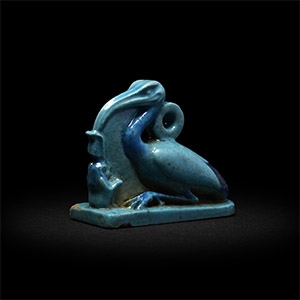
Egyptian Thoth as an Ibis with Maat
Ptolemaic Period, 332-30 B.C.Sold for (Inc. bp): £6,500
A blue-glazed composition amulet in the form of an ibis (representing the god Thoth) seated on a wedge-shaped base, facing a figure of Maat appearing as a diminutive stooping female with an ostrich feather; some details to both figures rendered in a darker blue glaze; suspension loop to the rear of the bird's neck. 9.15 grams, 37 mm
Acquired from Dr Jan Beekmans, circa 1984. UK private collection.
Maat and the moon god Thoth, husband and wife, together embody wisdom and cosmic order. As a divine couple, they served the sun god, Re. Like Thoth, the ancient Egyptians connected the ibis with the moon, owing to its crescent moon-shaped beak. The ibis was well known in antiquity for its refusal to drink unhealthy and poisoned water, or to kill poisonous reptiles, and set mankind an example of cleanliness; thus, like the god Thoth, the ibis offered protection against dangerous forces and served as a model for purity and good sense. Maat embodies the order that Thoth protects. Her symbol, an ostrich feather, references a bird that inhabits desert and savannah habitats, although it must never wander too far away from rivers and lakes. The ostrich cannot fly, but it is a fast runner and a strong fighter.
