
Loading, please wait...


LOT 0406
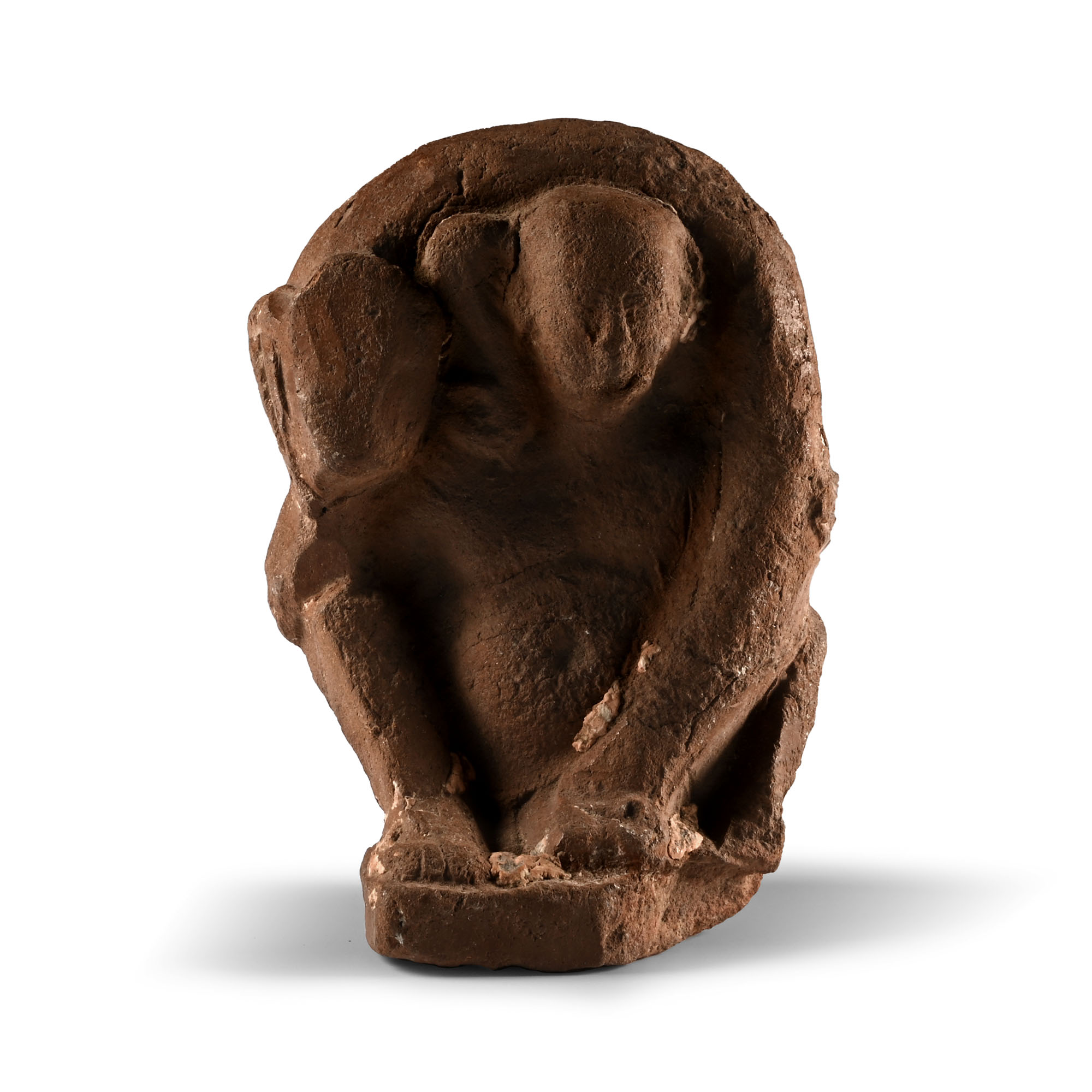
Egyptian Terracotta Ithyphallic Figurine of Harpocrates
PTOLEMAIC PERIOD, 3RD-2ND CENTURY B.C.
3 1/4 in. (160 grams, 84 mm).
Naked ithyphallic youthful Harpocrates seated, with shaved head and side-lock, his enormous phallus wrapped around on his neck. [No Reserve]
ProvenanceThe Erotica Collection Christian von Faber-Castell, Küsnacgt ZH, Switzerland, since the late 1970s.
This lot is accompanied by an illustrated lot declaration signed by the Head of the Antiquities Department, Dr Raffaele D’Amato.
Cf. Ross, T., ‘Egyptian Late Period figures in terracotta and limestone’ in Villing, A., Beregeron, M., Bourogiannis, G., Johnston, A., Leclere, F., Masson. A., Ross, T., Naukratis, Greeks in Egypt, London, 2015, pp.1-79, figs.93, 95, for a similar image of Harpocrates.
FootnotesIthyphallic figures in limestone, terracotta, gypsum and faience are relatively common in the 6th to 3rd-century B.C. deposits of Lower Egypt. Despite considerable variations, the group consistently depicts a seated ithyphallic plump baby with shaved head (or skull cap) and side-lock. They were identified by Gutch as Khonsu-Horus figures and subsequently by Bailey as Harpocrates, the Greek name for young Horus.
Christian von Faber-Castell (born 1950) is a renowned German entrepreneur and art collector, best known as a member of the prominent Faber-Castell family, famed for their iconic writing instruments. A passionate advocate for art and culture, Christian von Faber-Castell curated an extensive and diverse private collection of erotica, spanning centuries and cultures. His collection reflects a deep appreciation for the interplay of beauty, sensuality, and artistic expression, bringing together rare and unique works that explore themes of intimacy and human connection. Pieces from this collection have been featured in notable exhibitions and are celebrated for their artistic and historical significance. This offering represents a rare opportunity to acquire works from one of the most fascinating and eclectic private collections of its kind.
TimeLine Auctions follows a vetting process to ensure the authenticity and legality of all items, reinforcing our commitment to integrity and responsible trading. Each antiquity, antique, and coin lot undergoes thorough examination by a vetting committee of at least ten external specialists, professional trade association members, scientists, and archaeologists: Our Vetting Process
AUCTIONS:
TimeLine is a leading auction house specialising in antiquities, ancient art, collectables, natural history, coins, medals, and books. Our auctions offer museums, collectors, historians, and enthusiasts the opportunity to acquire unique and historically significant pieces.
LOT 0406
Egyptian Terracotta Ithyphallic Figurine of Harpocrates
Sold for (Inc. bp): £111
-
.jpg)
Egyptian Steatite Fragmentary Pectoral with Central Scarab Element
New Kingdom, 20th Dynasty, circa 1186-1069 B.C.Sold for (Inc. bp): £1,430
Obverse with scarab carved in high-relief and wing-case recessed to accept inlays (now absent), flanked by a small female goddess wearing a tall headdress, almost certainly Nephthys, with her arms raised in supplication; column with text to her rear, covered in gold foil and perhaps to be read as 'May my name be victorious: protection..'; reverse with the upper body of a male figure facing right with both arms raised towards the remains of a recumbent Anubis on a plinth above the top of a fragmentary shield-shaped plaque with incised text beginning 'Osiris Lord of Eternity forever..'; mounted on a custom-made stand. 53 grams, 69 mm (157 grams total, 11.5 cm including stand)
Eric Pascoe (d. 2019), Calenick House, Truro, Cornwall. Lodge & Thomas, Truro, Antiques & Fine Art Two Day Auction-Including the Ron Clifford Collection of Dinky & Britain's Toys, 26-27 September 2019, no.684. Acquired by the present owner at the above sale. with Bonhams, London, 8 December 2022, no.265. This lot is accompanied by an illustrated lot declaration signed by the Head of the Antiquities Department, Dr Raffaele D’Amato.
This fragment from an elaborate pectoral may exemplify an innovative design characteristic of the Ramesside Period, during which iconographic and textual elements began to diverge from the more conventional styles of earlier pectorals. For a discussion of some of these novel pectorals, refer to Whelan, P., 'An Epithet-Laden Pectoral,' Egitto e Vicino Oriente, 46 (2023), pp.7-28. -
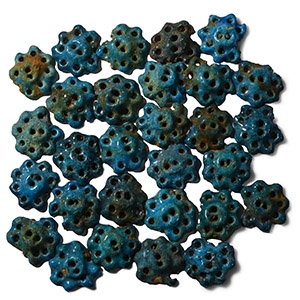
Egyptian Blue Faience Clothing Mounts
Roman Period, 30 B.C.-323 A.D.Estimate: £300 - 400 (+bp*)
Opening Bid: £135
Group of rosette mounts, each plano-convex in profile with two attachment holes to the centre and pierced loops to the rim. 124 grams total, 25-30 mm
UK private collection, formed in the 1980s. This lot is accompanied by an illustrated lot declaration signed by the Head of the Antiquities Department, Dr Raffaele D’Amato. -
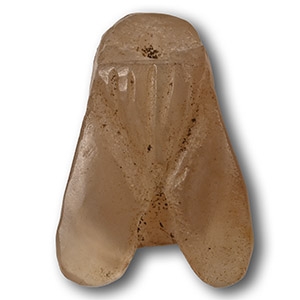
Egyptian Carnelian Fly Amulet
Late-Ptolemaic Period, 664-30 B.C.Sold for (Inc. bp): £52
Formed as a fly with long triangular wings on a tongue-shaped base. 0.65 grams, 12 mm
From an early 20th century collection. This lot is accompanied by an illustrated lot declaration signed by the Head of the Antiquities Department, Dr Raffaele D’Amato.
