Loading, please wait...

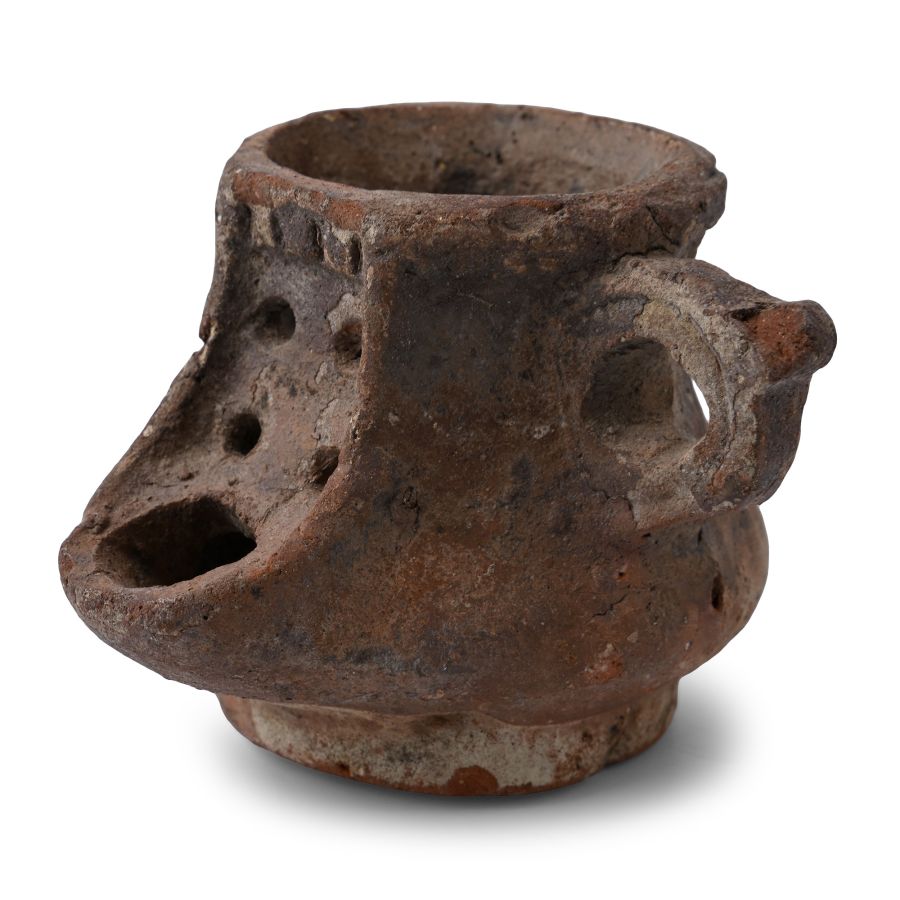
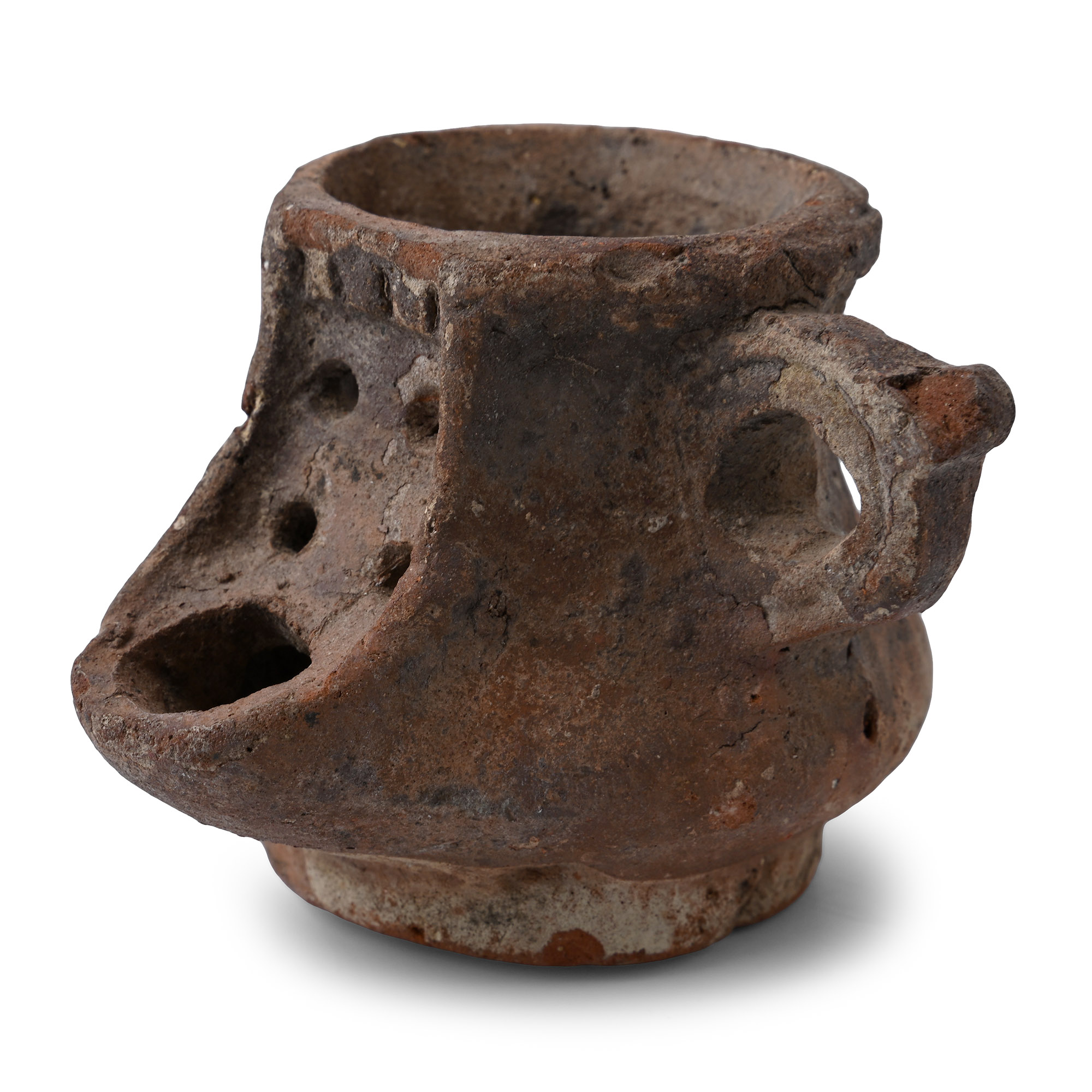
Egyptian Terracotta Handled Oil Lamp Egyptian Terracotta Handled Oil Lamp Egyptian Terracotta Handled Oil Lamp
Use mousewheel to zoom in and out, click to enlarge
Details

LOT 0486

Egyptian Terracotta Handled Oil Lamp

PTOLEMAIC PERIOD, CIRCA 3RD-1ST CENTURY B.C.

2 7/8 in. (94 grams, 74.6 mm wide).

Biconical body with tubular neck and thickened rim, short spout with four piercings above, and handle to the side. [No Reserve]

Provenance

From the private collection of Mr Brian Edwards, New Malden, Surrey, UK, formed from the late 1970s-early 1980s; thence by descent.

Accompanied by the original collector's data sheet with reference no.A116.

CONDITION
VETTING:

TimeLine Auctions follows a vetting process to ensure the authenticity and legality of all items, reinforcing our commitment to integrity and responsible trading. Each antiquity, antique, and coin lot undergoes thorough examination by a vetting committee of at least ten external specialists, professional trade association members, scientists, and archaeologists: Our Vetting Process


AUCTIONS:

TimeLine is a leading auction house specialising in antiquities, ancient art, collectables, natural history, coins, medals, and books. Our auctions offer museums, collectors, historians, and enthusiasts the opportunity to acquire unique and historically significant pieces.

LOT 0486

Egyptian Terracotta Handled Oil Lamp

Sold for (Inc. bp): £117

Print page

RELATED LOTS
  • Large Phoenician Alabaster Alabastron with Hieroglyphic Inscription
    Large Phoenician Alabaster Alabastron with Hieroglyphic Inscription
    Circa 600 B.C.

    Estimate: £15,000 - 20,000 (‡+bp*)

    Opening Bid: £7,500

    Barrel-shaped in profile with a rounded base, broad shoulder and flared mouth, two lateral integral loop handles; incised hieroglyphic legend to the shoulder. 420 grams, 37 cm


    Formerly in a private collection, Beirut, Lebanon, 1990s. Swiss private collection, acquired from Mr H., Geneva, 2010. This lot has been checked against the Interpol Database of stolen works of art and is accompanied by search certificate number no.13221-249178. Accompanied by a copy of an Art Loss Register certificate, no.S00059830

    In the Phoenician necropolises of Andalusia, the ashes of the deceased were enclosed in luxurious alabaster urns of Egyptian manufacture. In the Phoenician necropolis of Almuñécar, for example, some urns preserved inscriptions and emblems of various Egyptian pharaohs, who ruled the Nile region between the 16th and 8th centuries B.C. Alabaster vessels of this type, originally containing fine wines, have been discovered, albeit in smaller numbers, in the royal palaces of Assur and Samaria in the East, as part of war booty or gifts exchanged between royal houses.

    Lot Details

  • Egyptian Serpentine Shabti for King Senkamenisken
    Egyptian Serpentine Shabti for King Senkamenisken
    Nubia, Napatan Period, 643-623 B.C.

    Sold for (Inc. bp): £21,450

    Mummiform figure wearing a braided beard with chin-straps in relief, broad collar visible between the lappets of the nemes headdress adorned with a double uraeus, the crossed hands holding a hoe and pick, with a seed bag over the left shoulder, his broad face with straight nose, wide-set eyes and large ears, six horizontal lines of inscription, giving a version of Chapter 6 from the Book of the Dead; mounted on a custom-made display stand. 659 grams total, 21 cm including stand


    J.J. Klejman, Madison Avenue, New York, USA, 1960s. UK private collection, acquired from the above, 1960s. Bluett and Sons, London, 1979. Sheppard & Cooper, UK, private collection, 1980s. Sheikh Saoud Al-Thani, the 'Princely' private collection, UK. Acquired from the above in 2017. with Sotheby's, London, 5 July 2024, no.126. Accompanied by a copy of the Bluett and Sons invoice, 22 January 1979. This lot has been checked against the Interpol Database of stolen works of art and is accompanied by search certificate number no.13273-254064.

    Of the 1277 shabtis of Senkamenisken found in the king's burial chamber of his pyramid tomb at Nuri (Pyramid 3), 410 are made of serpentine, the remaining 867 of faience. The inscription reads: 'The illuminated one, the Osiris, the good god, lord of the two lands, Sekheper[en]re, true of voice, He says: "O this shabti, if anyone summons the Osiris Senkamenisken, true of voice, in order to do any work which is to be done in the God's Land (i.e. necropolis), to cultivate the fields, to irrigate the canals, to carry sand from the east to the west and vice versa, 'Here I am', you shall say".

    Lot Details

  • Egyptian Stone Age Hollow-base Arrowhead
    Egyptian Stone Age Hollow-base Arrowhead
    Neolithic Period, 4500-3600 B.C.

    Sold for (Inc. bp): £163

    A bifacial flint arrowhead with a pronounced hollow-base form. 2.55 grams, 35.6 mm


    From the late collection of a Cornish couple, formed from the early 1990s.

    Many hollow-base flint arrowheads were uncovered during excavations at Neolithic sites in Egypt, such as the Fayum region (cf. British Museum EA58736) and Merimde Beni Salama in the Delta (cf. Petrie Museum of Egyptian Archaeology UC10909).

    Lot Details

Stay up-to-date with the latest from TimeLine Auctions by joining our mailing list