
Loading, please wait...

LOT 0484
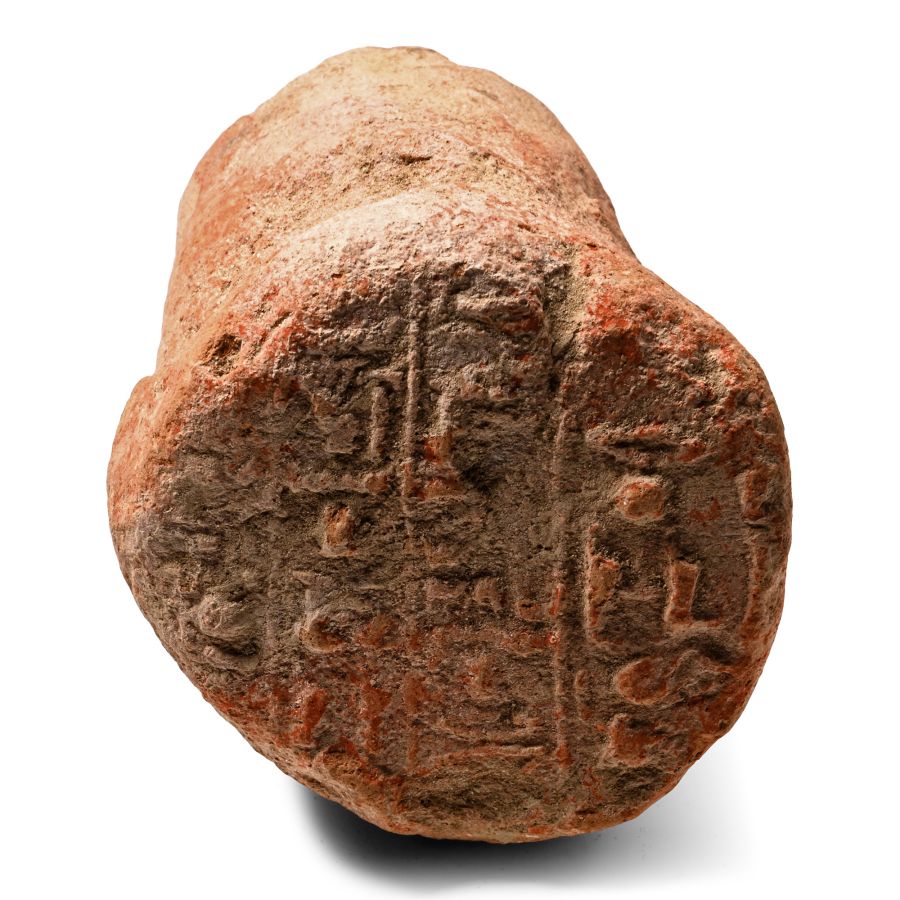
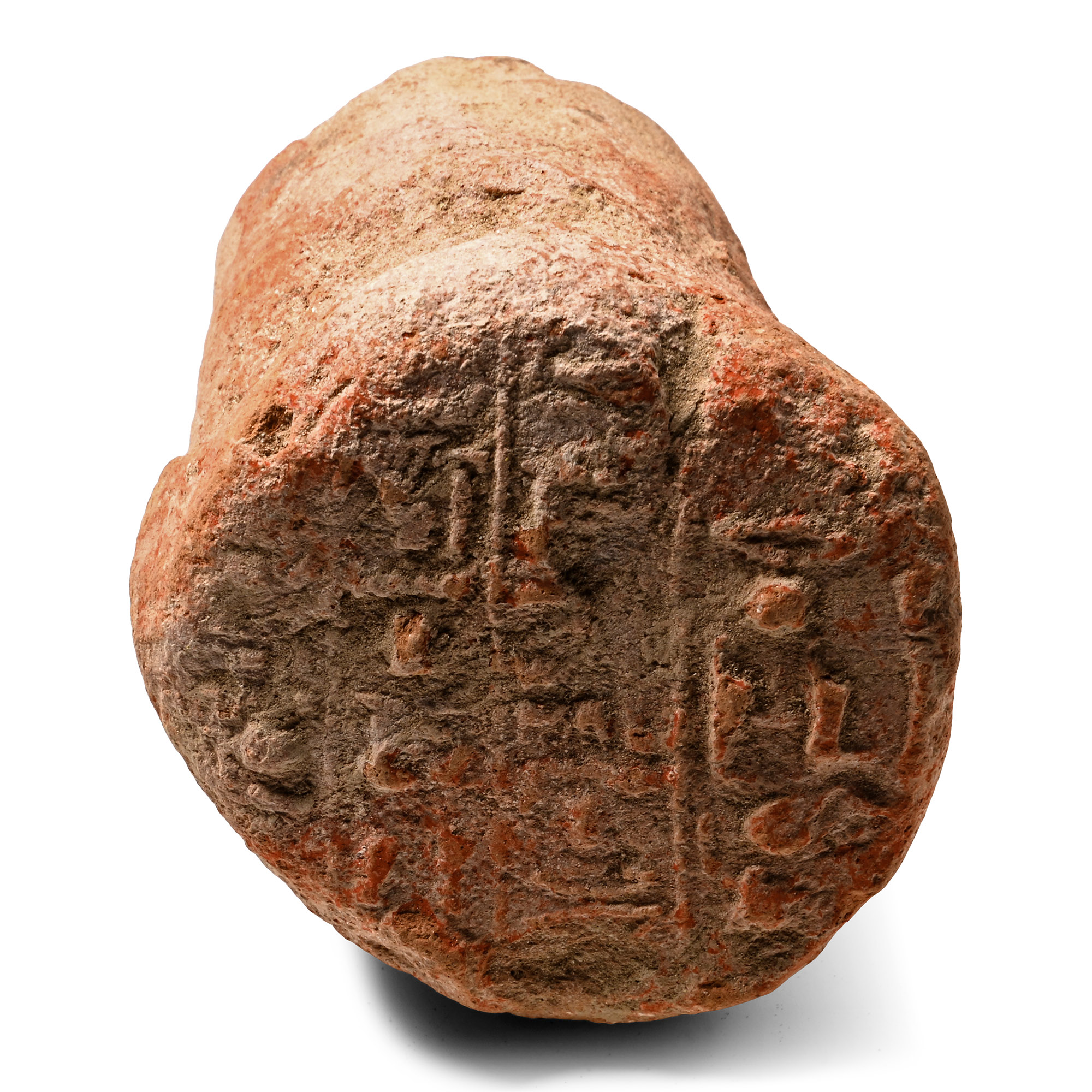
Egyptian Terracotta Funerary Cone of Amenhotep, Called Huy
NEW KINGDOM, 18TH DYNASTY, MID-TO-LATE 14TH CENTURY B.C.
2 3/8 in. (174 grams, 61 mm).
Sizeable portion of a funerary cone with a tapering profile and a circular flat end impressed with a partial stamp, which, when complete with five columns of text, would read: 'Honoured by Osiris, hereditary prince, Amenhotep, called Huy, the famous person in the entire land, born of the dignitary Hepu.' [No Reserve]
ProvenanceAcquired from Abdoul Rassoul on the West Bank at Luxor, 1974-1980 when a guest lecturer.
From the private collection of Peter Clayton, FCILIP, Dip, Arch, FSA, FRNS, Hemel Hempstead, Hertfordshire, UK; formed since the late 1950s.
Cf. Davies, N. de G. & Laming Macadam F., A Corpus of Inscribed Egyptian Funerary Cones, Oxford, 1957, no. 10, for the complete stamp design.
FootnotesAlthough funerary cones of Amenhotep have circulated for a long time, his tomb was documented only in 1996 by the German Egyptologist Friederike Kampp-Seyfried (tomb 396), primarily on the basis of the number of funerary cones found at the site. In this example, the cone appears to have been made too small to accommodate the full stamp design.
CONDITIONTimeLine Auctions follows a vetting process to ensure the authenticity and legality of all items, reinforcing our commitment to integrity and responsible trading. Each antiquity, antique, and coin lot undergoes thorough examination by a vetting committee of at least ten external specialists, professional trade association members, scientists, and archaeologists: Our Vetting Process
AUCTIONS:
TimeLine is a leading auction house specialising in antiquities, ancient art, collectables, natural history, coins, medals, and books. Our auctions offer museums, collectors, historians, and enthusiasts the opportunity to acquire unique and historically significant pieces.
LOT 0484
Egyptian Terracotta Funerary Cone of Amenhotep, Called Huy
Estimate £100 - 140€120 - 160 (for guidance only)$140 - 190 (for guidance only)
-
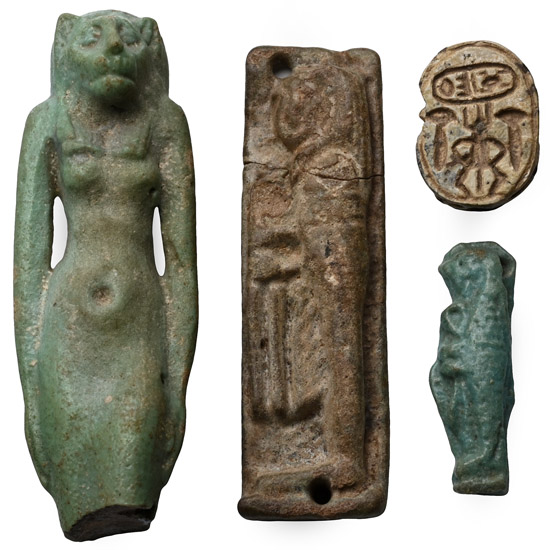
Egyptian Artefact Collection
Late Period-Ptolemaic Period, 664-30 B.C.Estimate: £60 - 80 (+bp*)
Bids: 3 | Current Bid: £33
Comprising a standing figure of Sekhmet, featuring a plain dorsal pillar with an integral suspension hole, lower legs missing; two hawk-headed Qebehsenuef, Sons of Horus amulets; steatite scarab with base decorated with a cartouche of Thutmose III and a Bes figure flanked by wadj signs 18.01 grams total, 16-53 mm
From the private collection of Peter Clayton, FCILIP, Dip, Arch, FSA, FRNS, Hemel Hempstead, Hertfordshire, UK; formed since the late 1950s. -
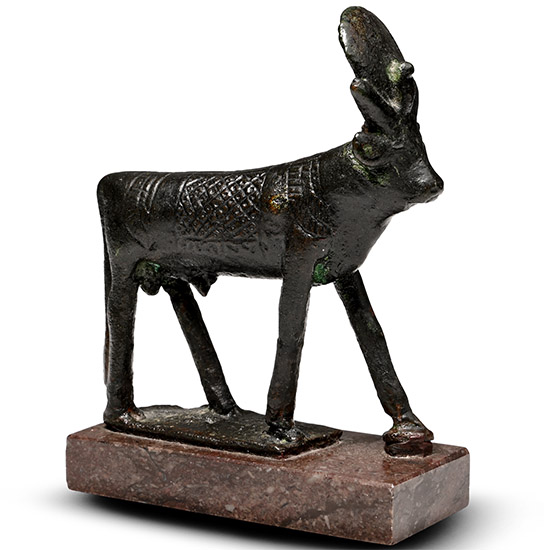
Egyptian Bronze Votive Apis Bull Statue
Ptolemaic Period, 2nd-1st century B.C.Estimate: £1,200 - 1,700 (‡+bp*)
Opening Bid: £650
Small votive statuette of a bull advancing with a sun disc and uraeus between the horns, on a rectangular plinth; incised caparison and two falcons with outstretched wings on its back; phallus and testicles present; mounted on a custom-made stand. 90 grams total, 72 mm high including stand
Ex Zurich art market, 1980s. Private collection Brigitte Leu, Zurich, between 1980 and 2003.
In Ancient Egypt, bull deities embodied aspects of fertility or the creative power of certain gods, such as Ra. Originally, the Apis bull was a fertility god in his own right, but he could also merge syncretically with other deities. For example, the creator god Ptah of Memphis found his "living repetition" in the Apis bull. When an Apis bull died, it was given a lavish funeral and interred in a magnificent hard-stone sarcophagus within the dedicated catacombs at Saqqara known as the Serapeum. -
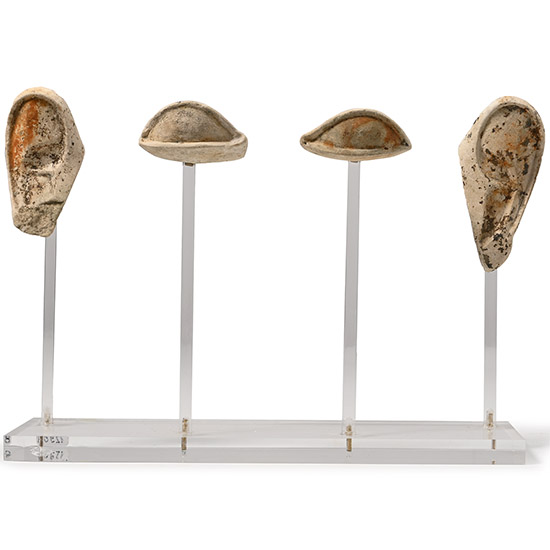
Egyptian Limestone Pair of Eyes and Ears
Late Period, 664-332 B.C.Estimate: £500 - 700 (‡+bp*)
Opening Bid: £250
A pair of narrow, almond-shaped eyes with elegantly curved, slightly set-off lids; the eyeballs are slightly convex; the reverse is smoothed; the tip and part of the surface of one earlobe are missing; traces of black paint and a reddish-yellow colour (paint or iron oxide deposits); originally served as inlays for a coffin mask. 234 grams total, 21.5 cm wide including stand
Israeli art market, 2015, from Mr I.H., a licensed art dealer from Jerusalem.
