
Loading, please wait...



LOT 2556
Egyptian Style Stone Bead Necklace String
20TH CENTURY A.D.
14 1/8 in. (4.71 grams, 36 cm).
Composed of small, annular turquoise, green and other beads. [No Reserve]
ProvenanceEx London, UK, collection, 1990s.
CONDITIONTimeLine Auctions follows a vetting process to ensure the authenticity and legality of all items, reinforcing our commitment to integrity and responsible trading. Each antiquity, antique, and coin lot undergoes thorough examination by a vetting committee of at least ten external specialists, professional trade association members, scientists, and archaeologists: Our Vetting Process
AUCTIONS:
TimeLine is a leading auction house specialising in antiquities, ancient art, collectables, natural history, coins, medals, and books. Our auctions offer museums, collectors, historians, and enthusiasts the opportunity to acquire unique and historically significant pieces.
LOT 2556
Egyptian Style Stone Bead Necklace String
Estimate £50 - 70€58 - 81 (for guidance only)$68 - 95 (for guidance only)
Opening Bid
£5 (EUR 6; USD 7) +BP*
-
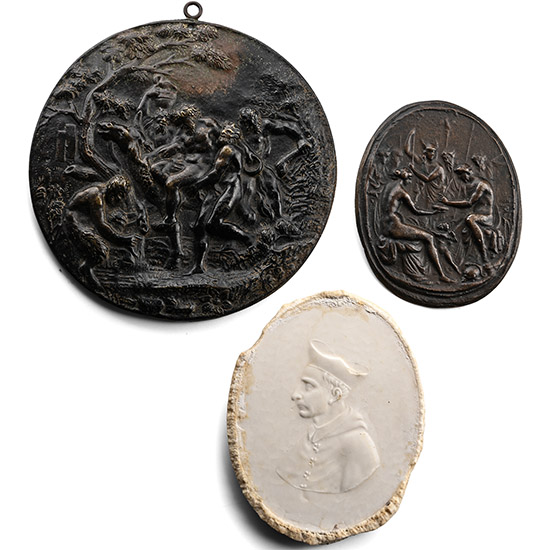
Post Medieval Bronze Plaque Collection
19th century A.D.Estimate: £50 - 70 (+bp*)
Opening Bid: £5
Comprising: elliptical type with mythic scene of nude Venus offering a bowl to Hercules, with Cupid below and Mercury to the rear; discoid type with a camel beneath a tree and three satyrs helping Silenus to ride it, all in a landscape; white plaster cast with bust of a Roman Catholic churchman wearing a biretta. 402 grams total, 8.1-12.6 cm
Acquired on the UK art market. Property of a Suffolk, UK, gentleman. -
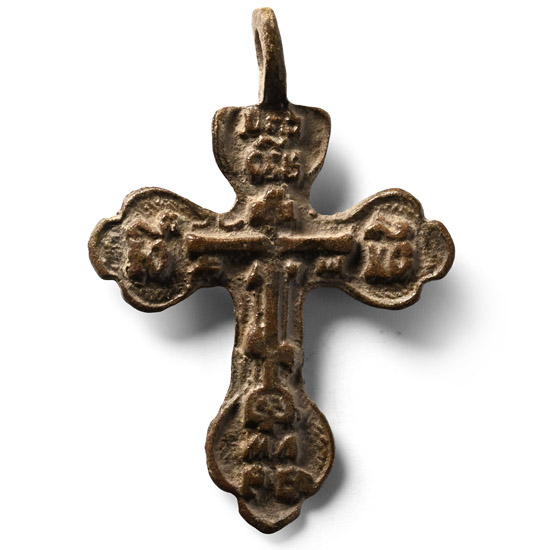
Eastern European Orthodox Bronze Cross Pendant
17th-18th century A.D.Estimate: £30 - 40 (+bp*)
Opening Bid: £5
Cross pommy pendant with integral pierced lug, low-relief crucifixion scene with monogram to each arm. 3.05 grams, 43 mm
Acquired from Chris Martin-Zakheim, Iconastas, 5 Piccadilly Arcade, London SW1. From the private collection of a West London, UK, gentleman, formed since the early 2000s. -
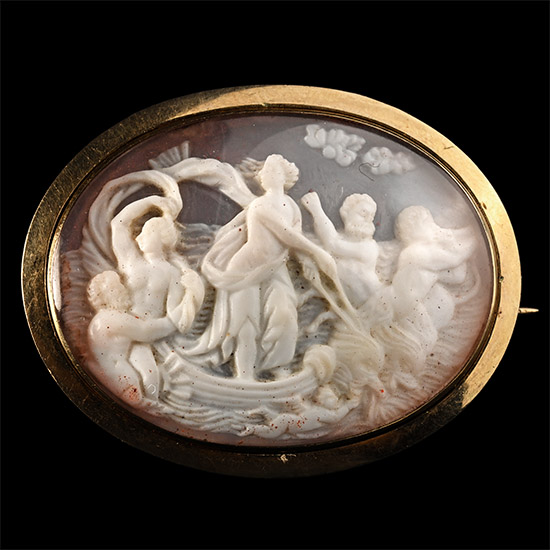
Renaissance Shell Cameo of the Triumph of Galatea, after Raphael, in a Later Gold Brooch
Circa 1530–1560 A.D.Estimate: £1,800 - 2,400 (+bp*)
Opening Bid: £900
An oval cameo carved in high relief in shell, with opaque white figures against a pale grey-lilac ground, depicting the Triumph of Galatea, the composition centering on the partially draped sea nymph standing in a shell-shaped marine chariot, surrounded by a closely arranged procession of Tritons, Nereids and fantastic sea creatures, on the left, a marine figure and companion incorporated among the curling drapery and sea forms; immediately to the right of Galatea a prominently modelled bearded Triton, while a further male marine figure projecting forwards at the far right, the curved, ribbed vehicle beneath the principal figure represents her shell chariot; the small forms in the upper field may represent remnants of the airborne putti included in the engraved compositions; the cameo enclosed beneath a high convex glass cover in a plain gold brooch mount, a narrow bezel around the oval perimeter, and a long projecting brooch pin, the gold mount probably British, early 19th century. 11.6 grams, 40 mm
Acquired on the European art market. UK, private collection. This lot has been checked against the Interpol Database of stolen works of art and is accompanied by search certificate no.13507-263384.
The subject derives from Raphael’s Triumph of Galatea, painted for Agostino Chigi at the Villa Farnesina in Rome around 1512. Raphael represented Galatea amid a marine procession of Tritons and Nereids, combining classical imagery with a treatment of the subject associated with Angelo Poliziano’s Stanze per la Giostra. The composition was rapidly disseminated through prints, which made it available to artists and craftsmen working beyond Rome. Uffizi Galleries, The Triumph of Galatea. The Royal Collection preserves an Italian cameo, dated to the late 16th century, depicting a putto in a shell-shaped chariot drawn through the waves by a Triton carrying a Nereid. That cameo was subsequently placed in an 18th-century mount. It provides a related example for both Renaissance marine imagery and the later mounting of an earlier carving as a jewel. Royal Collection Trust, Putto, Triton and Nereid, RCIN 43770. The present cameo combines an ambitious multifigure relief with a composition derived from Raphael’s Galatea and its engraved adaptations.
