
Loading, please wait...
LOT 0457
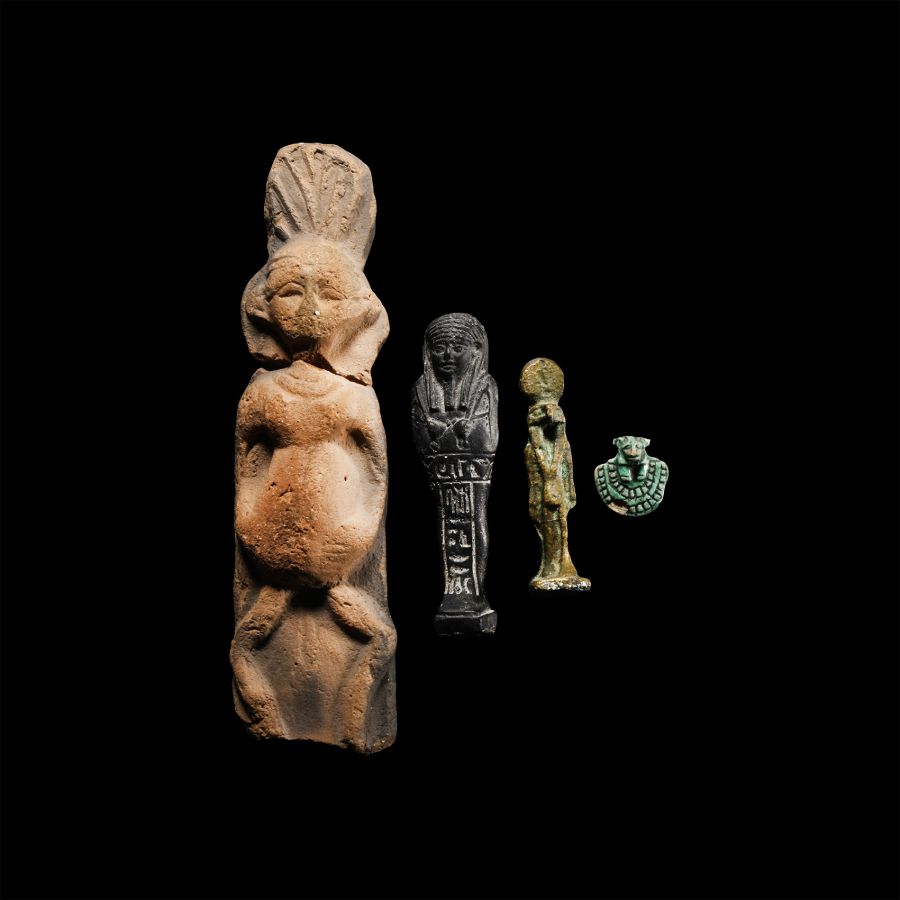
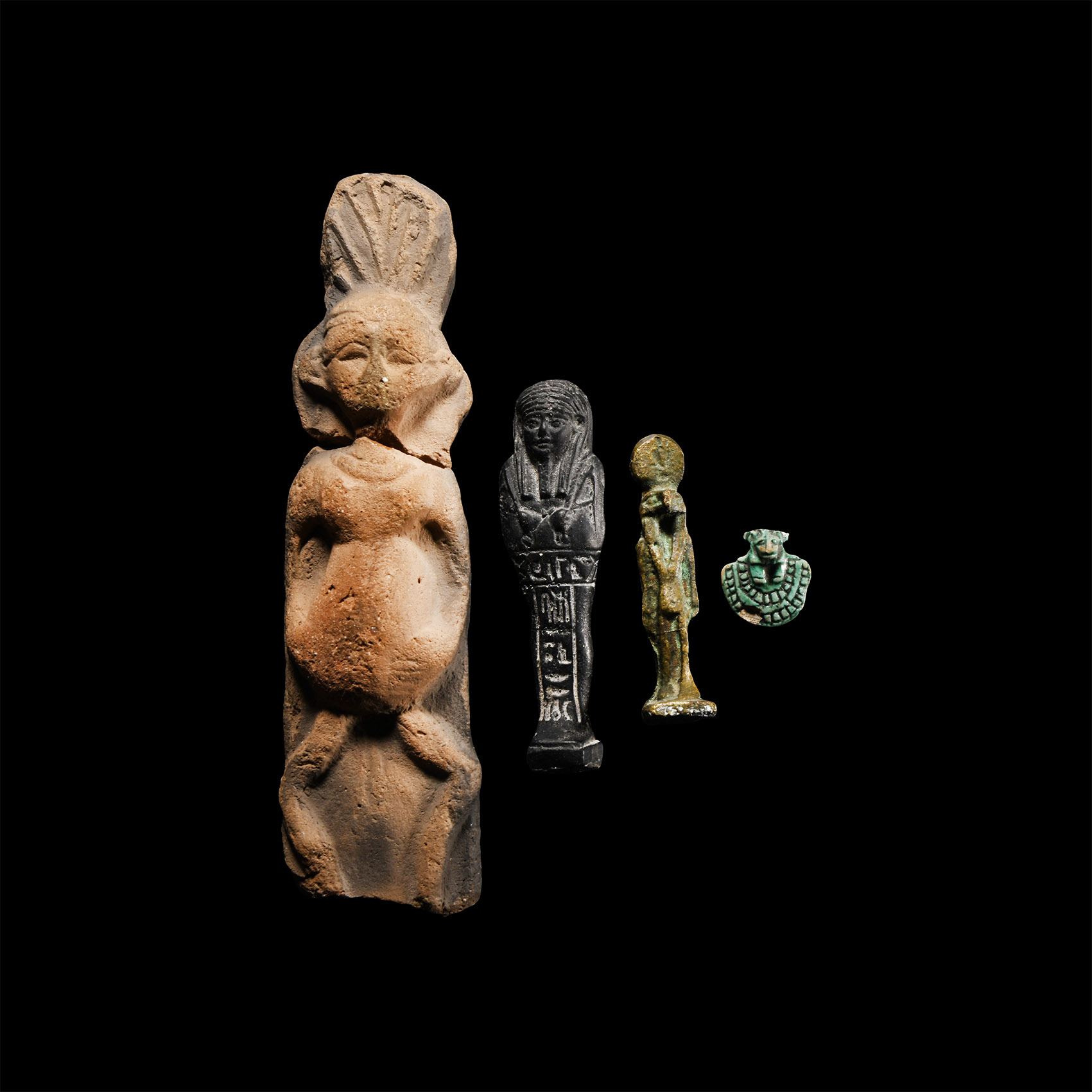
Egyptian Style Figurine Collection
20TH CENTURY A.D. AND EARLIER
3/4 - 5 1/8 in. (134 grams total, 1.8 - 13.1 cm).
Comprising: a small composition shabti with T-shaped inscription giving the dedication: sḥḏ wsꞽr ḥm-nṯr pꜢ-di…..? ms n Ꜣst-ꞽr.s mꜢʾ ḫrw ‘The illuminated, the Osiris, God’s Servant, Pa-di.....(?), born to Isis-ires true of voice’; bronze Horus with sun disc and lappet wig; accompanied by two after the antique items: figure of Bes with feather headdress and a composition aegis plaque. [4, No Reserve]
ProvenanceAcquired from a private UK collection in the late 1990s.
Private collection of Mr T.H., Norfolk, UK.
TimeLine Auctions follows a vetting process to ensure the authenticity and legality of all items, reinforcing our commitment to integrity and responsible trading. Each antiquity, antique, and coin lot undergoes thorough examination by a vetting committee of at least ten external specialists, professional trade association members, scientists, and archaeologists: Our Vetting Process
AUCTIONS:
TimeLine is a leading auction house specialising in antiquities, ancient art, collectables, natural history, coins, medals, and books. Our auctions offer museums, collectors, historians, and enthusiasts the opportunity to acquire unique and historically significant pieces.
-
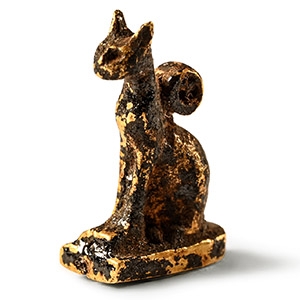
Egyptian Gold God Bastet Cat Amulet
Late New Kingdom, 1070-900 B.C.Sold for (Inc. bp): £650
Modelled seated on a tongue-shaped base, with simple facial detailing and suspension loop to the back. 0.52 grams, 8 mm
From an early 20th century French collection.
The goddess Bastet was believed to be the daughter of the sun god and was shown with the features of a lion up until about 1000 B.C. when she was portrayed as a cat or human with a cat head. As the daughter of Ra she was associated with the rage inherent in the sun god's eye which was considered to be his instrument of vengeance. Her development into a cat goddess occurred during the New Kingdom but did not fully develop until the Late Period. She was still associated with the destructive power of the sun and was shown on the prow of the solar boat, decapitating the evil serpent Apophis in the Book of the Dead. The maternal, protective and hunting characteristics of the cat are obvious in Bastet and she was seen as a protector of pregnant women and young children. In the Pyramid Texts she is invoked by the deceased king to act as his protector and to help him reach the sky to join the sun god; the king proclaims that Bastet is his mother and nurse. Like her counterpart, Sekhmet, Bastet has an aggressive side and, in a text from Karnak, Amenhotep II described his enemies being slaughtered like the victims of Bastet. The goddess had a shrine at Karnak, where she is known as the 'Lady of Asheru' which aligns her closely with the goddess Mut, the consort of Amun-Ra. Her most famous shrine was in the north-east Delta region, at Bubastis, and was known as Per-Bastet or 'the House of Bastet.' Herodotus describes the festival of Bastet as one of the most elaborate in all of Egypt and identifies her with the Greek Artemis. Cemeteries of cats have been excavated at Bubastis and at Saqqara and Memphis. -
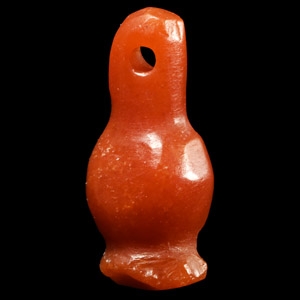
Egyptian Orange Carnelian Poppy Head Amulet
New Kingdom, 18th Dynasty, 1550-1292 B.C.Sold for (Inc. bp): £98
Polished and with integral suspension loop. 0.3 grams, 11 mm
UK gallery, early 2000s. -
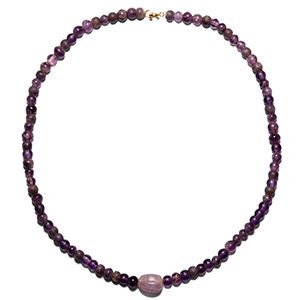
Egyptian Amethyst Bead Necklace with Scaraboid
Middle Kingdom, 2010-1961 B.C. and laterEstimate: £600 - 800 (+bp*)
Opening Bid: £325
Restrung using oblate amethyst beads, lavender-coloured scaraboid to the centre with incised anatomical detailing; modern clasp. 28.7 grams, 47 cm long
Acquired 1930-1940. From an early 20th century collection, London, UK.
