
Loading, please wait...

LOT 0572
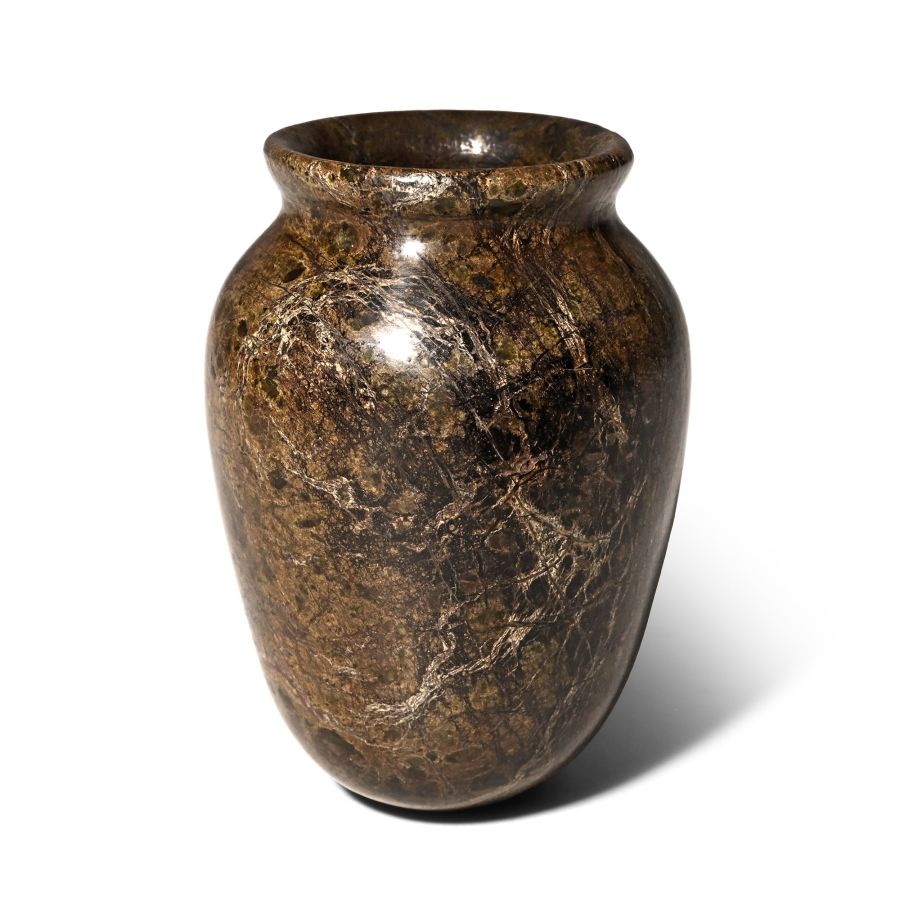
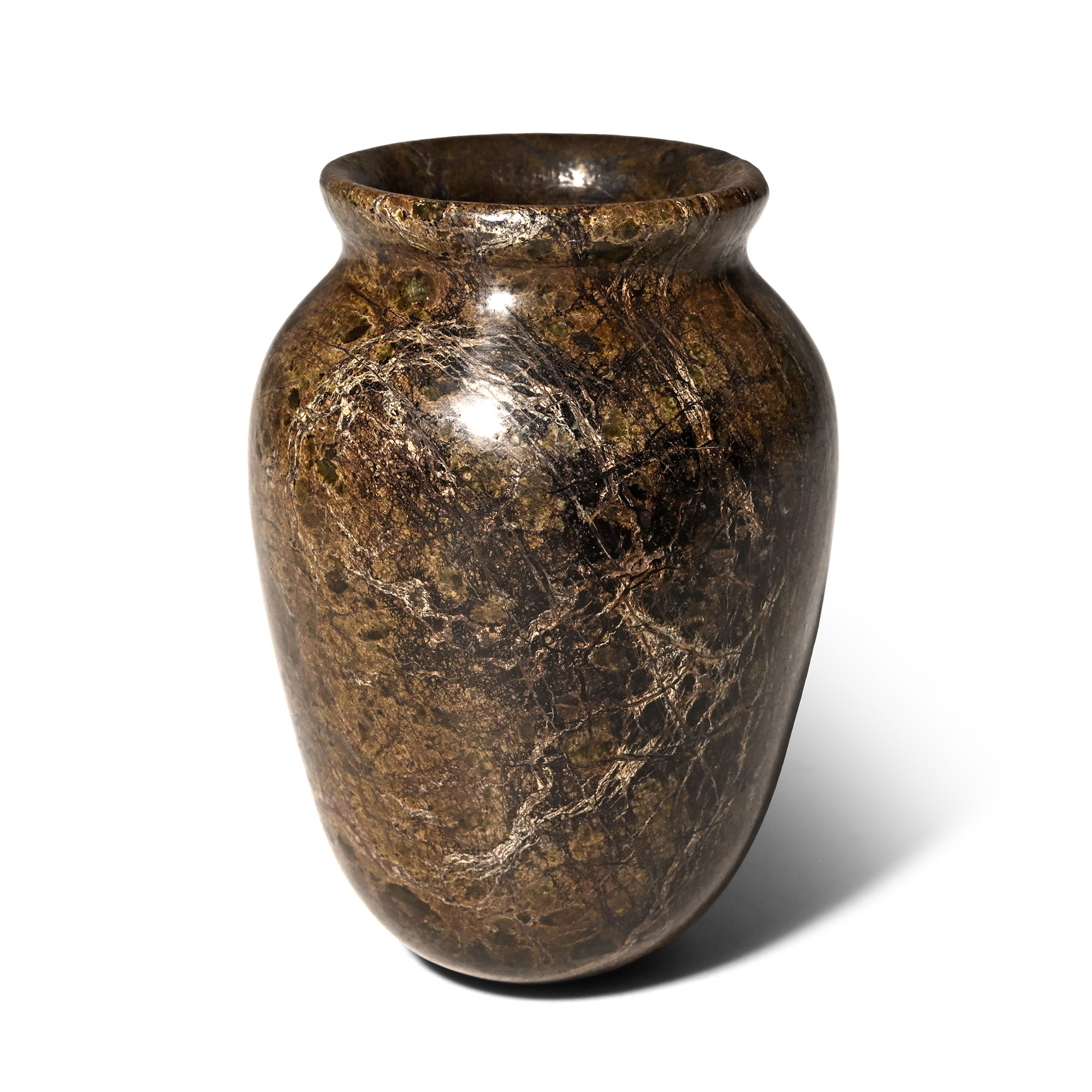
Egyptian Stone Round-Bottomed Kohl Jar
NAQADA II-III PERIOD, CIRCA 3500-3000 B.C. OR LATER
3 in. (179 grams, 78 mm).
Ovoid in profile with flared rim to the mouth.
ProvenanceEx Belinda Elliston collection, a member of the Egyptian Exploration Society, 1940s onwards.
LiteratureCf. El-Khouli, Egyptian Stone Vessels: Predynastic Period to Dynasty III, vol.3, London, 1974, pl. 76, no. 1896, for the type.
CONDITIONTimeLine Auctions follows a vetting process to ensure the authenticity and legality of all items, reinforcing our commitment to integrity and responsible trading. Each antiquity, antique, and coin lot undergoes thorough examination by a vetting committee of at least ten external specialists, professional trade association members, scientists, and archaeologists: Our Vetting Process
AUCTIONS:
TimeLine is a leading auction house specialising in antiquities, ancient art, collectables, natural history, coins, medals, and books. Our auctions offer museums, collectors, historians, and enthusiasts the opportunity to acquire unique and historically significant pieces.
LOT 0572
Egyptian Stone Round-Bottomed Kohl Jar
Estimate £400 - 600€460 - 700 (for guidance only)$540 - 810 (for guidance only)
-
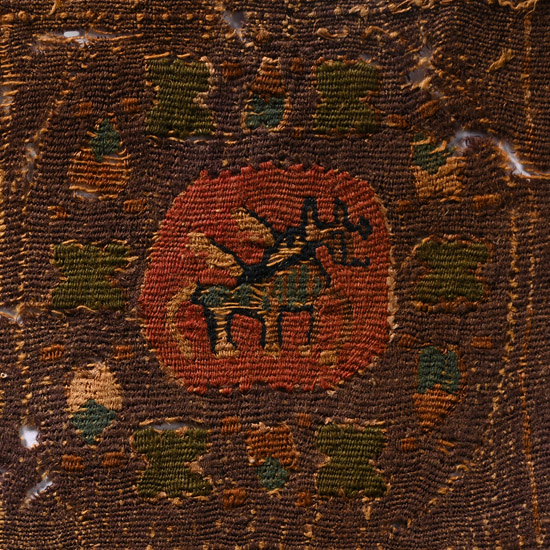
Egyptian Coptic Textile Fragment of a Tunic Tablion with Pegasus
Circa 7th century A.D.Estimate: £40 - 60 (+bp*)
Bids: 1 | Current Bid: £5
In natural wool in shades of light brown, yellow, green, blue, and red with S-twist yarn, depicting the figure of Pegasus within a central medallion, surrounded by geometric and vegetal motifs; borders ornamented with meanders. 1.3 grams, 10.5 cm
Acquired 1970s-1996. Property of a North American collector. London collection, 2016.
The tabula, or tablion, was a square embroidery used to decorate tunics or mantles. The central figure is a rare representation of the winged horse Pegasus, a motif derived from Greek mythology, showing that classical iconography was still alive among the Christian Graeco-Roman people. -
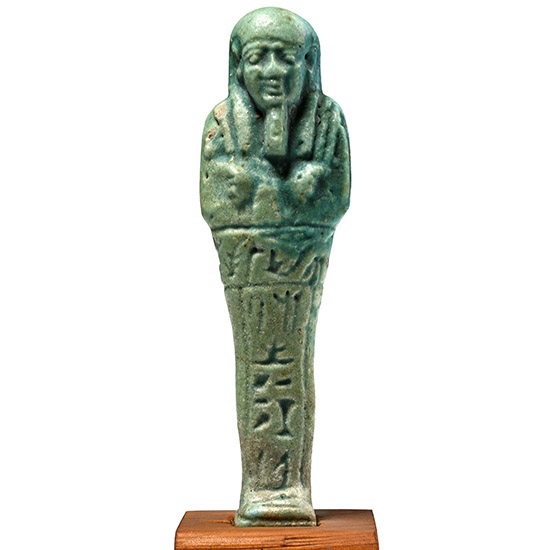
Egyptian Blue Glazed Faience Shabti of the Royal Scribe Aahmes
Persian Period, circa 6th century B.C.Estimate: £500 - 700 (+bp*)
Bids: 3 | Current Bid: £110
Mummiform figure wearing a lappet wig and long false beard, arms crossed over the chest; the left hand holds a pick, the right a hoe, and a cord from a small seed bag hangs over the shoulder; plain dorsal pillar; a T-form hieroglyphic text arrangement on the lower body, with the horizontal line reading: 'The illuminated one, the Osiris, the royal scribe Aahmes,' and the central column 'born to Hotep-Bastet, true of voice'; with a wooden display stand bearing the legend 'Ushabti of Aahmes, Royal Scribe, Persian period'. 44.7 grams, 10.7 cm (62.2 grams total, 12.2 cm including stand)
Acquired Herne Bay High Street, circa February 1957, for 2 shillings and sixpence. From the private collection of Peter Clayton, FCILIP, Dip, Arch, FSA, FRNS, Hemel Hempstead, Hertfordshire, UK; formed since the late 1950s. Accompanied by an old handwritten information card by Peter Clayton, collection no.4. -
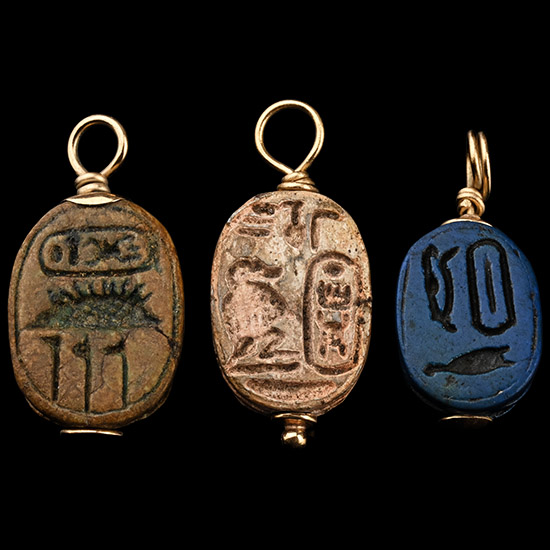
Egyptian Faience Scarabs with Gold Mounts
Late Period, 664-332 B.C. and laterEstimate: £400 - 600 (‡+bp*)
Opening Bid: £200
Comprising: a chestnut-coloured steatite scarab with a Thutmosis III cartouche and hieroglyphs on the underside; a tan-coloured faience scaraboid with a Thutmosis III cartouche on the convex obverse and the same cartouche with hieroglyphs, faced by a seated baboon, on the underside; offered with a modern blue scarab in a gold mount. 6.05 grams total, 22-25 mm
Private collection of Kal Noselson, New York, acquired between 1976 and the late 1990s; thence by descent. Accompanied by the collector's original inked images.
