
Loading, please wait...


LOT 0415
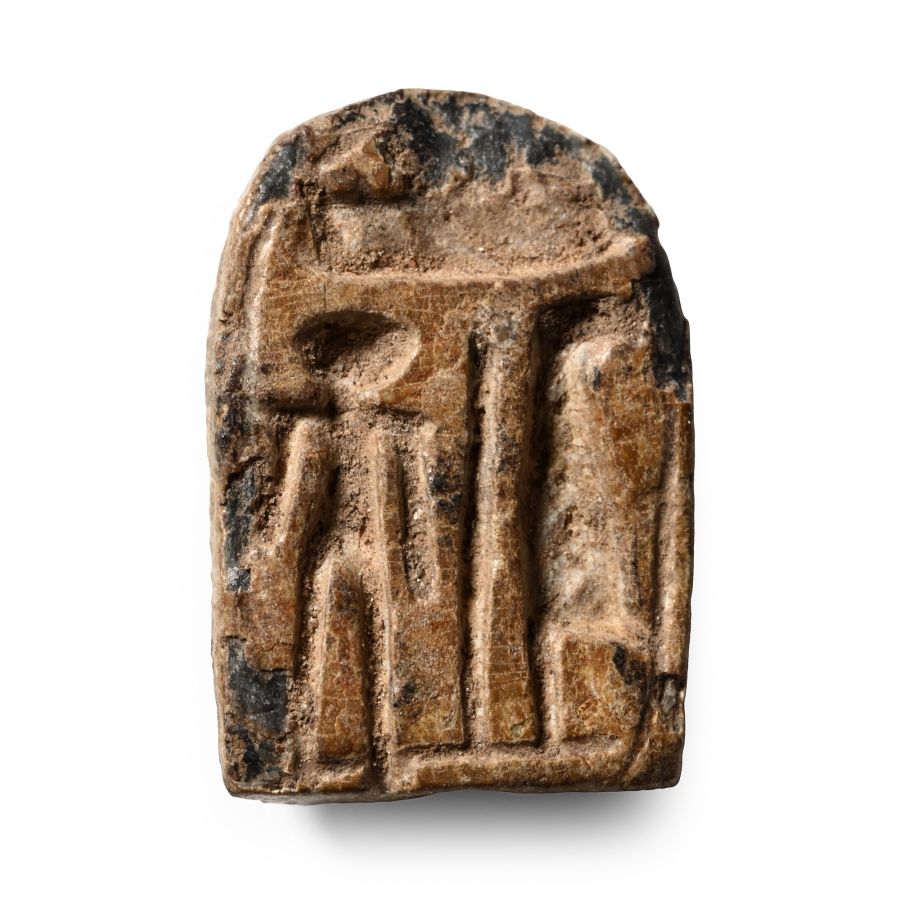
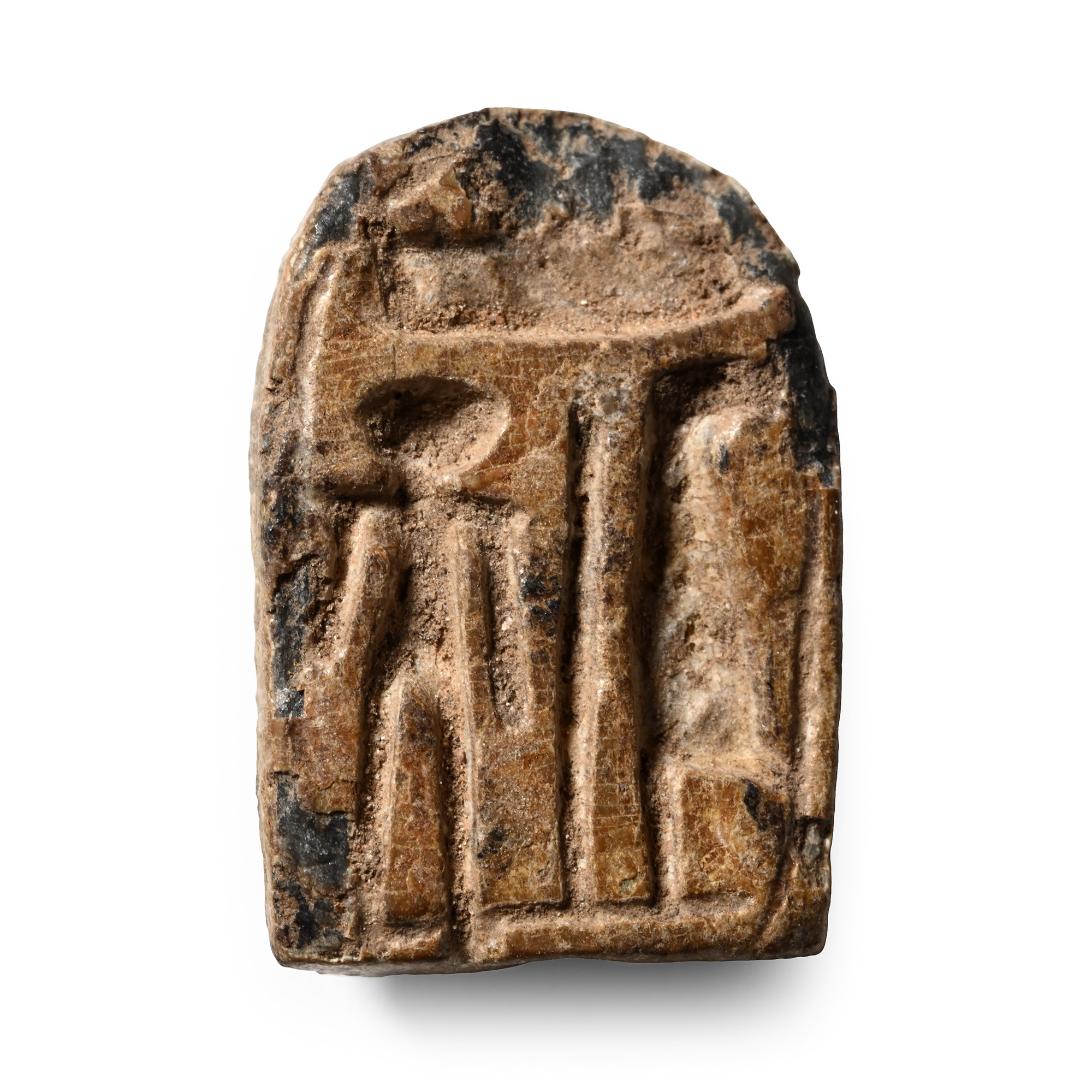
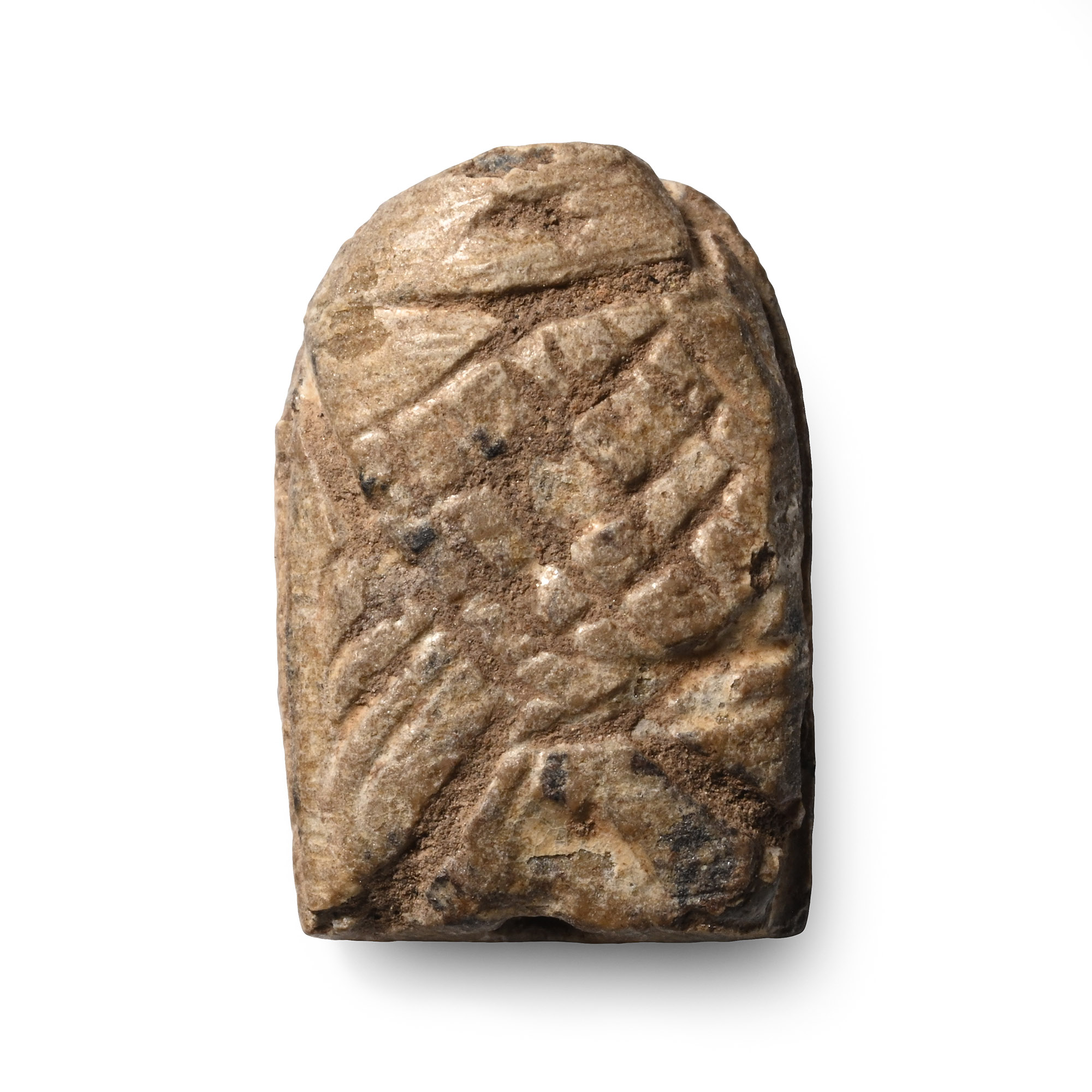
Egyptian Steatite Tilapia Fish Plaque Amulet
LATE PERIOD, 664-332 B.C.
5/8 in. (1.72 grams, 16 mm).
The domed upper face shaped as a fish with scale detailing, the underside has three hieroglyphs consisting of a men (draughtboard) sign, with a figure of a standing deity wearing a sun-disc crown next to a large Maat feather to the right, pierced longitudinally.
ProvenanceEx Mustaki collection, early 20th century, UK.
Accompanied by a previously illustrated catalogue card with provenance.
Cf. Andrews, C., Amulets of Ancient Egypt, London, 1994, p. 41, for a discussion of fish amulets.
FootnotesFish amulets symbolised regeneration.
CONDITIONTimeLine Auctions follows a vetting process to ensure the authenticity and legality of all items, reinforcing our commitment to integrity and responsible trading. Each antiquity, antique, and coin lot undergoes thorough examination by a vetting committee of at least ten external specialists, professional trade association members, scientists, and archaeologists: Our Vetting Process
AUCTIONS:
TimeLine is a leading auction house specialising in antiquities, ancient art, collectables, natural history, coins, medals, and books. Our auctions offer museums, collectors, historians, and enthusiasts the opportunity to acquire unique and historically significant pieces.
-
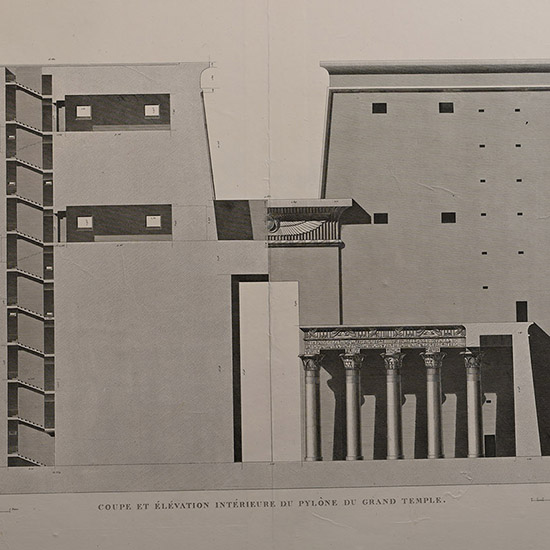
Very Large Egyptian Expedition Lithograph of the Temple of Edfou
Early 19th century A.D.Sold for (Inc. bp): £94
Proof etching on laid paper of plate 52 from Vol.I of Description de l'Égypte : ou, Recueil des observations et des recherches qui ont été faites en Égypte pendant l'expédition de l'armée française, titled Edfou (Apollinopolis Magna) Coupe et élévation intérieure du pylône du grand temple. 230 grams, 105.5 x 69 cm
From the collection of a North American priest. Acquired between 1981-1996. Property of a North American collector.
Produced between February 1802 and 1830 on the orders of Napoleon Bonaparte; published between 1809 and 1828. Just 1,000 copies were distributed to various institutions, printed on laid paper with an 'Égypte ancienne et moderne' watermark. The book is subtitled Recueil des observations et des recherches qui ont été faites en Égypte pendant l’expédition de l’Armée française, publié par les ordres de Sa Majesté l’Empereur Napoléon le Grand (Gathering of observations and discoveries which were made in Egypt during the expedition of the French army, published on the orders of His Majesty the Emperor Napoleon the Great). It was the world's first encyclopedia devoted exclusively to the remains of ancient Egypt. The plates of this book are the first to present the archaeological sites of Thebes (Luxor). The temple at Edfu in Upper Egypt is dedicated to Horus and was built during the Ptolemaic Period. It remains one of the best-preserved temples in Egypt. -
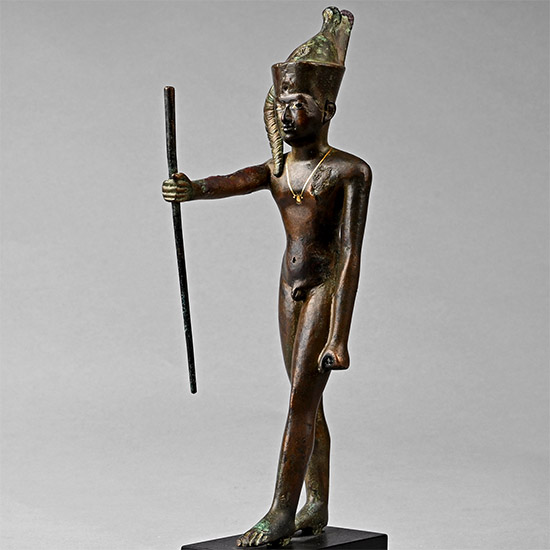
Large Egyptian Bronze Statue of the God Ihy with Gold Necklace and Silver Inlaid Eyes
Late Period, 664-332 B.C.Sold for (Inc. bp): £20,800
Depicted nude in an advancing pose; silver inlaid eyes, braided sidelock of youth; left hand by his side, drilled to accept a separate element, the other outstretched at a right angle to his body, holding a tapering cylindrical staff, not belonging; he may originally have held a sistrum, an ancient Egyptian percussion instrument, or a menat, both closely associated with the goddess Hathor; here, Ihy wears the Pschent crown with remains of uraeus, and an inlaid gold necklace suspended with an ib pendant around his neck; finely detailed facial features, with engraved Nekhbet vulture with outspread wings at the back of the crown; integral lugs on soles of feet; mounted on a custom-made stand. 899 grams total, 25 cm including stand
From the Singer family collection, Germany, acquired circa 1962. with A.A.L., Geneva, 1980. with Christie's, London, 25 April 2015, no.163 [£50,000-£70,000]. Private collection, London, UK. Accompanied by copies of the relevant Christie's catalogue pages. This lot has been checked against the Interpol Database of stolen works of art and is accompanied by search certificate number no.13309-258229.
Ihy was an Egyptian god associated with music, joy, and ritual celebrations, particularly as the divine child of Hathor and of Horus or Ra. He is typically depicted as a youthful figure, often naked or lightly clothed, wearing a sidelock of youth and carrying a sistrum or menat, both percussion instruments closely connected with ritual performances in Hathor's cult, especially at the temples of Dendera and Edfu. His name is generally understood to mean 'the musician' or 'the one who plays music,' although it may also mean 'calf', a reference to his relationship with the cow-goddess Hathor. Bronze statuettes of Ihy, such as this example, were probably produced as votive offerings dedicated in temples, especially those devoted to Hathor. Worshippers may have commissioned such figures in the hope of obtaining divine favour, protection, fertility, healing, or participation in the blessings linked with music and festivity. Some examples may also have served as cult images used in temple ceremonies or as protective objects placed in domestic or funerary settings. -
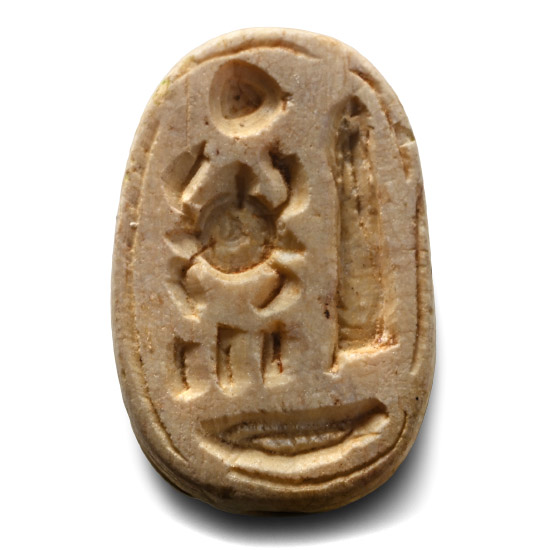
Egyptian Steatite Scarab
Late Period, 664-332 B.C.Sold for (Inc. bp): £208
Anatomical detailing on the carapace and the body is pierced longitudinally, with five hieroglyphic signs on the underside. 2 grams, 16 mm
From the private collection of a European gentleman (1942-2024), formed since the 1970s.
The three hieroglyphs on the left side, together with the bottom sign, spell out the throne name of Tutankhamun (Neb-kheperu-Ra), although the long sign to the right, resembling a reed leaf or Maat feather, indicates that it may be a good luck legend, perhaps interpreted as 'True Lord of Manifestations is Ra'.
