
Loading, please wait...
LOT 0585
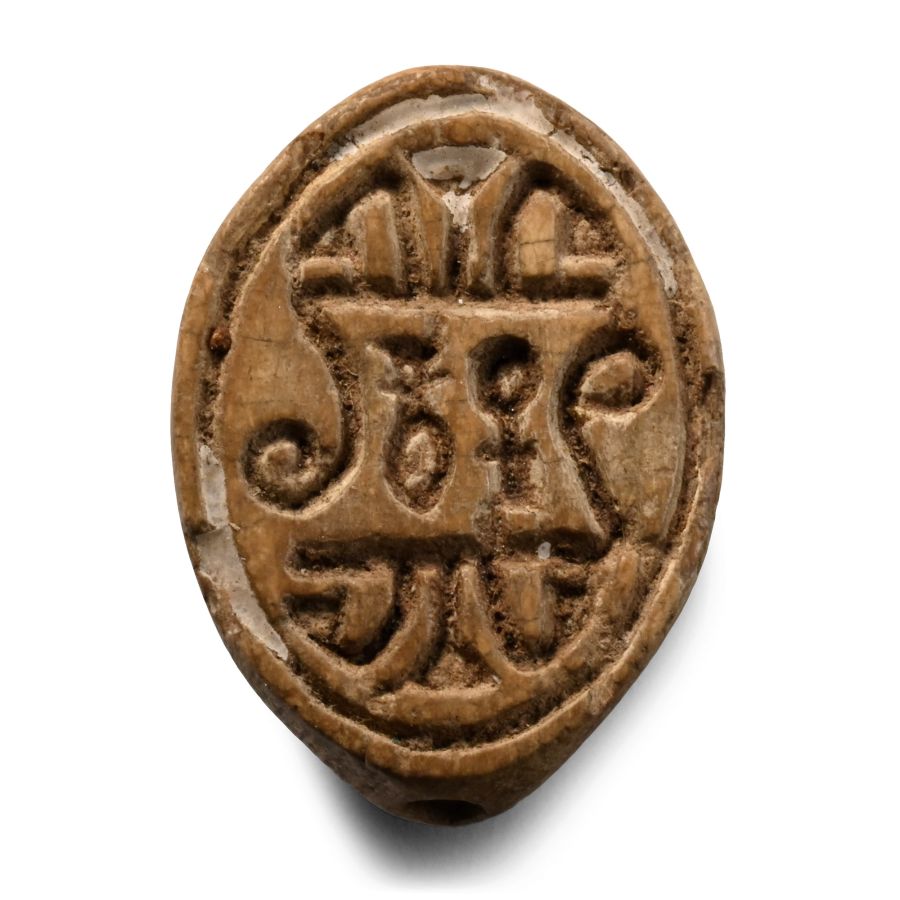
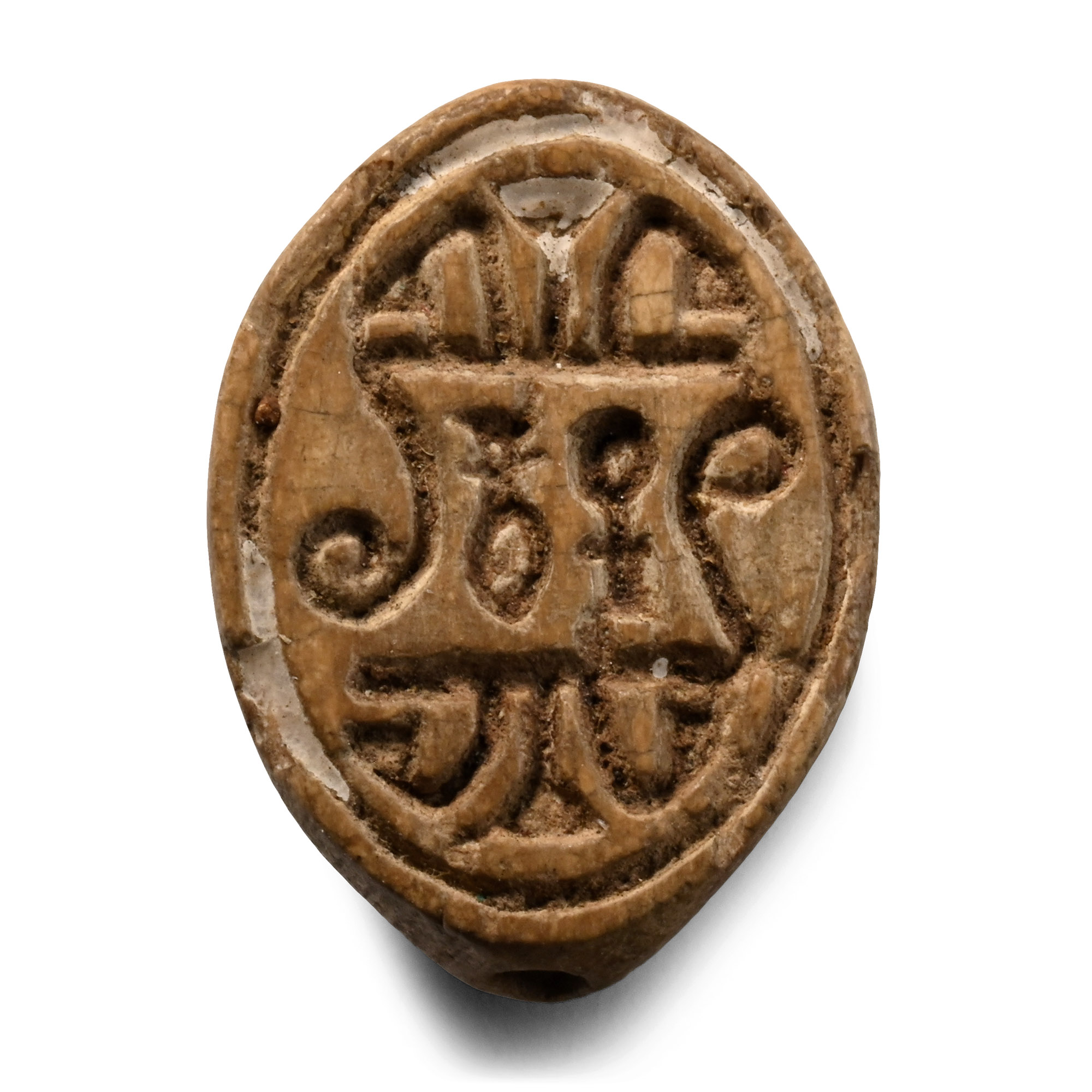
Egyptian Steatite Scaraboid Amulet with Hieroglyphs
HYKSOS PERIOD-EARLY NEW KINGDOM, CIRCA 1782-1500 B.C.
3/4 in. (2.36 grams, 20 mm).
Plano-convex in section, underside with nfr and ankh hieroglyphs meaning 'good life', with a stylised lotus plant motif above and below. [No Reserve]
ProvenanceExcavated from Egypt in 1914.
From the private collection of Mr David Sams and his wife, Elizabeth Kate Sams, gentry and amateur archaeologists who travelled to Egypt in 1914 with their daughter, Ethel. Mr Sams and his wife led digging expeditions from which these items come, from the family estate of Mr and Mrs Sams, by direct descent to their granddaughter.
TimeLine Auctions follows a vetting process to ensure the authenticity and legality of all items, reinforcing our commitment to integrity and responsible trading. Each antiquity, antique, and coin lot undergoes thorough examination by a vetting committee of at least ten external specialists, professional trade association members, scientists, and archaeologists: Our Vetting Process
AUCTIONS:
TimeLine is a leading auction house specialising in antiquities, ancient art, collectables, natural history, coins, medals, and books. Our auctions offer museums, collectors, historians, and enthusiasts the opportunity to acquire unique and historically significant pieces.
LOT 0585
Egyptian Steatite Scaraboid Amulet with Hieroglyphs
Estimate £40 - 60€46 - 70 (for guidance only)$54 - 81 (for guidance only)
-
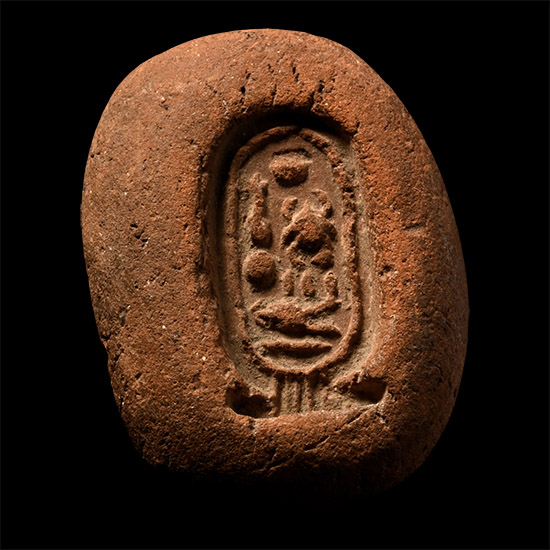
Egyptian Terracotta Mould with Impression of the Cartouche of Pharaoh Akhenaten
New Kingdom, 18th Dynasty, Amarna Period, 1353-1332 B.C.Estimate: £400 - 600 (+bp*)
Bids: 6 | Current Bid: £220
Rounded tongue-shaped mould with an impressed cartouche containing the throne name of Akhenaten, Nefer-kheperu-Re (meaning 'Beautiful are the Manifestations of Re'). 4.26 grams, 25 mm
Acquired 7th February 1962, for 5 shillings. From the private collection of Peter Clayton, FCILIP, Dip, Arch, FSA, FRNS, Hemel Hempstead, Hertfordshire, UK; formed since the late 1950s. Accompanied by an old handwritten information card by Peter Clayton, collection no.86.
Moulds like this were used to produce faience amulets or inlays bearing the pharaoh's cartouche. Akhenaten's throne name, Nefer-kheperu-Re, remained unchanged throughout his reign, while his birth name changed from Amenhotep IV ('Amun is satisfied') to Akhenaten ('Servant of the Aten'). -
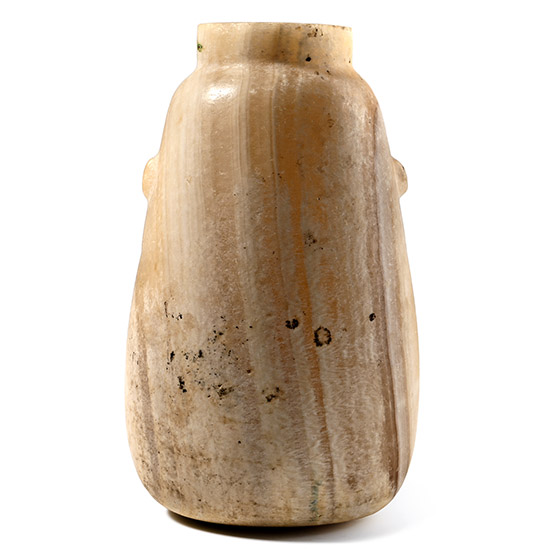
Large Egyptian Alabaster Alabastron
Late Period, 664-332 B.C.Estimate: £1,200 - 1,700 (‡+bp*)
Opening Bid: £650
Elongated vessel widening slightly towards the flat base with broad, cylindrical neck; vertical rim to the mouth, probably slightly reground; two lateral knob handles. 867 grams, 15.5 cm
Body intact. Some dark discolourations.
Acquired from Galerie Arete, Zurich, 15 April 1988. Ex private collection, Therwil, Switzerland.
The veining of the finely polished alabaster underscores the vessel’s form; the interior is smoothed, but the base lacks the same polish as the wall and was either reground or not polished in the first place. -
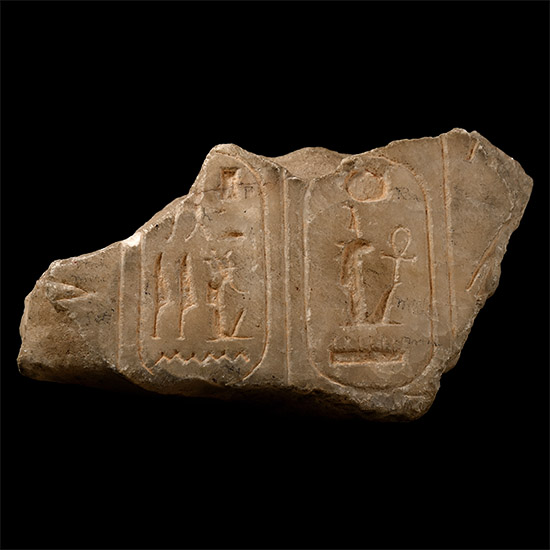
Egyptian Alabaster Fragment with Pharaoh Seti I's Cartouches
New Kingdom, 19th Dynasty, circa 1278 B.C.Estimate: £2,000 - 3,000 (+bp*)
Bids: 13 | Current Bid: £550
Thick section of alabaster with traces of four columns of hieroglyphs, including two partially preserved cartouches, one containing the birth name and epithet of Seti I, Seti mery-en-Ptah ('Seti, beloved of Ptah'), and the other his throne name, Men-Maat-Re ('Eternal is the justice of Re'). 526 grams, 13.8 cm
Received by gift from archaeologist Cyril Aldred, September 1964. From the private collection of Peter Clayton, FCILIP, Dip, Arch, FSA, FRNS, Hemel Hempstead, Hertfordshire, UK; formed since the late 1950s. Accompanied by an old handwritten information card by Peter Clayton, collection no.123. This lot has been checked against the Interpol Database of stolen works of art and is accompanied by search certificate no.13494-262900.
Peter Clayton's card suggests that the fragment may come from Seti's alabaster sarcophagus, the elaborately decorated lower half of which is in the John Soane Museum, London. The fragment may belong to the lid, which plunderers smashed in antiquity and which survives only in a relatively small number of fragments.
