
Loading, please wait...
LOT 0420
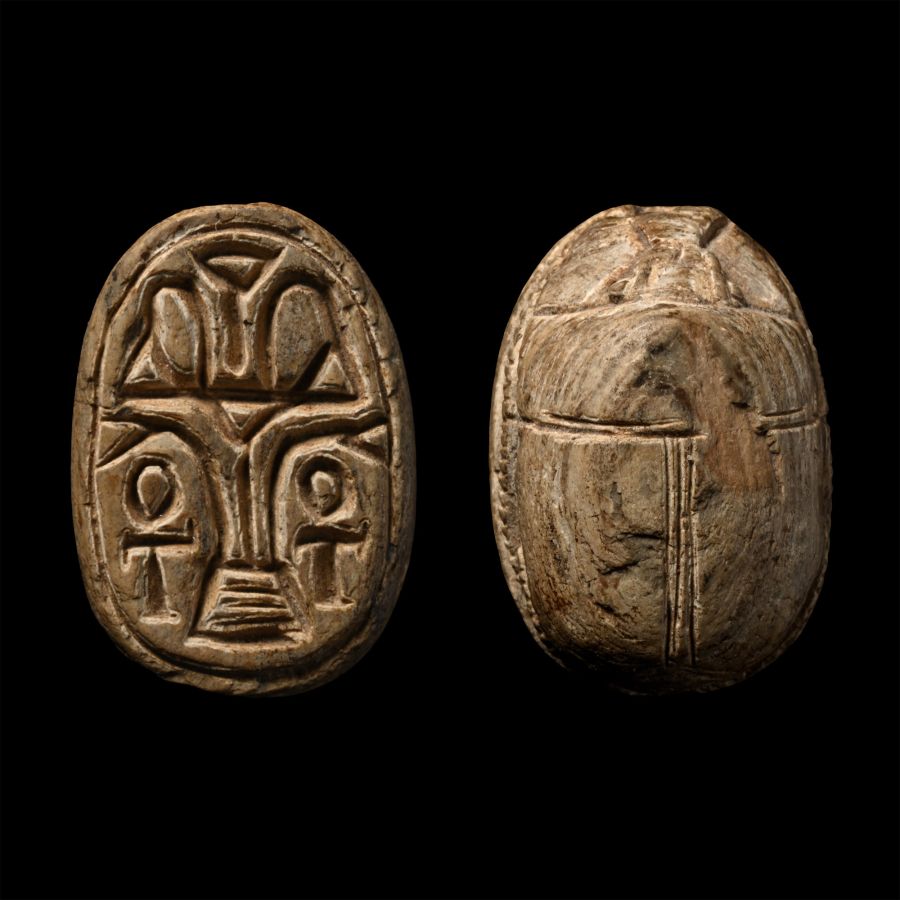
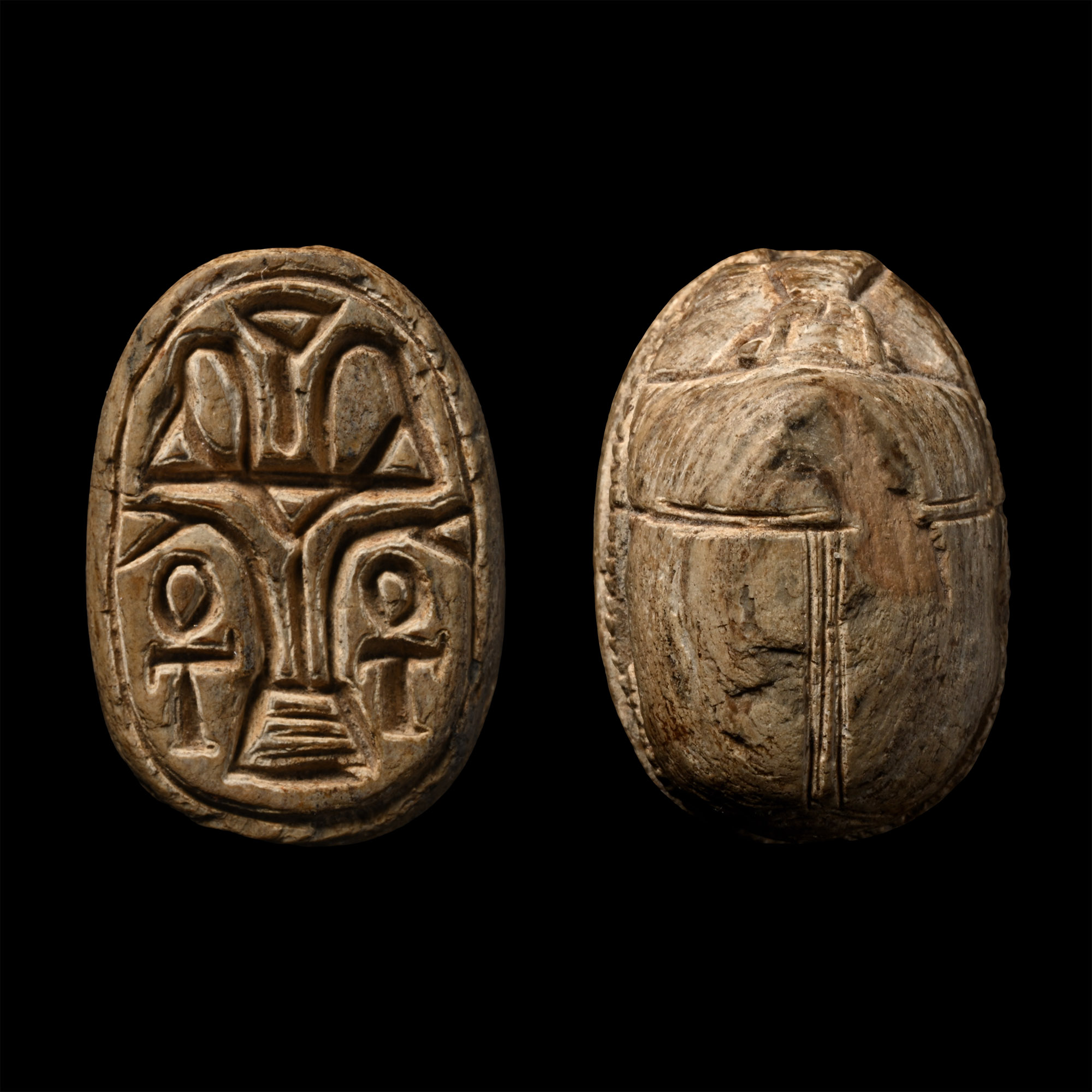
Egyptian Steatite Scarab
MIDDLE KINGDOM-SECOND INTERMEDIATE PERIOD, CIRCA 1900-1560 B.C.
7/8 in. (5.2 grams, 22 mm).
Plano-convex in section with segmented carapace and mouth parts; to the underside, the 'Sema-Tawy' central motif and two flanking ankh glyphs. [No Reserve]
ProvenanceFrom the collection of David Donlan (1947-2025), a dedicated and lifelong collector with a passion for the ancient world and the natural sciences, forming his collection from the 1960s onwards, using many reputable dealers across the United Kingdom, including the well-regarded Coincraft and The Parthenon Gallery.
FootnotesThe 'sema- tawy' is a powerful symbol representing the unification of Upper and Lower Egypt. It traditionally consists of a windpipe entwined with lotus and papyrus plants. The ankh signs are the Egyptian hieroglyphs for 'life'.
CONDITIONTimeLine Auctions follows a vetting process to ensure the authenticity and legality of all items, reinforcing our commitment to integrity and responsible trading. Each antiquity, antique, and coin lot undergoes thorough examination by a vetting committee of at least ten external specialists, professional trade association members, scientists, and archaeologists: Our Vetting Process
AUCTIONS:
TimeLine is a leading auction house specialising in antiquities, ancient art, collectables, natural history, coins, medals, and books. Our auctions offer museums, collectors, historians, and enthusiasts the opportunity to acquire unique and historically significant pieces.
-
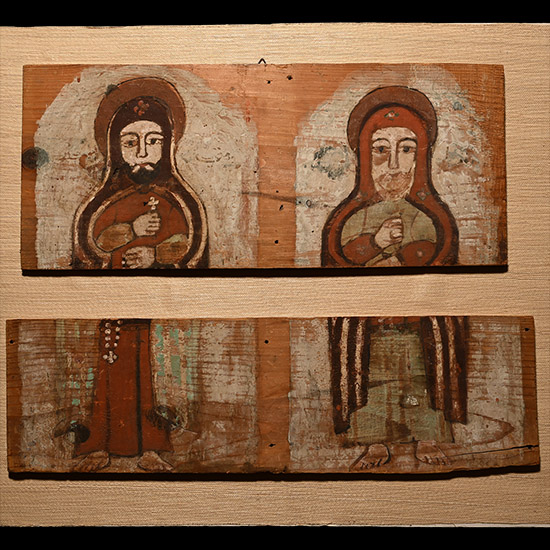
Late Coptic Panels Decorated with Two Standing Saints
17th-18th century A.D.Sold for (Inc. bp): £3,900
Two wooden panels showing two standing nimbate figures, probably Saint Daloucham on the right, wearing a red veil, and a bearded figure on the left, probably Saint Pachomius, holding a small cross and prayer beads; mounted on a fabric-covered backing board. 1.05 kg total, 65.2 x 50 cm
Leclere, Marseille, 20 April 2013, no.99. Private collection, UK. Accompanied by an academic report by Dr Raffaele D’Amato. This lot has been checked against the Interpol Database of stolen works of art and is accompanied by search certificate number no.12184-221677.
Stylistically, the icon can be compared to the paintings in the Church of St. Thomas in Achmim, which could also help identify one of the two saints. Especially important in this regard are the parallels between the robes of the saints and those of Saint Thomas in the church’s Doom, with long folds coloured with identical colours; the floral decoration of the sleeves of the inner tunic, and the faces of the Saints, with oval and widened eyes. The influence of Ethiopian paintings of the same period is evident in the Church of Achmim, like in this icon. The painting preserves the distant memory of medieval paintings, through a Coptic cultural humus whose vestiges are still today in Egypt, Nubia and Ethiopia. In the Church of Achmim are represented the martyrs of Achmim, i.e. Saint Pachomius and his sister Saint Daloucham. It is not impossible that one of the represented ascetic monks could be Pachomius. It is also probable that the icon was part of a wider group, representing also other important characters of the Coptic Church. -
.jpg)
Egyptian Bronze Seated Cat Statuette
Late Period, 664-332 B.C.Estimate: £600 - 800 (+bp*)
Opening Bid: £333
Bastet in crouching pose with her tail wrapped close to right side of her body, seated on a tongue-shaped base, with a suspension loop on the creature’s back. 90 grams, 55 mm
Acquired on the UK art market, 1990s. Private collection, New York, USA. -
.jpg)
Very Large Egyptian Expedition Lithograph of the Hypogees Papyrus Manuscript from Thebes
Early 19th century A.D.Estimate: £80 - 100 (+bp*)
Opening Bid: £40
Proof etching on laid paper of plate 68 from Vol .II of Description de l'Égypte : ou, Recueil des observations et des recherches qui ont été faites en Égypte pendant l'expédition de l'armée française. entiled Thèbes. Hypogées. Manuscrit sur papyrus. 256 grams, 104 x 68.5 cm
From the collection of a North American priest. Acquired between 1981-1996. Property of a North American collector.
Produced between February 1802 and 1830 on the orders of Napoleon Bonaparte; published between 1809 and 1828. Just 1,000 copies were distributed to various institutions, printed on laid paper with an 'Égypte ancienne et moderne' watermark. The book is subtitled Recueil des observations et des recherches qui ont été faites en Égypte pendant l’expédition de l’Armée française, publié par les ordres de Sa Majesté l’Empereur Napoléon le Grand (Gathering of observations and discoveries which were made in Egypt during the expedition of the French army, published on the orders of His Majesty the Emperor Napoleon the Great). It was the world's first encyclopedia devoted exclusively to the remains of ancient Egypt. The plates of this book are the first to present the archaeological sites of Thebes (Luxor). The papyrus manuscript was recovered from an underground tomb chamber (hypogeum). The text is written in a cursive style of hieroglyphs known as hieratic.
