
Loading, please wait...
_900x900.jpg "Egyptian Steatite Scarab with Bes")
_200x200.jpg "Egyptian Steatite Scarab with Bes")
_900x900.jpg "Egyptian Steatite Scarab with Bes")
_200x200.jpg "Egyptian Steatite Scarab with Bes")
.jpg "Egyptian Steatite Scarab with Bes")
.jpg "Egyptian Steatite Scarab with Bes")
LOT 0455
Egyptian Steatite Scarab with Bes
LATE PERIOD, 664-332 B.C.
1 1/4 in. (10.7 grams, 31 mm).
Plano-convex in section with detailed obverse, the underside with the figure of Bes flanked by adoring baboons and sun discs.
ProvenanceEx London, UK collection, 1990s.
LiteratureCf. Matouk, F.S., Corpus du scarabée égyptien. Vol. 2: Analyse thématique, Beirut, 1976, p.345, no.584, for the baboon and Bes motif.
FootnotesBes became one of ancient Egypt's most popular apotropaic deities from the New Kingdom onwards. Despite his somewhat fearful appearance, Bes was the patron and protector of pregnant women and children and believed to protect the wearer from snakes. The depiction of baboons flanking Bes with their arms raised before the sun disk was a common feature on temple wall reliefs. In ancient Egyptian religious literature, baboons heralded the dawn and, thus, the rebirth of the sun.
CONDITIONTimeLine Auctions follows a vetting process to ensure the authenticity and legality of all items, reinforcing our commitment to integrity and responsible trading. Each antiquity, antique, and coin lot undergoes thorough examination by a vetting committee of at least ten external specialists, professional trade association members, scientists, and archaeologists: Our Vetting Process
AUCTIONS:
TimeLine is a leading auction house specialising in antiquities, ancient art, collectables, natural history, coins, medals, and books. Our auctions offer museums, collectors, historians, and enthusiasts the opportunity to acquire unique and historically significant pieces.
LOT 0455
Egyptian Steatite Scarab with Bes
Estimate £150 - 200€170 - 230 (for guidance only)$200 - 270 (for guidance only)
-
.jpg)
Egyptian Gold Uraeus Amulet
Late New Kingdom, 1070-900 B.C.Estimate: £250 - 350 (+bp*)
Opening Bid: £125
Depicting a rearing cobra sporting a sun disc with its coiled body below resting on the hieroglyphic neb sign. 0.38 grams, 11 mm
From an early 20th century French collection. -
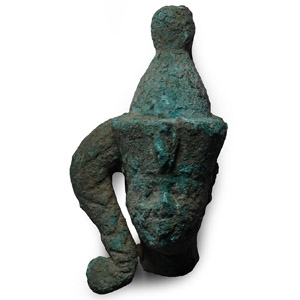
Egyptian Bronze Head of Harpocrates
Late Period, circa 664-332 B.C.Sold for (Inc. bp): £117
Head from a statuette of Harpocrates, wearing the Pschent crown fronted by uraeus, sporting the large plaited sidelock above the right ear. 86.5 grams, 60 mm
Acquired in the mid 1980s-1990s. Private collection, Switzerland, thence by descent. Private collection, since the late 1990s.
Harpocrates is the Greek rendering of the Egyptian Hor-pa-khered, meaning 'Horus the Child'. This title refers to Horus as the divine infant of Isis and Osiris. Wearing the amulet of Harpocrates was believed to offer the same protection that Isis gave her beloved son. -
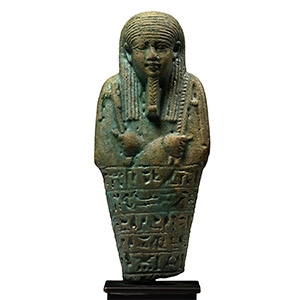
Very Large Egyptian Faience Shabti for Hor-Aset
Late Period, 664-322 B.C.Sold for (Inc. bp): £2,860
The upper part of a large mummiform shabti wearing a striated tripartite wig and long plaited divine beard, holding a pick in the left hand, the right hand holding a hoe and the cord of a seed bag hanging over his left shoulder; the face expertly modelled with carefully rendered cosmetic lines around the eyes, slightly smiling lips giving it a serene expression; plain back pillar terminating at the base of the wig; five horizontal rows of hieroglyphic inscription giving the dedication sḥḏ wsı͗r ḥr (-pn-n-) Ꜣst, ‘The illuminated one, the Osiris Hor (pen-en) Aset’ followed by a version of Chapter 6 from the Book of the Dead; mounted on a custom-made display stand. 509 grams total, 20 cm including stand
Ex Y.F. collection. Acquired in the US, 2011. with Medusa Ancient Art, Quebec. Private collection, Europe. This lot has been checked against the Interpol Database of stolen works of art and is accompanied by a search certificate number no.12374-226922.
