
Loading, please wait...
LOT 0527
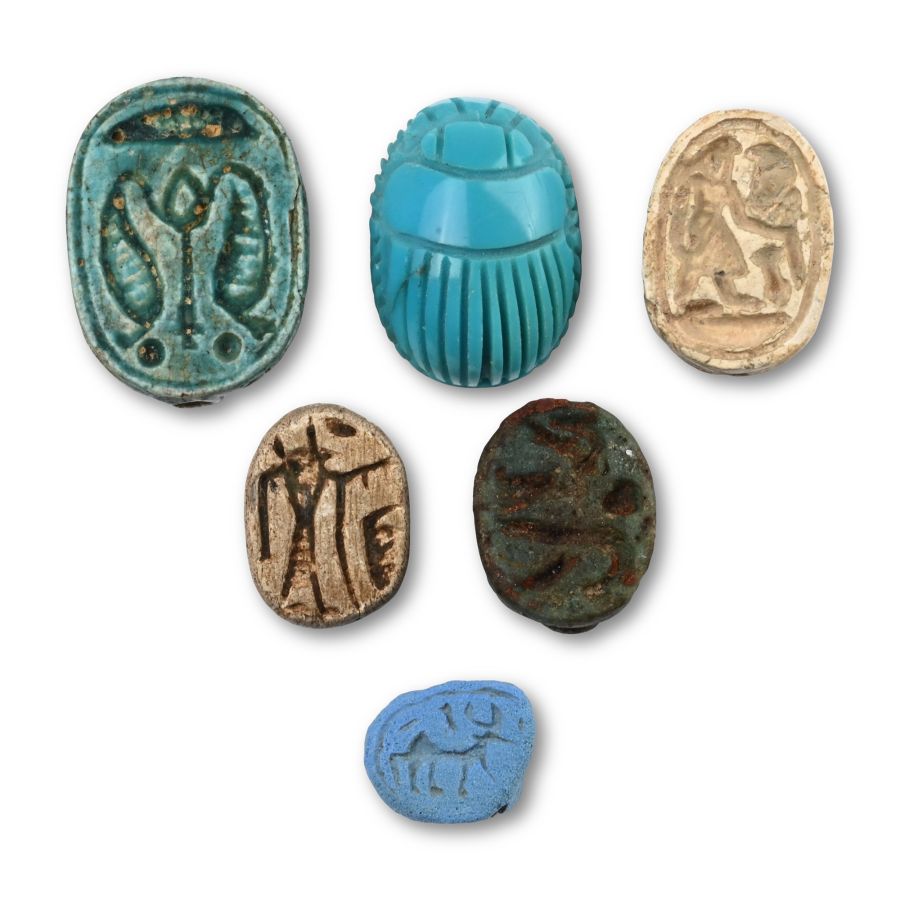
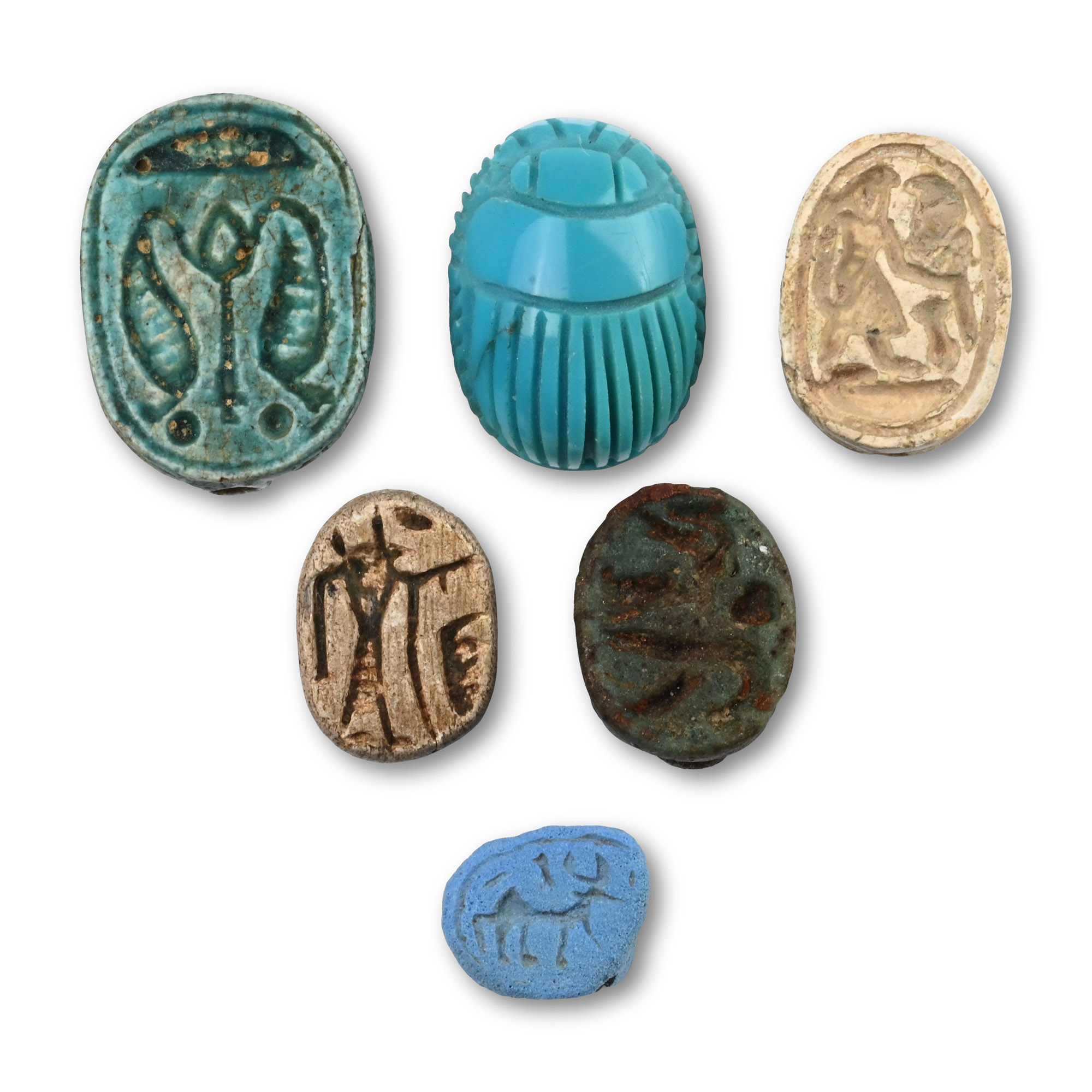
Egyptian Steatite Scarab Group
MAINLY LATE PERIOD, 664-332 B.C.
3/8 - 3/4 in. (11.7 grams total, 10-20 mm).
The designs include: a line border enclosing a central nefer sign, flanked by two rearing cobras with sun discs above, and a neb sign below; a turquoise scarab with deeply incised body detailing; a line border enclosing a striding figure before a cobra(?) and a nefer sign, with a neb sign below; a standing figure with a long staff and a sun disc above, facing an indeterminate object; indeterminate symbols with a sun disc above; and a quadruped with a long tail and erect ears or horns (possibly a jackal or an ibex). [6]
ProvenanceAcquired on the European art market in the early 2000s.
with Galerie Rhéa, Zurich, Switzerland.
This lot is accompanied by an illustrated lot declaration signed by the Head of the Antiquities Department, Dr Raffaele D'Amato.
TimeLine Auctions follows a vetting process to ensure the authenticity and legality of all items, reinforcing our commitment to integrity and responsible trading. Each antiquity, antique, and coin lot undergoes thorough examination by a vetting committee of at least ten external specialists, professional trade association members, scientists, and archaeologists: Our Vetting Process
AUCTIONS:
TimeLine is a leading auction house specialising in antiquities, ancient art, collectables, natural history, coins, medals, and books. Our auctions offer museums, collectors, historians, and enthusiasts the opportunity to acquire unique and historically significant pieces.
-
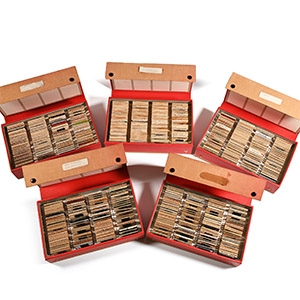
Historic Collection of 825 Slides of Archaeological Objects From Egypt
1960s-1980s A.D.Sold for (Inc. bp): £1,040
Housed in five linen-covered boxes, covering regalia, jewellery, chariots, daggers, bows, sticks, Old Kingdom sculpture, Saite sculpture, canopic, sarcophagi, Middle Kingdom and general objects etc. 4.43 kg total, 26.5 x 16.5 x 6.5 cm each box
Property of archaeologist Stephanie Gee, N.W. London, UK, 1960s-1980s. This lot is accompanied by an illustrated lot declaration signed by the Head of the Antiquities Department, Dr Raffaele D'Amato.
Stephanie Gee was a prominent archaeologist who took part in several expeditions in Egypt. She was a trusted assistant to the British-Australian archaeologist Veronica Seton-Williams, who excavated in Egypt, Britain, and the Near East. Stephanie also took part in the Tell El-Farâ'în expeditions of 1965-1968, and assisted Seton-Williams with preparing the 1966 expedition report. Their collaboration continued and Stephanie helped with the manuscript of Seton-Williams’ book ‘The Road to El-Aguzein’, a narrative account of her life that was first published in 1988. -
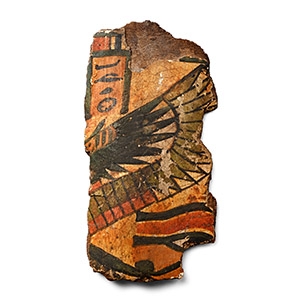
Egyptian Cartonnage Section with Eye and Wing
Third Intermediate Period, circa 1069-860 B.C.Sold for (Inc. bp): £416
Sub-rectangular in plan with irregular and fragmented edge; prepared plaster surface featuring a line-bordered column with four cursive hieroglyphs naming Behedet (bḥdt); a section of finely painted outstretched wing with feather detailing to lower edge in red and blue; below, a wedjat eye in black with red medial band; fabric back to reverse. 48 grams, 17 cm
Formerly from an old collection of a Wiltshire, UK, collector, acquired before 1980. Property of a private collector, West London, UK. This lot is accompanied by an illustrated lot declaration signed by the Head of the Antiquities Department, Dr Raffaele D'Amato.
This fragment most likely originates from the lower chest section of a so-called anthropoid 'yellow coffin' from the Third Intermediate Period. The wing belongs to a protective deity; as Behedet is a name given to several locations (Edfu, Tell el-Balamun, and Lepidotonpolis) associated with Horus, it seems probable that the wing belongs to the falcon form of this god. -
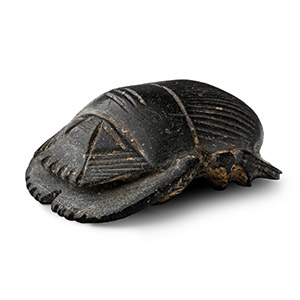
Egyptian Hardstone Heart Scarab
Late Period, 664-332 B.C.Estimate: £500 - 700 (+bp*)
Opening Bid: £250
With stylised geometric ribbed carapace and underside. 16.6 grams, 33 mm
From an early 20th century collection. Ex London, UK, gallery. From a private UK collection This lot is accompanied by an illustrated lot declaration signed by the Head of the Antiquities Department, Dr Raffaele D'Amato.
The scarab amulet was one of ancient Egypt’s most widespread symbols, signifying rebirth, transformation, and protection. Modelled on the dung beetle associated with the sun god Khepri—believed to roll the sun across the sky—it symbolised the cycle of life and renewal. Widely used from the early Middle Kingdom onwards, scarabs served as funerary amulets (as here), personal charms, and seals, often inscribed with prayers or names. They reflect both spiritual beliefs and daily life in ancient Egypt.
