
Loading, please wait...
_900x900.jpg "Egyptian Steatite Scarab Collection")
_200x200.jpg "Egyptian Steatite Scarab Collection")
_900x900.jpg "Egyptian Steatite Scarab Collection")
_200x200.jpg "Egyptian Steatite Scarab Collection")
.jpg "Egyptian Steatite Scarab Collection")
.jpg "Egyptian Steatite Scarab Collection")
LOT 0510
Egyptian Steatite Scarab Collection
HYKSOS PERIOD AND NEW KINGDOM, 18TH-13TH CENTURY B.C.
3/4 - 1 in. (15 grams total, 18-24 mm).
Each with a domed carapace, two with a figure on the underside surrounded by hieroglyphs, two inscribed with hieroglyphic signs.
ProvenanceAcquired in Europe before 1992.
Private collection, UK.
Cf. Ben-Tor, D., Scarabs, Chronology, and Interconnections: Egypt and Palestine in the Second Intermediate Period, Fribourg/Göttingen, 2007, pl. 102, Design Class 10A, 13, for a close parallel to the top left scarab; Bietak, M., Czerny, E. (eds.), Scarabs of the Second Millennium BC from Egypt, Nubia, Crete and the Levant: Chronological and Historical Implications, Vienna, 2004, p. 97, fig. 91, for a Palestinian scarab with a design similar to that of the bottom-left scarab; Newberry, P.E., Catalogue général des antiquités égyptiennes du Musée du Caire N° 36001-37521, Scarab-shaped Seals, Cairo, 1907, p. 358 (CG37430), pl. XVIII, for a New Kingdom finger ring with a scarab decorated with a near-identical design to the top right scarab; Ben-Tor, D., Scarabs, Chronology, and Interconnections: Egypt and Palestine in the Second Intermediate Period, Fribourg/Göttingen, 2007, pl. 52, Design Class 3A4, for variants of the Horus hawk with symbols motif of the bottom right scarab.
CONDITIONTimeLine Auctions follows a vetting process to ensure the authenticity and legality of all items, reinforcing our commitment to integrity and responsible trading. Each antiquity, antique, and coin lot undergoes thorough examination by a vetting committee of at least ten external specialists, professional trade association members, scientists, and archaeologists: Our Vetting Process
AUCTIONS:
TimeLine is a leading auction house specialising in antiquities, ancient art, collectables, natural history, coins, medals, and books. Our auctions offer museums, collectors, historians, and enthusiasts the opportunity to acquire unique and historically significant pieces.
-
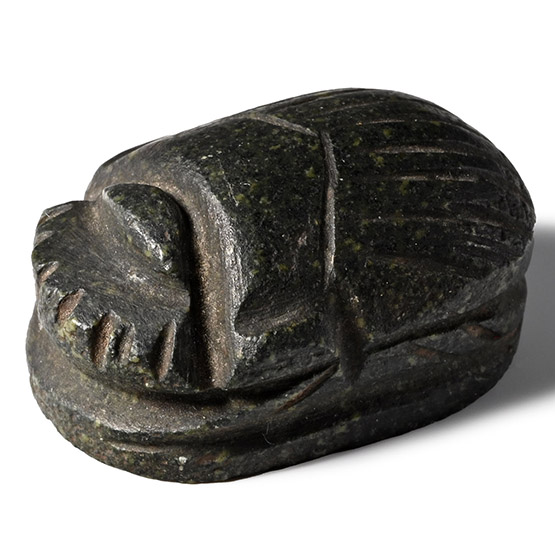
Egyptian Black Hardstone Scarab
Late Period, 664-332 B.C.Sold for (Inc. bp): £234
Dark green hardstone with paler speckles; with a boldly carved head, clypeus, prothorax and elytra, and legs indicated at the sides; plain underside. 17 grams, 29 mm
Ex Irene Newman, Birdham, Chichester, West Sussex, England. with Stride & Son Auctioneers, Chichester, West Sussex, England, 23 April 2015, no.1599 [Part]. Acquired by the present owner at the above sale.
The scarab, which represented the dung beetle, was the most popular amulet in ancient Egypt for approximately two thousand years until the Ptolemaic Period when it gradually fell out of favour. The popularity of scarabs extended beyond the borders of Egypt, and they were also distributed and produced in other regions, such as Phoenicia and Israel. The beetle is named khepri, derived from the verb 'to come into existence', and was considered the embodiment of the creator god Khepri, who was self-engendered. The ancient Egyptians mistakenly believed that the young beetle emerging from the dung ball was the result of an act of self-creation. -
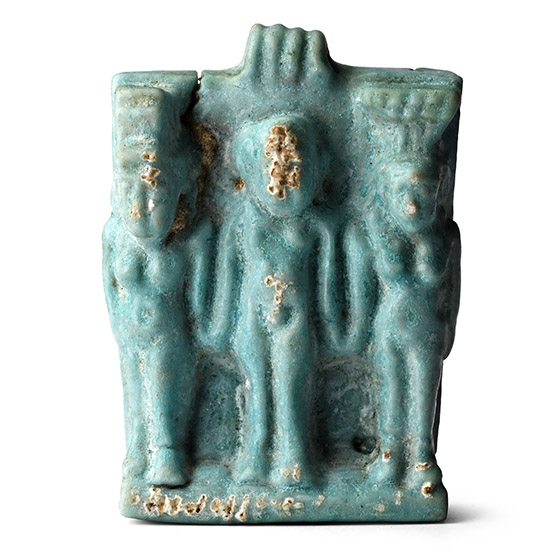
Egyptian Faience Triad Amulet
Late Period, 664-332 B.C.Estimate: £400 - 600 (+bp*)
Opening Bid: £222
Depicting in high relief the Osirian triad (Isis, Horus, Nephthys) standing side by side on an integral plinth against a dorsal pillar; Nephthys (right) and Isis (left) are shown frontally, wearing headdresses with their specific attributes, each holding the hands of the central Horus figure, shown naked and with the side-lock of youth; a ribbed loop at the top for suspension. 8.56 grams, 33 mm
From the collection of a Swedish noble family, 1920s.
Isis and Nephthys operate as complementary sister deities who guard both Osiris and the deceased through mourning, magical protection, and ritual lamentation, while Horus, the child of Isis, signifies renewal and legitimate kingship. On amulets, the triad translates into a compact visual statement of protection: the deceased is imagined as being held within the sisters’ magical and ritual care, while Horus embodies the successful outcome of that protection in the form of rebirth and continuity. -
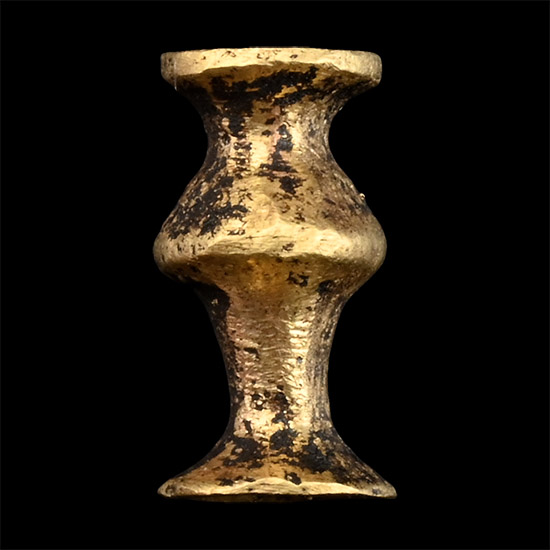
Egyptian Gold Vase-Shaped Bead
Late New Kingdom, 1279-1070 B.C.Sold for (Inc. bp): £234
With median baluster and flange to each end. 4.80 grams, 50 mm
Ex French collection, early 20th century.
This bead likely represents a hes vase, an important ritual vessel used for libations to both the living and the dead.
