
Loading, please wait...
_900x900.jpg "Egyptian Steatite Bust in a Gold Pendant")
_200x200.jpg "Egyptian Steatite Bust in a Gold Pendant")
.jpg "Egyptian Steatite Bust in a Gold Pendant")
LOT 0012
Egyptian Steatite Bust in a Gold Pendant
PTOLEMAIC-ROMAN PERIOD, 2ND CENTURY B.C.-2ND CENTURY A.D.
1 1/2 in. (8.75 grams, 38 mm).
Fragment of a carved panel or vessel depicting a female bust, possibly a queen or Isis, modelled in half-round relief, wearing a loosely draped tunic, a tiered wesekh collar, and a heavy curled, tripartite wig; reverse with lotus flower ropework and other ornamentation; mounted in a later gold suspension frame.
ProvenancePrivate collection, Southern France, 1970s.
Acquired on the English art market.
Cf. Walker, S., Higgs, P. (eds.), Cleopatra of Egypt from History to Myth, London, 2001, pp. 76-77, no. 56, for the stela depiction of Queen Arsinoe III wearing a similar garment; pp.160-161, no.160, for a statue of Cleopatra VII wearing a tripartite wig with similarly tight curls.
FootnotesThis fragment likely originates from an elaborately decorated bowl belonging to a specific group thought to have been made in Alexandria (cf. Page-Gasser, M., Wiese, A.B., Ägypten: Augenblicke der Ewigkeit, Mainz, 1997, for a complete example). The purpose of these bowls is unclear, but they may have been used as votive offerings in sanctuaries.
CONDITIONTimeLine Auctions follows a vetting process to ensure the authenticity and legality of all items, reinforcing our commitment to integrity and responsible trading. Each antiquity, antique, and coin lot undergoes thorough examination by a vetting committee of at least ten external specialists, professional trade association members, scientists, and archaeologists: Our Vetting Process
AUCTIONS:
TimeLine is a leading auction house specialising in antiquities, ancient art, collectables, natural history, coins, medals, and books. Our auctions offer museums, collectors, historians, and enthusiasts the opportunity to acquire unique and historically significant pieces.
-
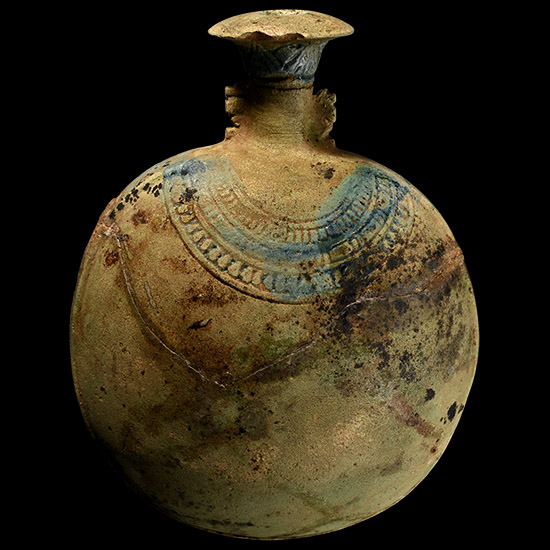
Egyptian Glazed Faience New Year Flask with Baboons
Late Period, 664-332 B.C.Estimate: £2,000 - 3,000 (+bp*)
Opening Bid: £1,000
Lentoid body with segmented collars and blue detailing around the shoulders, neck with papyrus stalk detailing and a domed rim; addorsed stylised baboons flanking the neck. 263 grams, 16 cm
Acquired on the UK art market, 1990s. Private collection, New York, USA. This lot has been checked against the Interpol Database of stolen works of art and is accompanied by search certificate number no.13350-255452.
The concept of renewal is expressed through the form, decoration, and inscriptions of this type of flask. Their rounded bodies evoke the sun disc, symbolising daily rebirth, while the squatting baboons flanking the mouth allude to those that greeted the rising sun each morning. The blue collar decoration, including floral motifs, as seen here, symbolises the renewal of the agricultural cycle through the annual Nile inundation. The papyrus-capital spout reinforces this theme of regeneration. Although traditionally dated exclusively to the 26th Dynasty, examples recovered from Late Period and early Ptolemaic contexts indicate that their popularity actually endured for several centuries. -
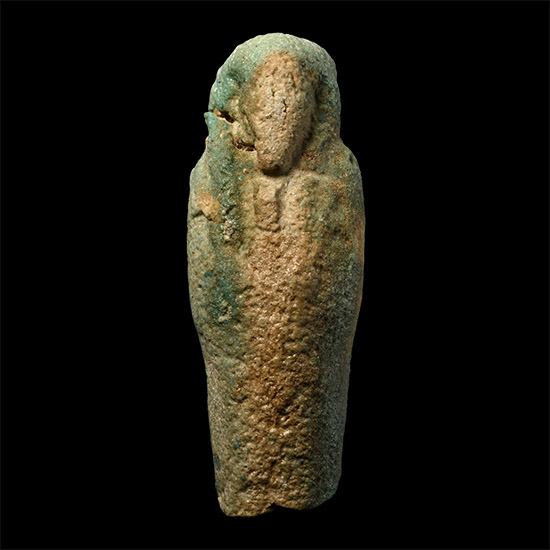
Egyptian Faience Shabti
Late Period, 664-332 B.C.Sold for (Inc. bp): £59
Plano-convex in section with moulded piriform face and wig, tools in the crossed hands, accompanied by an old handwritten note 'faience. Ceramic composed of crushed quartz or quartz sand with small amounts of lime and plant ash or naron. Coated with a bright blue or green glaze or soda[...]' and to verso 'Late period 700-400 BC Ex Margaret Seton-Jones from Flinders Petrie'. 10.5 grams, 49 mm
Ex Margaret Seton-Jones from Flinders Petrie. From the private collection of a Canadian gentleman living in Essex, UK, formed since the 1920s-circa 1990. Property of an Essex lady until the late 1990s; thence by descent. From the private collection of an Essex gentleman since the late 1990s. Accompanied by a handwritten slip with description and provenance. -
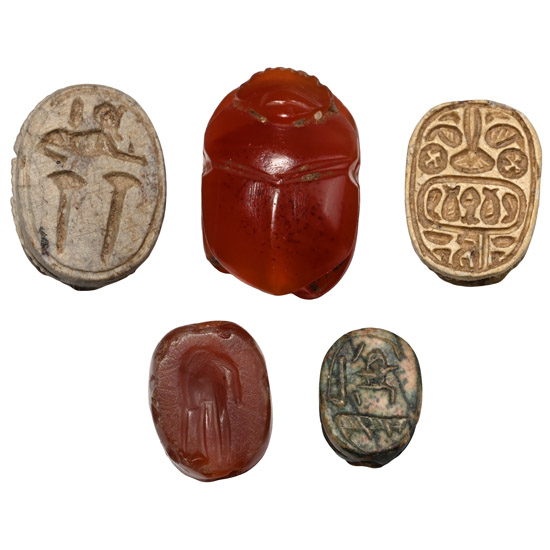
Egyptian Stone Scarab Group
Second Intermediate Period-Ptolemaic Period, circa 1600-30 B.C.Sold for (Inc. bp): £391
Comprising: carnelian type with plain underside; similar with incuse hand symbol; small greenstone type with scarab beetle and other signs; grey stone type with sphinx, indistinct hes- vase above, and two papyrus stalks below; another with a decorative cartouche panel and other signs; two supplied with a museum-quality impression. 7.12 grams total, 10-17 mm
From the private collection of a European gentleman (1942-2024), formed since the 1970s.
