
Loading, please wait...
LOT 0531
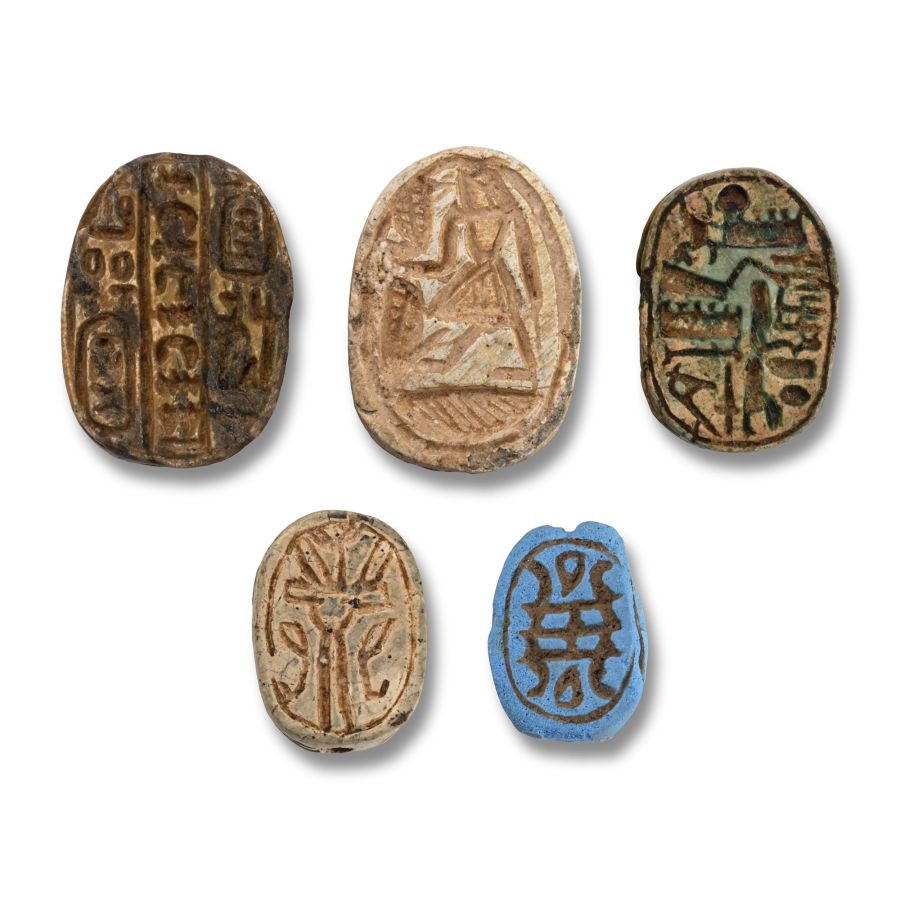
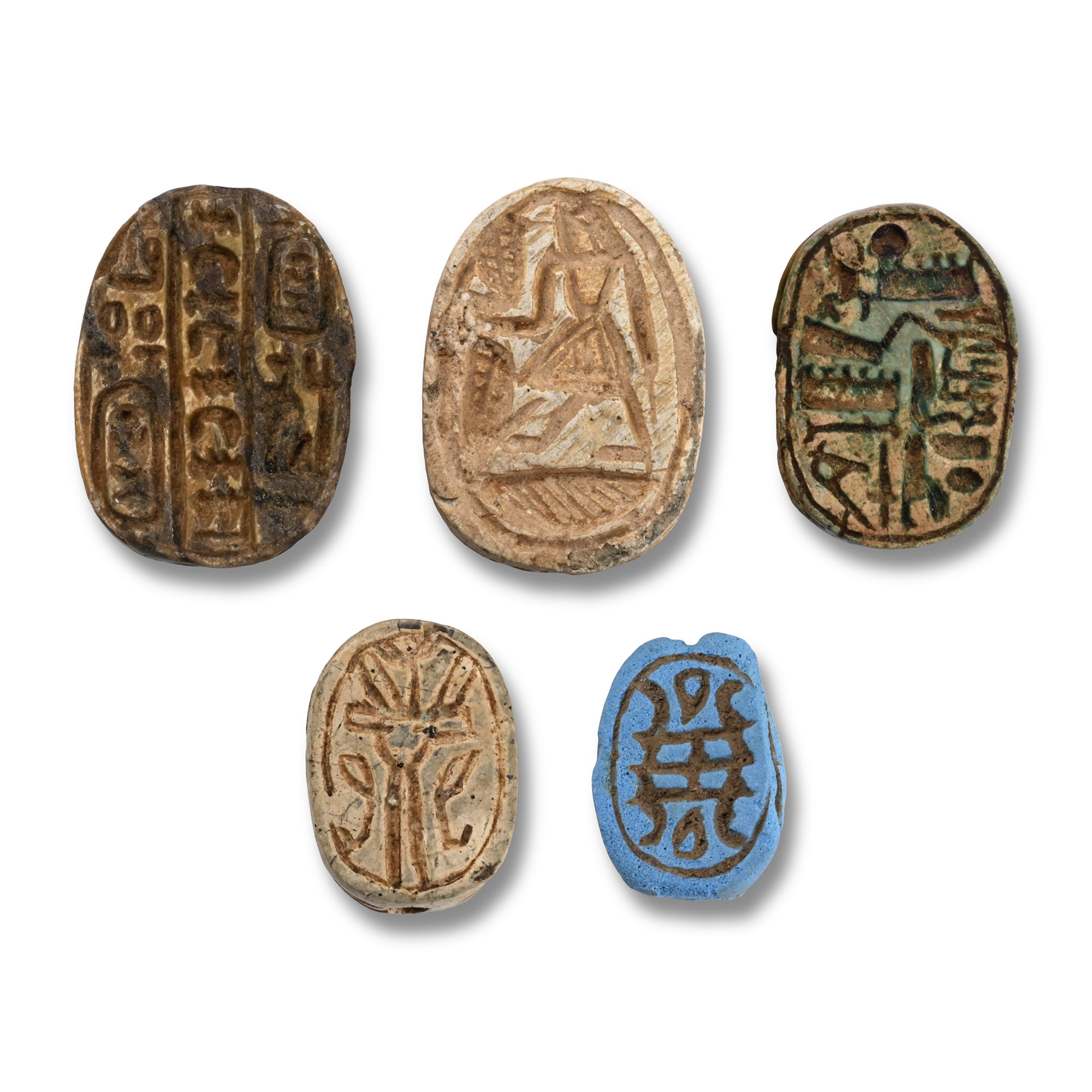
Egyptian Steatite and Faience Scarab Group
MAINLY SECOND INTERMEDIATE PERIOD–NEW KINGDOM, CIRCA 1660-1069 B.C.
1/2 - 3/4 in. (10.6 grams total, 13-19 mm).
Designs include: a tripartite design with ankh, water, nwb, and men signs, with indistinct cartouches possibly of Thutmose III, and signs spelling the phrase 'powerful is the justice of Re' (user-Maat-Re); a line border enclosing the stylised depiction of a striding figure grasping a crocodile, with a neb sign below; a line border enclosing a multitude of signs, including Thutmose III’s throne name (men-kheper-Re), and that of Amun; a line border enclosing central Hathoric sistrum; a line border enclosing a symmetrical motif in contrasting black glaze. [5]
ProvenanceAcquired on the European art market in the early 2000s.
With Galerie Rhéa, Zurich, Switzerland.
TimeLine Auctions follows a vetting process to ensure the authenticity and legality of all items, reinforcing our commitment to integrity and responsible trading. Each antiquity, antique, and coin lot undergoes thorough examination by a vetting committee of at least ten external specialists, professional trade association members, scientists, and archaeologists: Our Vetting Process
AUCTIONS:
TimeLine is a leading auction house specialising in antiquities, ancient art, collectables, natural history, coins, medals, and books. Our auctions offer museums, collectors, historians, and enthusiasts the opportunity to acquire unique and historically significant pieces.
LOT 0531
Egyptian Steatite and Faience Scarab Group
Estimate £150 - 200€170 - 230 (for guidance only)$200 - 270 (for guidance only)
Opening Bid
£75 (EUR 87; USD 101) ‡+BP*
-
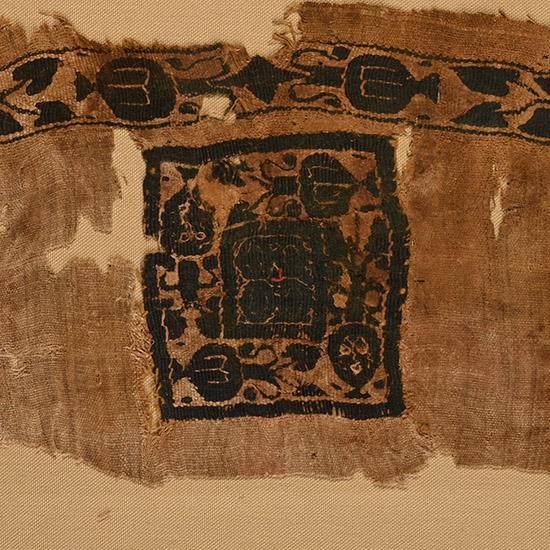
Egyptian Mounted Coptic Tunic Textile Fragment with Clavus and Tabula
Circa 6th century A.D.Estimate: £80 - 100 (+bp*)
Bids: 2 | Current Bid: £15
Showing a large portion of a tunic, decorated with a clavus and a tablion, both featuring foliate ornaments alternating with kantharoi, the centre of the tablion patterned with rosettes surrounded by kantharoi on the four sides; mounted on a backing board. 174 grams total, 57 cm
Acquired 1970s-1996. Property of a North American collector. London collection, 2016.
This type of embroidery was typical of tunics and garments characterised by full-length clavi and segmenta, decorated with either intricate geometric patterns or floral and vegetal motifs. In Christian symbology, the kantharos was an ancient Greek wine cup that symbolised resurrection and eternal life through Christ. -
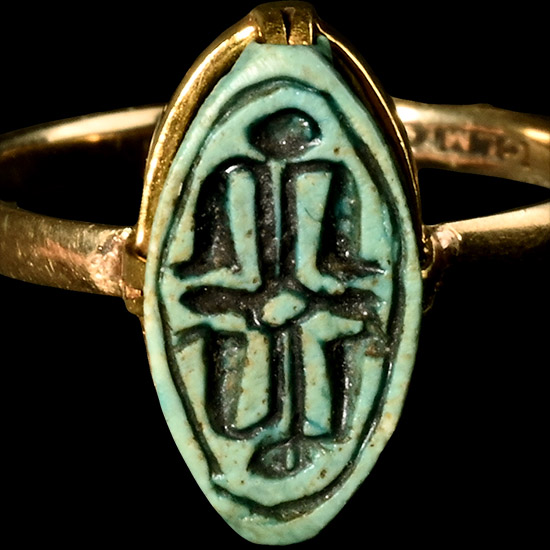
Egyptian Blue Faience Cowroid with Uraei in Gold Ring
Third Intermediate Period, 1069-860 B.C.Estimate: £500 - 700 (+bp*)
Opening Bid: £250
Slender, lentoid form with a finely striated edge design; the main motif comprises four outward-facing uraei, one in each quadrant, with a sun disc at each end, mounted in a modern gold ring. 2.33 grams, 22.62 mm overall, 16.76 mm internal diameter (approximate size British M, USA 6, Europe 12.46, Japan 12)
Private collection, London. -
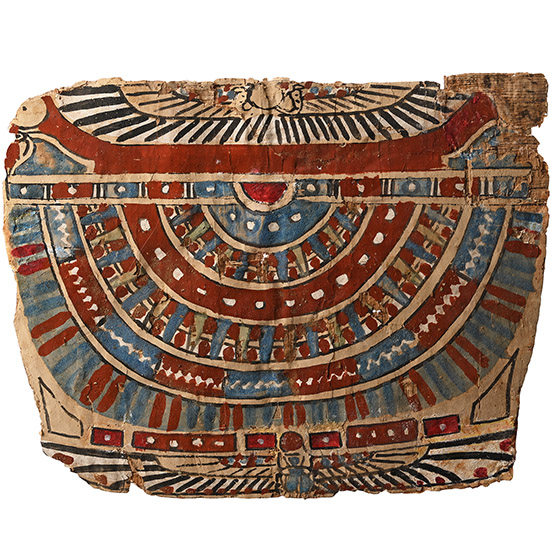
Egyptian Cartonnage Pectoral Panel on Stand
Late Period-Ptolemaic Period, circa 664-30 B.C.Estimate: £1,500 - 2,000 (+bp*)
Opening Bid: £800
Rectangular panel with bands of triangles, teardrops and other motifs in white, red, blue and pale green; winged scarab at the bottom, lower portion of a winged sun disc flanked by uraei to the top; mounted on a custom-made stand. 2.06 kg total, 31.4 cm wide including stand
Ex early 20th century collection, London, UK. Accompanied by a copy of a previous illustrated catalogue page, including provenance. This lot has been checked against the Interpol Database of stolen works of art and is accompanied by search certificate no.13518-263302.
This piece was probably part of a set of cartonnage trappings placed on the mummy.
