
Loading, please wait...


LOT 0507
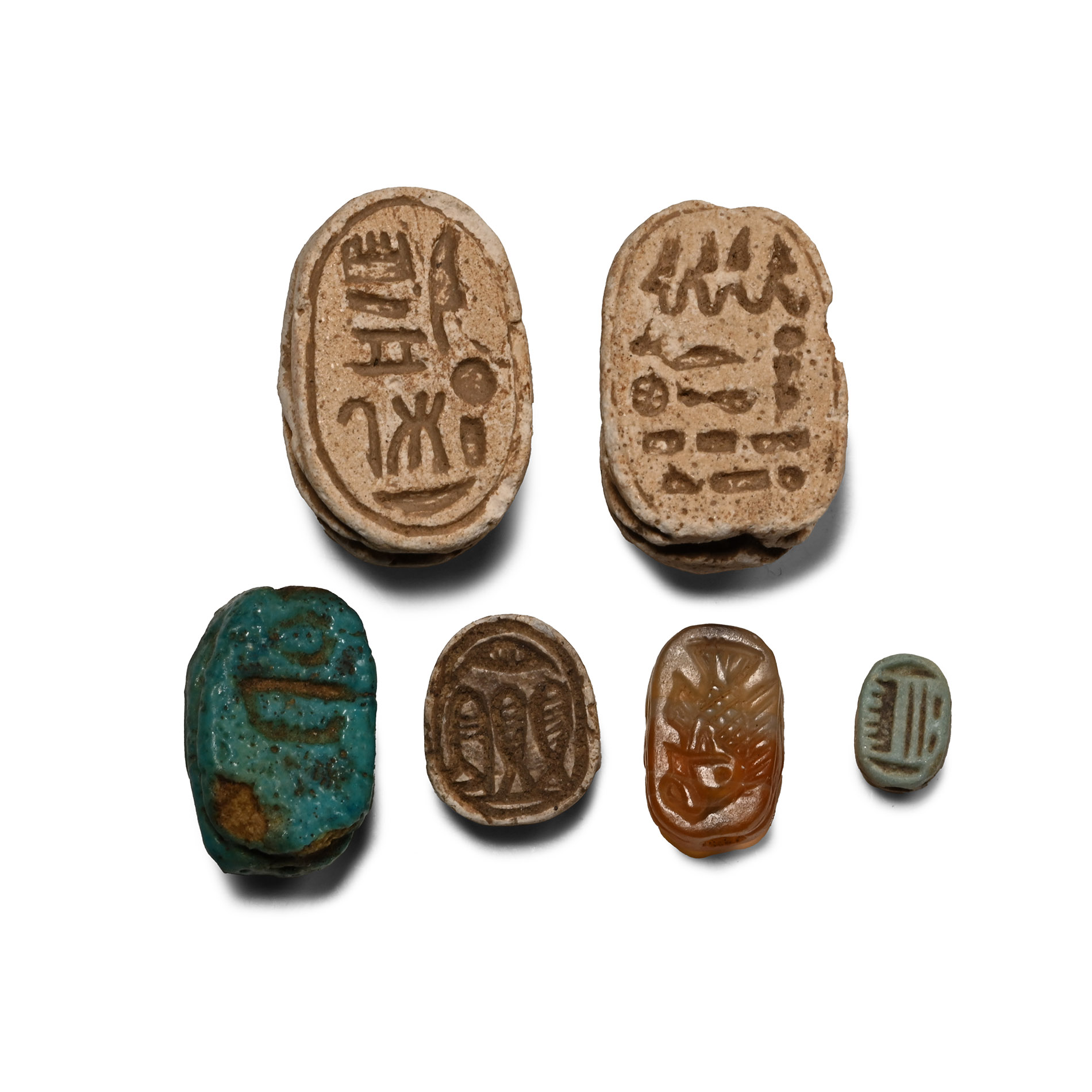
Egyptian Steatite and Faience Scarab Group
LATE PERIOD, 664-332 B.C.
1/4 - 3/4 in. (8.68 grams total, 7-21 mm).
Their bases decorated with hieroglyphs and figures, including one with the motto 'Amun lord of the Two Lands', another with the motto 'lord Ramesses beloved of Amun', and one with a detailed representation of a Nile tilapia fish. [6, No Reserve]
ProvenanceFrom an early 20th century collection.
CONDITIONTimeLine Auctions follows a vetting process to ensure the authenticity and legality of all items, reinforcing our commitment to integrity and responsible trading. Each antiquity, antique, and coin lot undergoes thorough examination by a vetting committee of at least ten external specialists, professional trade association members, scientists, and archaeologists: Our Vetting Process
AUCTIONS:
TimeLine is a leading auction house specialising in antiquities, ancient art, collectables, natural history, coins, medals, and books. Our auctions offer museums, collectors, historians, and enthusiasts the opportunity to acquire unique and historically significant pieces.
-
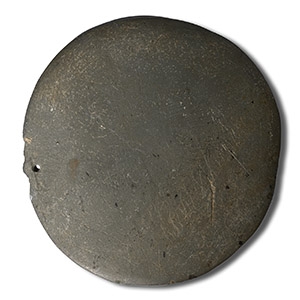
Egyptian Pre-Dynastic Greywacke Palette
Predynastic Period, Naqada III, circa 3300–2960 B.C.Estimate: £500 - 700 (‡+bp*)
Opening Bid: £250
Circular in plan with smoothed faces, pierced through the edge. 238 grams, 13.3 cm
Acquired in the mid 1980s-1990s. Private collection, Switzerland, thence by descent. Private collection, since the late 1990s.
Palettes were utilitarian objects used in the Predynastic Period to grind and mix mineral-based eye pigments (including ochre, malachite, and haematite). Greywacke cosmetic palettes were easily carved in various shapes and sizes, including zoomorphic representations and geometric forms. The symbolism of this circular palette may be connected to the sun disc, which featured prominently in ancient Egyptian culture. The palette was so significant in Predynastic society that purely ceremonial versions, often impractically large for their original purpose, were produced for use in temple rituals. The most famous is the highly decorated Narmer Palette discovered at Hierakonpolis. -
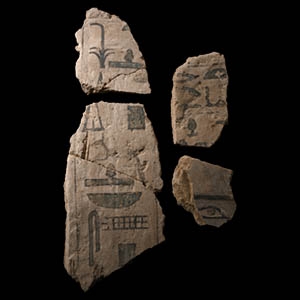
Egyptian Limestone Fragment Group
Middle Kingdom, 2035-1550 B.C.Sold for (Inc. bp): £1,404
Comprising four fragments of dressed and plastered wall, each with painted hieroglyphs in blue, green and black shades, some with low-relief modelling. 1.03 kg total, 10.1-27.7 cm
Acquired in the mid 1980s-1990s. Private collection, Switzerland, thence by descent. Private collection, since the late 1990s.
These fragments seem to be sections of tomb wall reliefs. They include portions of an offering formula, mention of a 'district', a festival, and the symbol of Anubis. The decoration in different parts of some Middle Kingdom tombs had scenes and texts applied in paint or executed with raised relief carving. -
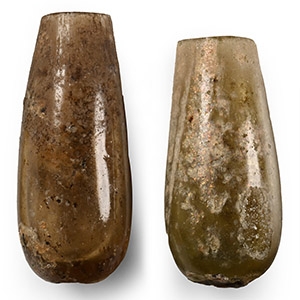
Egyptian Glass Phial Group
1st millennium B.C.Sold for (Inc. bp): £59
Each is a tapering bulb shape with a flat-cut mouth. 13.8 grams total, 35-37 mm
From the collection of Mr S.M., London, UK, formed from 1979-1999.
