
Loading, please wait...


LOT 0412
Egyptian Smoky Quartz Heart Amulet
LATE PERIOD, 664-332 B.C.
5/8 in. (0.76 grams, 16 mm).
Carved with lateral triangular lugs, a pronounced rim surmounted by a ribbed suspension loop.
ProvenanceFrom a 20th century UK collection.
LiteratureCf. Andrews, C., Amulets of Ancient Egypt, London, 1994, pp. 72-73, for a discussion of this amulet type.
CONDITIONTimeLine Auctions follows a vetting process to ensure the authenticity and legality of all items, reinforcing our commitment to integrity and responsible trading. Each antiquity, antique, and coin lot undergoes thorough examination by a vetting committee of at least ten external specialists, professional trade association members, scientists, and archaeologists: Our Vetting Process
AUCTIONS:
TimeLine is a leading auction house specialising in antiquities, ancient art, collectables, natural history, coins, medals, and books. Our auctions offer museums, collectors, historians, and enthusiasts the opportunity to acquire unique and historically significant pieces.
-
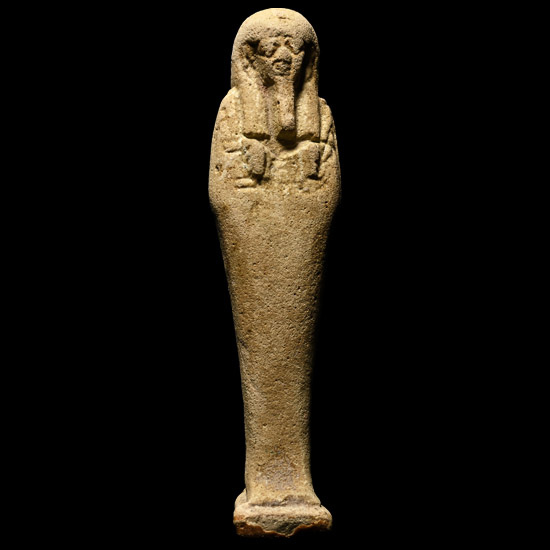
Egyptian Faience Hieroglyphic Shabti
Late Period-Ptolemaic Period, 525-30 B.C.Sold for (Inc. bp): £390
Slender in profile with tripartite wig and incised tools in the crossed hands, net to the left shoulder; dorsal pillar with impressed hieroglyphic legend. 23.6 grams, 89 mm
Ex Alexander Crawford Collection. From the collection of David Donlan (1947-2025), a dedicated and lifelong collector with a passion for the ancient world and the natural sciences, forming his collection from 1960s onwards, using many reputable dealers across the United Kingdom, including the well-regarded Coincraft and The Parthenon Gallery.
Alexander Crawford Lamb (1843-1897) was a Scottish hotelier, art collector, antiquarian and collector of paintings, literary works, china, furniture, antiquities and other ephemera and memorabilia. His most notable literary achievement was the publication of a massive volume entitled Dundee: Its Quaint and Historic Buildings, 1895. -
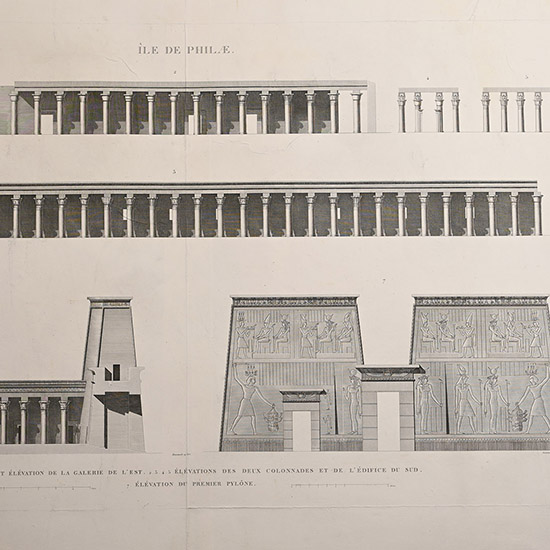
Very Large Egyptian Expedition Lithograph of the Temple of Philae
Early 19th century A.D.Sold for (Inc. bp): £94
Proof etching on laid paper of plate 6 from Description de l'egypte entitled Île de Philae. Coupe et élévation de la galerie de l'est. Élévations des deux colonnades et de l'édifice du sud. Élévation du premier pylône. 252 grams, 104 x 68.5 cm
From the collection of a North American priest. Acquired between 1981-1996. Property of a North American collector.
Produced between February 1802 and 1830 on the orders of Napoleon Bonaparte; published between 1809 and 1828. Just 1,000 copies were distributed to various institutions, printed on laid paper with an 'Égypte ancienne et moderne' watermark. The book is subtitled Recueil des observations et des recherches qui ont été faites en Égypte pendant l’expédition de l’Armée française, publié par les ordres de Sa Majesté l’Empereur Napoléon le Grand (Gathering of observations and discoveries which were made in Egypt during the expedition of the French army, published on the orders of His Majesty the Emperor Napoleon the Great). It was the world's first encyclopedia devoted exclusively to the remains of ancient Egypt. The plates of this book are the first to present the archaeological sites of Thebes (Luxor). The Philae temple complex was one of the major monuments dismantled from its original location and relocated to a new site during the Aswan High Dam project. Most of the complex dates to the Ptolemaic Period, although some earlier and later elements remain. -

Egyptian Black Steatite Eye of Horus Amulet
Late Period, 664-332 B.C.Sold for (Inc. bp): £819
Carved unifacial amulet with hatched eyebrow and ribbed suspension loop. 1.45 grams, 19 mm
From a 20th century UK collection.
The wedjat-eye amulet is a representation of the healed eye of the god Horus, featuring both human and falcon elements. The name Wedjat in ancient Egyptian means ‘the one that is sound.’ According to Egyptian mythology, Horus' eye was wounded or taken by the god Seth and restored by Thoth. The wedjat-eye amulet was thought to protect its wearer and bestow the power of recovery and regeneration onto them. It was very popular and used by both the living and the dead.
