
Loading, please wait...
_900x900.jpg "Egyptian Sky Blue Faience Shabti")
_200x200.jpg "Egyptian Sky Blue Faience Shabti")
.jpg "Egyptian Sky Blue Faience Shabti")
LOT 0511
Egyptian Sky Blue Faience Shabti
LATE PERIOD-PTOLEMAIC PERIOD, CIRCA 380-30 B.C.
2 3/8 in. (5.7 grams, 61 mm).
Mummiform figure with a lappet wig and beard. [No Reserve]
ProvenanceEx private collection, London, UK, 1970s-1990s.
LiteratureCf. Martin, G.T. et al., The Tomb-Chapels of Paser and Raia at Saqqâra, London, 1985, p. 26 (no. 55), pl. 31, for examples of 310 complete and 56 fragmentary similar shabtis.
CONDITIONTimeLine Auctions follows a vetting process to ensure the authenticity and legality of all items, reinforcing our commitment to integrity and responsible trading. Each antiquity, antique, and coin lot undergoes thorough examination by a vetting committee of at least ten external specialists, professional trade association members, scientists, and archaeologists: Our Vetting Process
AUCTIONS:
TimeLine is a leading auction house specialising in antiquities, ancient art, collectables, natural history, coins, medals, and books. Our auctions offer museums, collectors, historians, and enthusiasts the opportunity to acquire unique and historically significant pieces.
-
.jpg)
Historic Collection of 859 Slides of Archaeological Sites and Artefacts From Egypt
1960s-1980s A.D.Sold for (Inc. bp): £1,430
Housed in five linen-covered boxes, covering tombs, wall paintings, Tutankhamun, Giza, El Kab, Menkaure, Roash, Merysankh, Medinet Habu, Abusir, Ramesses III Temple, Seti I Chapel etc. 4.34 kg total, 26.5 x 16.5 x 6.5 cm each box
Property of archaeologist Stephanie Gee, N.W. London, UK, 1960s-1980s.
Stephanie Gee was a prominent archaeologist who took part in several expeditions in Egypt. She was a trusted assistant to the British-Australian archaeologist Veronica Seton-Williams, who excavated in Egypt, Britain, and the Near East. Stephanie also took part in the Tell El-Farâ'în expeditions of 1965-1968, and assisted Seton-Williams with preparing the 1966 expedition report. Their collaboration continued and Stephanie helped with the manuscript of Seton-Williams’ book ‘The Road to El-Aguzein’, a narrative account of her life that was first published in 1988. -
.jpg)
Egyptian Faience Mahes Amulet
Late Period, 664-332 B.C.Sold for (Inc. bp): £140
Standing figure of the lion-headed god wearing the atef crown and a uraeus, arms slightly forward; with dorsal pillar and rectangular base; pierced for suspension. 1.43 grams, 27 mm
Ex early 20th century collection, London, UK.
Mahes was an Egyptian lion-headed deity symbolising divine protection, royal power, and justice. Considered a son of Sekhmet or Bastet, he represented the aggressive solar force of Ra, serving as a fierce defender of cosmic order. Venerated in the Delta, especially at Leontopolis, Mahes was depicted as a lion or as a man with a lion's head, often adorned with the atef-crown and uraeus. -
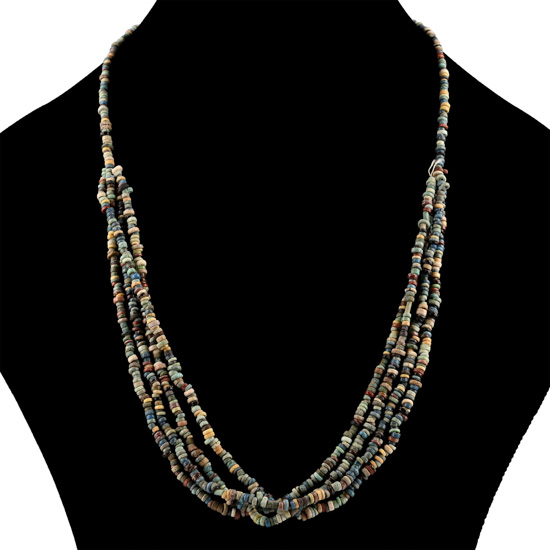
Egyptian Multi-Stranded Mummy Bead Necklace
Late Period, 664-332 B.C.Sold for (Inc. bp): £143
Four-stranded designer necklace composed of polychrome beads of mainly disc and cylindrical types. 25.5 grams, 65 cm
Acquired before 1979. From the private collection of Mr F.A., South Kensington, London, UK; thence by descent 2014.
For thousands of years, artisans in Egypt created vibrant ceramics to echo the beauty of rare jewels. These ornaments were created with almost every material, colour, and texture imaginable, and they come from across Egypt and beyond: vibrant blue lapis lazuli from Afghanistan, glossy black obsidian from Turkey, and aqua-green turquoise from the Sinai. They were worn in life and, after death, they served as precious ornamentation for mummies.
