
Loading, please wait...
_900x900.jpg "Egyptian Silver Isis and Horus Amulet")
_200x200.jpg "Egyptian Silver Isis and Horus Amulet")
_900x900.jpg "Egyptian Silver Isis and Horus Amulet")
_200x200.jpg "Egyptian Silver Isis and Horus Amulet")
_900x900.jpg "Egyptian Silver Isis and Horus Amulet")
_200x200.jpg "Egyptian Silver Isis and Horus Amulet")
_900x900.jpg "Egyptian Silver Isis and Horus Amulet")
_200x200.jpg "Egyptian Silver Isis and Horus Amulet")
.jpg "Egyptian Silver Isis and Horus Amulet")
.jpg "Egyptian Silver Isis and Horus Amulet")
.jpg "Egyptian Silver Isis and Horus Amulet")
.jpg "Egyptian Silver Isis and Horus Amulet")
LOT 0508
Egyptian Silver Isis and Horus Amulet
LATE PERIOD, 664-332 B.C.
1 1/2 in. (2 1/2 in.) (6.2 grams, 39 mm (20.7 grams total, 62 mm including stand)).
Isis enthroned wearing a cow's horn headdress with a solar disc, suckling the infant Horus on her lap; loop to rear of crown; mounted on a custom-made stand. [No Reserve]
ProvenanceEx Mythes & Legend.
Ex Cohen collection 2011.
Property of a French collector.
Cf. Andrews, C., Amulets of Ancient Egypt, London, 1994, item 18(a).
FootnotesIn ancient Egyptian mythology, Isis was the sister-wife of Osiris and the mother of the sky god Horus. She is associated with aspects of fertility and motherhood and is often depicted in various artworks seated in a nursing pose with her son Horus on her lap, as here.
CONDITIONTimeLine Auctions follows a vetting process to ensure the authenticity and legality of all items, reinforcing our commitment to integrity and responsible trading. Each antiquity, antique, and coin lot undergoes thorough examination by a vetting committee of at least ten external specialists, professional trade association members, scientists, and archaeologists: Our Vetting Process
AUCTIONS:
TimeLine is a leading auction house specialising in antiquities, ancient art, collectables, natural history, coins, medals, and books. Our auctions offer museums, collectors, historians, and enthusiasts the opportunity to acquire unique and historically significant pieces.
-
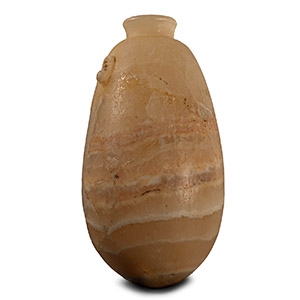
Egyptian Alabaster Alabastron
Third Intermediate Period, circa 8th-7th century B.C.Estimate: £1,000 - 1,400 (‡+bp*)
Opening Bid: £500
Ovoid jar with a rounded base, concave shoulders and flared neck/rim; remains of lug handles. 332 grams, 14 cm
Acquired in the mid 1980s-1990s. Private collection, Switzerland, thence by descent. Private collection, since the late 1990s. -
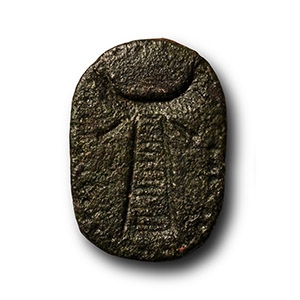
Phoenicio-Egyptian Dark Green Stone Scarab
Circa 6th-4th century B.C.Estimate: £250 - 350 (+bp*)
Opening Bid: £139
With textured carapace, bull-horned column to the reverse. 3.94 grams, 15 mm
From the property of the late Mr SM, London, UK, 1969-1999.
The widespread adoption of the scarab, both as a symbol linked to the concept of rebirth, and in its function as a seal, exemplifies the extent of Egyptian influence on Phoenician culture, from its origins in the Levant to its spread across the Mediterranean. -
.jpg)
Egyptian Faience Offering Cup of Ramesses II
New Kingdom, 19th Dynasty, circa 1279-1213 B.C.Sold for (Inc. bp): £1,170
Blue faience cylindrical offering cup, gently tapering form with slightly flared foot and rim, a black painted rectangular frame containing a hieroglyphic inscription including cartouches containing the throne and birth names of Ramesses II and the dedication: skr-wsı͗r mry nb tꜢwy (wsr-mꜢꜤt-re stp-n-re) nb ḫꜤw (ı͗mn mry re-mssw), ‘Beloved of Sokar-Osiris, lord of the Two Lands (The justice of Re is powerful, Chosen of Re), lord of appearances (Beloved of Amun, Ramesses)’. 29.94 grams, 46 mm
Francesc Cambó i Batlle (1876-1947) a prominent Spanish politician, art patron and philanthropist. Gifted to his friend, the archaeologist Josep Gilbert i Buch. Acquired from Gilbert's family by the present owner's grandfather in the early 1980s. Private collection of a European noble.
Francesco Cambó i Batlle was a notable figure in early 20th century Spain, best known for his role in politics as a leader of the Catalan nationalist movement and as a patron of the arts. He was a key benefactor of the Museo del Prado and left a significant legacy through his art collections. His deep connection to the cultural and artistic life of Spain makes items from his collection particularly valuable and historically significant.
