Loading, please wait...
Details
LOT 0468
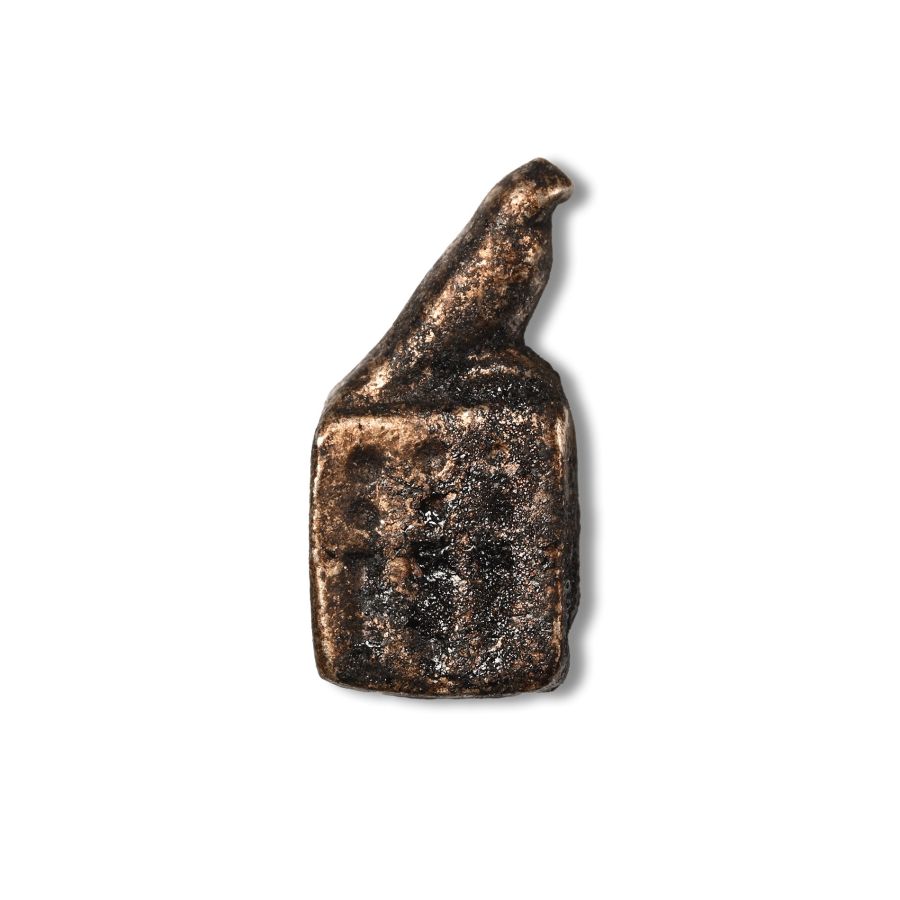
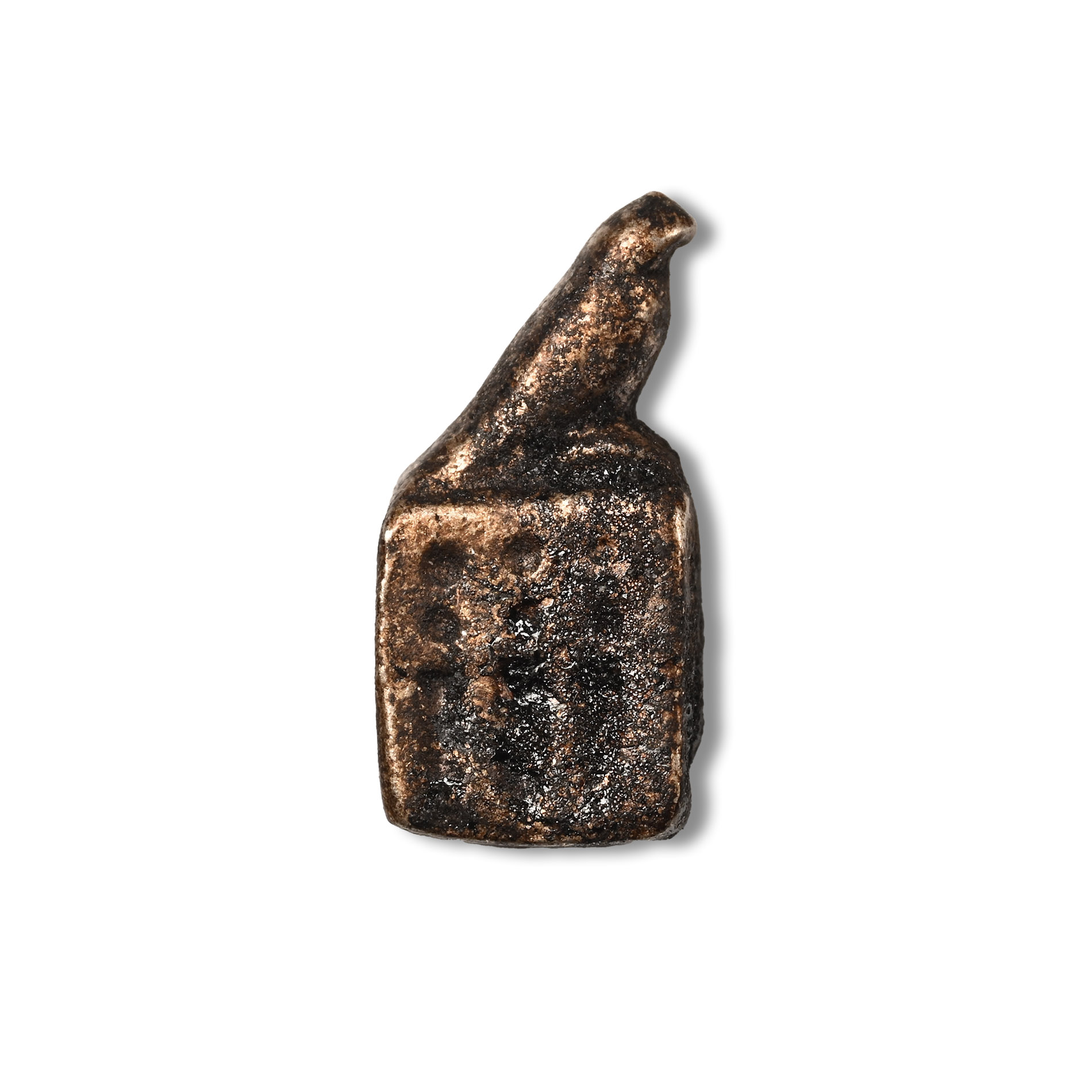
Egyptian Silver Horus Serekh Amulet
LATE-PTOLEMAIC PERIOD, 664-30 B.C.
3/8 in. (0.71 grams, 10 mm).
An element from a necklace in the form of Horus in falcon form sitting atop the palace façade motif (serekh). [No Reserve]
Provenance
From an early 20th century collection.
This lot is accompanied by an illustrated lot declaration signed by the Head of the Antiquities Department, Dr Raffaele D’Amato.
Literature
Cf. Aldred, C., Jewels of the Pharaohs: Egyptian Jewellery of the Dynastic Period, London, 1971, pp. 21, 173, fig. 1, for similar elements used on a First Dynasty bracelet; Andrews, C., Amulets of Ancient Egypt, London, 1994, p.61 fig. 66 l, for a faience example dated to the Ptolemaic Period.
Footnotes
Examples of this distinctive motif can be traced back to the very beginning of Egyptian history. It represents the recessed niches of royal and religious architecture, and served as a device to contain the Horus name of the king. The most notable example of jewellery incorporating this motif is the elaborate bracelet found in the tomb of King Djer at Abydos, which is composed of alternating turquoise and gold falcon-topped serekhs. Similar examples of this element occur as late as the Ptolemaic Period.
CONDITIONVETTING:
TimeLine Auctions follows a vetting process to ensure the authenticity and legality of all items, reinforcing our commitment to integrity and responsible trading. Each antiquity, antique, and coin lot undergoes thorough examination by a vetting committee of at least ten external specialists, professional trade association members, scientists, and archaeologists: Our Vetting Process
AUCTIONS:
TimeLine is a leading auction house specialising in antiquities, ancient art, collectables, natural history, coins, medals, and books. Our auctions offer museums, collectors, historians, and enthusiasts the opportunity to acquire unique and historically significant pieces.
RELATED LOTS
-
Very Large Egyptian Wooden Head of Osiris
30th Dynasty-Ptolemaic Period, 380-30 B.C.Sold for (Inc. bp): £13,000
Carved in the round head with plaster prepared surface; with integral Atef crown ornamented with lateral bronze ostrich plumes and uraeus to the brow; carved facial detailing with broad nose and small mouth; applied bronze braided beard with scrolled tip; ears pierced to accept earrings; mounted on a custom-made stand. 3.62 kg total, 52.5 cm high including stand
Acquired by the family from an antiquities dealer in Egypt, October 1982. Ex Dunkirk Manor, Theescombe, Stroud. Mr F.D. collection, acquired from the above. Accompanied by an academic report by Egyptologist Paul Whelan. This lot has been checked against the Interpol Database of stolen works of art and is accompanied by a search certificate number no.12513-231999. This lot has been cleared against the Art Loss Register database, and is accompanied by an illustrated lot declaration signed by the Head of the Antiquities Department, Dr Raffaele D’Amato.
This head likely originates from a large-scale standing figure of the underworld god Osiris. In contrast to the ubiquitous small bronze Osiris figurines found at cult sites throughout Egypt – which were left by pilgrims as votive offerings – large-scale wooden statues are much rarer. Their scarcity is partly due to the fragile nature of wood, which made such statues more susceptible to decay over time, but also because these larger figures were used in more specialised and exclusive ritual contexts. This is evidenced by the significant discovery of a large wooden Osiris statue in a cache of votive objects at Saqqara, associated with a temple shrine. The find suggests that the sizeable image of Osiris played an important role in religious ceremonies in the temple, where it presumably served as the focus of veneration. The Saqqara cache dates no later than the reign of Nectanebo II (360-343 B.C.), whose temple pavement covered it. However, the exact dating of the wooden statue is less certain, with estimates ranging from the New Kingdom to the 26th Dynasty. -
Egyptian Terracotta Ithyphallic Figurine of a Seated Male
Ptolemaic Period, 2nd-1st century B.C.Sold for (Inc. bp): £143
Representing a hunchback in a crouched position, leaning against his emphasised phallus and resting a triangular harp on it. 64 grams, 63 mm
The Erotica Collection Christian von Faber-Castell, Küsnacgt ZH, Switzerland, since the late 1970s. This lot is accompanied by an illustrated lot declaration signed by the Head of the Antiquities Department, Dr Raffaele D’Amato.
From the 4th century B.C. onwards, small-scale sculptures developed into a rich repertoire of grotesque types. These so-called grotesques were an enhancement of the Hellenistic interest in the human body and its weakness and imperfections by depicting disfigured individuals. According to some scholars, terracotta (and bronze) figurines of this kind were life-like representations of beggars and others who gathered at big feasts in temples or at the houses of the wealthy. In the latter case, they indicated the importance and wealth of the host as the more beggars an event attracted, the greater the fortune of the event organiser. By implication, the bronze and terracotta portraits of these marginal people could have become symbols and charms of good luck that would have been placed in private houses. Christian von Faber-Castell (born 1950) is a renowned German entrepreneur and art collector, best known as a member of the prominent Faber-Castell family, famed for their iconic writing instruments. A passionate advocate for art and culture, Christian von Faber-Castell curated an extensive and diverse private collection of erotica, spanning centuries and cultures. His collection reflects a deep appreciation for the interplay of beauty, sensuality, and artistic expression, bringing together rare and unique works that explore themes of intimacy and human connection. Pieces from this collection have been featured in notable exhibitions and are celebrated for their artistic and historical significance. This offering represents a rare opportunity to acquire works from one of the most fascinating and eclectic private collections of its kind. -
Egyptian Stone Stela with Pharaoh, Isis, Horus and Thoth
Ptolemaic Period, 3rd-2nd century B.C.Sold for (Inc. bp): £16,900
Round-topped stela with decoration on two registers; the lunette, featuring a winged sun disc with pendant uraei; the main panel with a frieze in sunk relief depicting the pharaoh wearing the double crown, facing left offering the hieroglyphic symbol for 'fields'; a goddess stands behind him, possibly Isis, wearing a tight-fitting robe and sporting a tall two-plumed headdress, with one hand raised in praise; facing the pharaoh is the falcon-headed god, possibly Horus or Her-wer, wearing a double-crown, and behind him stands the ibis-headed Thoth wearing the Atef crown, both gods hold a was-sceptre; repaired, mounted on a custom-made stand. 19.45 kg total, 55 cm including stand
Acquired in the mid-1980s-1990s. Private collection, Switzerland, thence by descent. Private collection, since the late 1990s. Accompanied by an academic report by Egyptologist Paul Whelan. This lot has been checked against the Interpol Database of stolen works of art and is accompanied by search certificate number no.12200-222172. This lot has been cleared against the Art Loss Register database, and is accompanied by an illustrated lot declaration signed by the Head of the Antiquities Department, Dr Raffaele D’Amato.
The overall tripartite composition is comparable to numerous stelae of the Ptolemaic Period and can be dated to the 3rd-2nd century B.C. The decorative lunette and/or sky bands and bold sunk relief winged sun disc are characteristic of this period, as is the fringed detailing of the female’s garment. The offering of the ‘field’ symbol is also a frequent depiction of the stelae of this period, which can be understood as a ‘catch-all’ device representing an offering of all the produce from the fields. Such stelae were often produced as stock products to which clients would have their names and other details added. Therefore, the stela is likely an example of one awaiting purchase. After the purchase, the hieroglyphic labels would be added to the figurative tableau, and a dedicatory text would be carved into the plain rectangle in the lower part. Sometimes, however, it appears that a purchaser could not afford the additional expense of a professionally engraved inscription, and so would scratch a short dedication in the lower panel as seen, for example, in the stela for Horudja from the Delta site of Tanis and now in the Musée du Louvre (inv. no. AF 11682).