Loading, please wait...

Use mousewheel to zoom in and out, click to enlarge

Details

LOT 0412

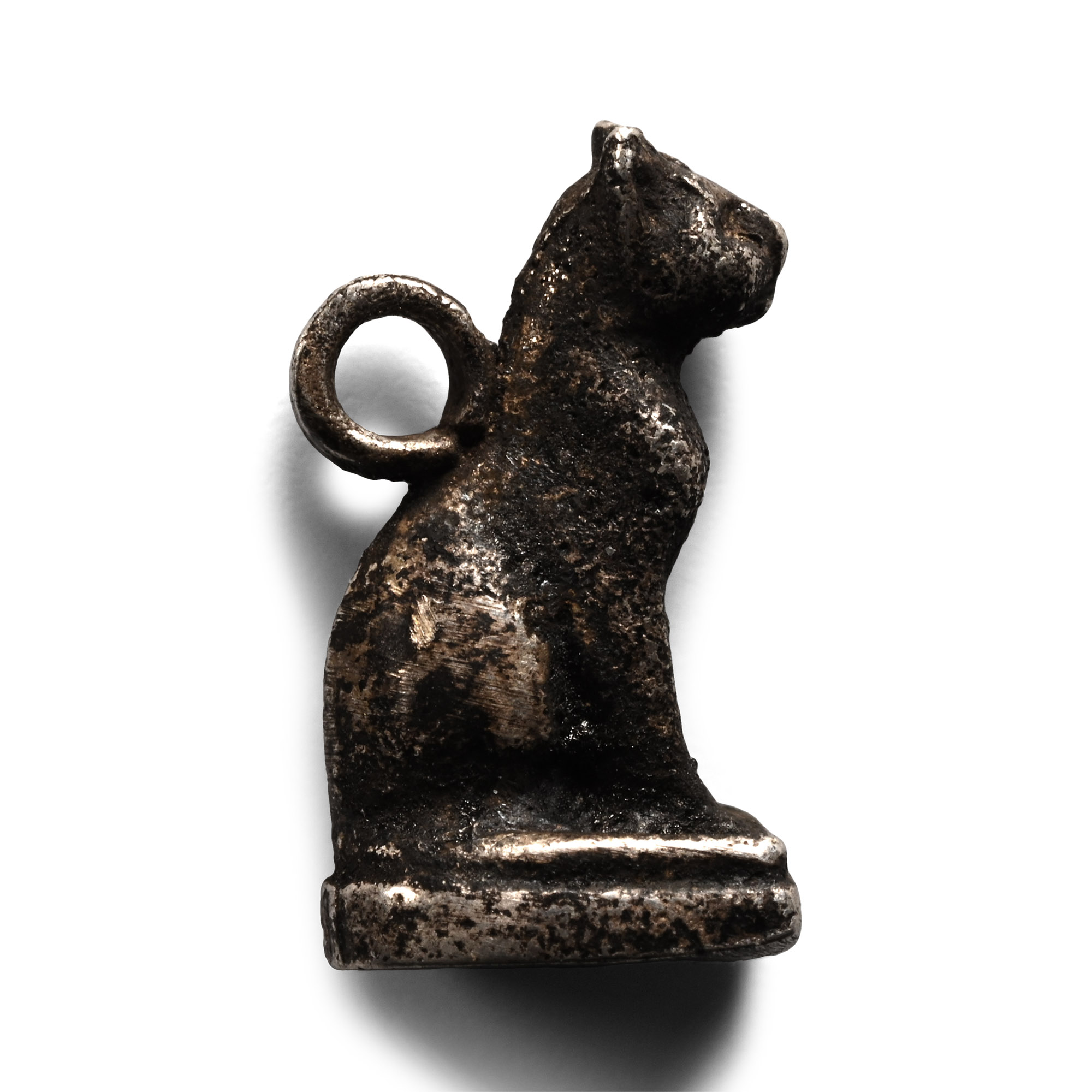
Egyptian Silver Goddess Bastet Cat Amulet

LATE-PTOLEMAIC PERIOD, 664-30 B.C.

1/2 in. (1.58 grams, 12 mm).

Seated figure of a cat with pointed ears mounted on a rectangular base with a rounded end; suspension loop on the back. [No Reserve]

Provenance

From an early 20th century collection.
This lot is accompanied by an illustrated lot declaration signed by the Head of the Antiquities Department, Dr Raffaele D’Amato.

Literature

Cf. Andrews, C., Amulets of Ancient Egypt, London, 1994, item 29(c).

CONDITION

VETTING:

TimeLine Auctions follows a vetting process to ensure the authenticity and legality of all items, reinforcing our commitment to integrity and responsible trading. Each antiquity, antique, and coin lot undergoes thorough examination by a vetting committee of at least ten external specialists, professional trade association members, scientists, and archaeologists: Our Vetting Process


AUCTIONS:

TimeLine is a leading auction house specialising in antiquities, ancient art, collectables, natural history, coins, medals, and books. Our auctions offer museums, collectors, historians, and enthusiasts the opportunity to acquire unique and historically significant pieces.

LOT 0412

Egyptian Silver Goddess Bastet Cat Amulet

Sold for (Inc. bp): £234

Print page

RELATED LOTS

  • Egyptian Black Hardstone Scarab
    Egyptian Black Hardstone Scarab
    Late Period, 664-332 B.C.

    Estimate: £400 - 600 (‡+bp*)

    Opening Bid: £200

    Dark green hardstone with paler speckles; with a boldly carved head, clypeus, prothorax and elytra, and legs indicated at the sides; plain underside. 17 grams, 29 mm


    Ex Irene Newman, Birdham, Chichester, West Sussex, England. with Stride & Son Auctioneers, Chichester, West Sussex, England, 23 April 2015, no.1599 [Part]. Acquired by the present owner at the above sale. This lot is accompanied by an illustrated lot declaration signed by the Head of the Antiquities Department, Dr Raffaele D’Amato.

    The scarab, which represented the dung beetle, was the most popular amulet in ancient Egypt for approximately two thousand years until the Ptolemaic Period when it gradually fell out of favour. The popularity of scarabs extended beyond the borders of Egypt, and they were also distributed and produced in other regions, such as Phoenicia and Israel. The beetle is named khepri, derived from the verb 'to come into existence', and was considered the embodiment of the creator god Khepri, who was self-engendered. The ancient Egyptians mistakenly believed that the young beetle emerging from the dung ball was the result of an act of self-creation.

    Lot Details

  • Romano-Egyptian Terracotta Figure of Baubo
    Romano-Egyptian Terracotta Figure of Baubo
    Ptolemaic Period, 2nd-1st century B.C.

    Estimate: £700 - 900 (+bp*)

    Opening Bid: £350

    The squatting figure depicted nude, a garland upon her propoloma and thick braids falling on her shoulders, her legs bent and spread wide, her right hand touching her genitals and the left hand raised holding a lotus flower. 375 grams, 15.8 cm


    with Superior Galleries, Los Angeles, USA. Ex Dr W. Benson Harer, Los Angeles, USA, March 1985. This lot is accompanied by an illustrated lot declaration signed by the Head of the Antiquities Department, Dr Raffaele D’Amato.

    Baubo was a minor divinity of the Greek mythology, linked to the cult of Demeter and Persephone. The statuette belongs to the second type of Baubo figurines, widespread in the last Ptolemaic and Roman period in Egypt. The Egyptian Baubo figures are split into two groups, and this one belongs to the first group depicting a woman seating frontally whilst holding a musical instrument. In some of these figurines her right hand is touching her genitalia. Many of them were used as amulets or as ex-voto.

    Lot Details

  • Egyptian Faience Figure of Nefertum
    Egyptian Faience Figure of Nefertum
    Ptolemaic Period, 332-30 B.C.

    Estimate: £600 - 800 (‡+bp*)

    Opening Bid: £300

    Turquoise faience standing figure of Nefertum in a striding pose with arms at the sides, sporting a black coloured tripartite wig surmounted by the god's distinctive headdress consisting of a lotus flower with two plumes on top; a suspension loop at the back; repaired. 71 grams total, 13 cm including stand


    Property from an American deceased estate, acquired between 1970 and 1989. with Bonham's, London, 28 October 2009, no.81 [Part]. This lot is accompanied by an illustrated lot declaration signed by the Head of the Antiquities Department, Dr Raffaele D’Amato.

    Nefertum was closely associated with the creator god Ptah and the goddesses Sekhmet and Bastet. He represented the first sunlight and the sweet scent of the Egyptian blue lotus flower (nymphaea caerulea). According to beliefs, the sun rose from the bloom of a blue lotus, embodying notions of rebirth and rejuvenation. Additionally, as the lotus was seen as a symbol of fertility, it is possible that this amulet was also worn for that purpose.

    Lot Details

Stay up-to-date with the latest from TimeLine Auctions by joining our mailing list