
Loading, please wait...
LOT 0018
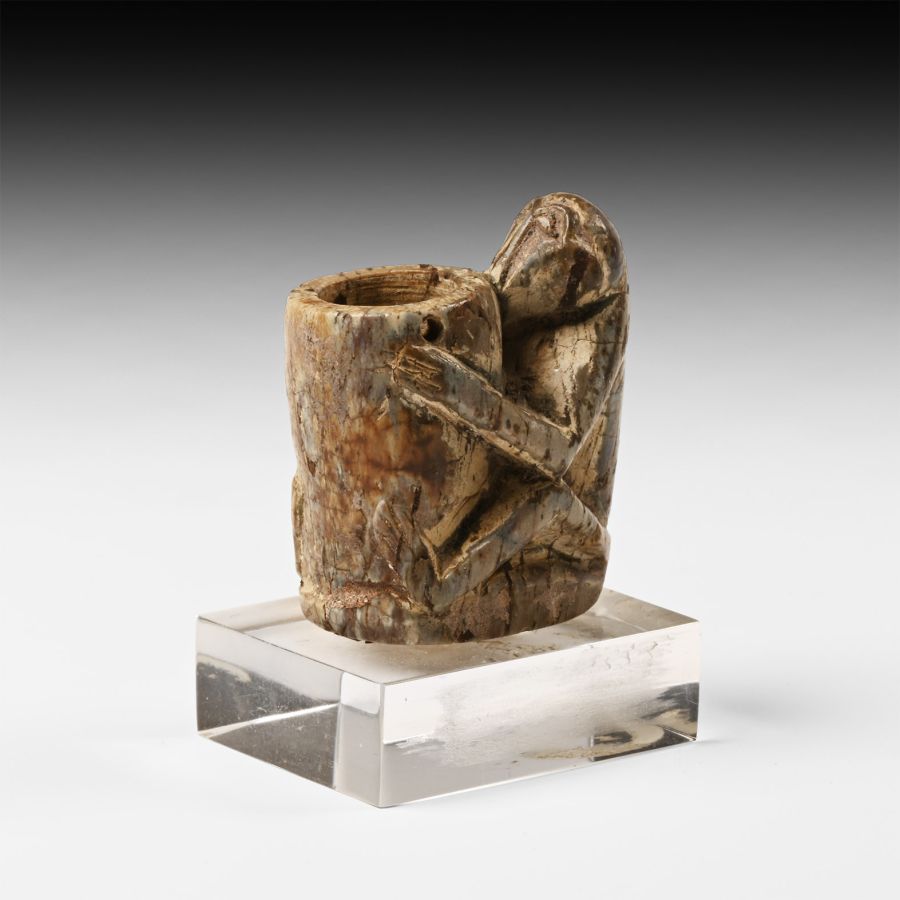
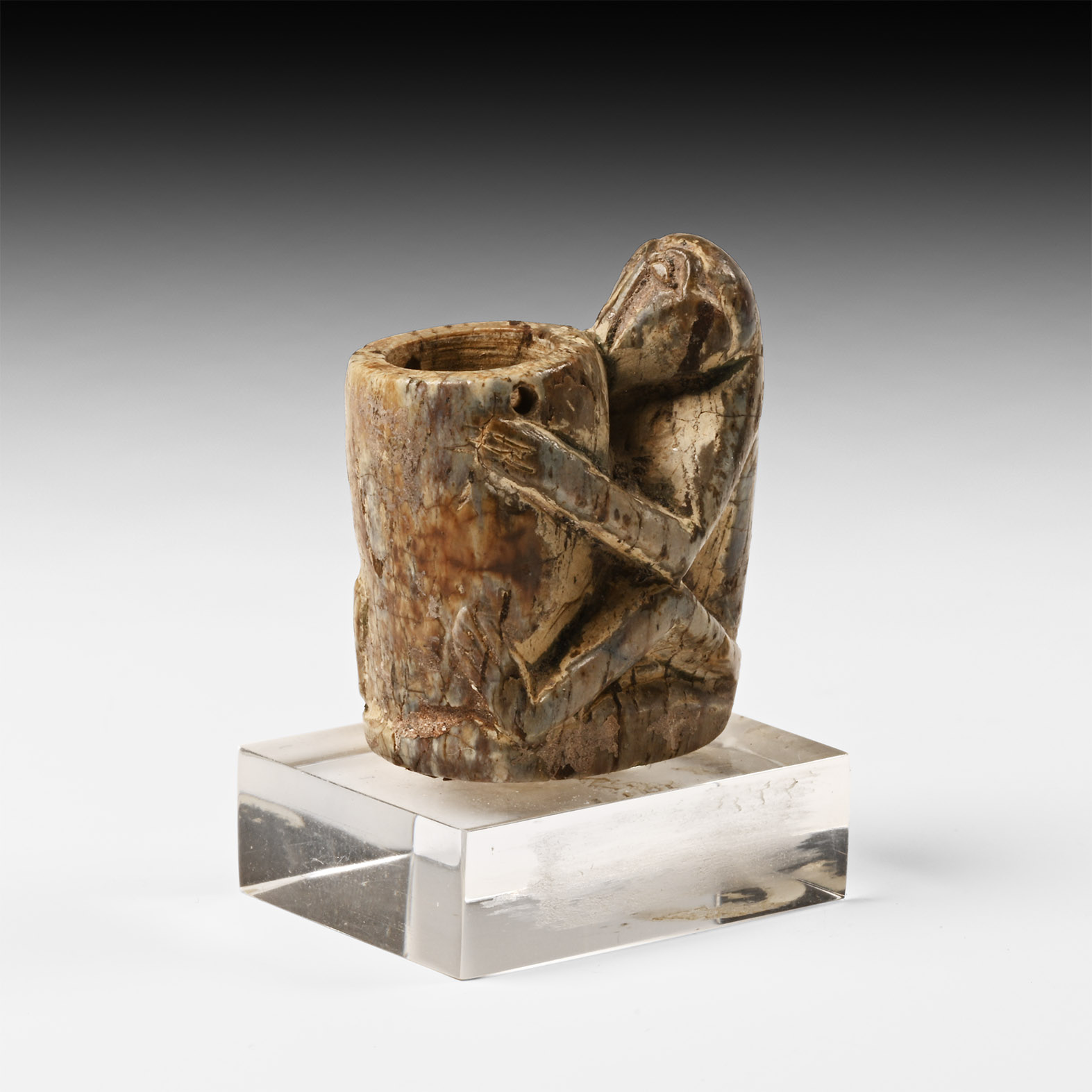
Egyptian Seated Monkey Kohl Pot
NEW KINGDOM, 1225-1070 B.C.
1 1/2 in. (21.2 grams total, 37 mm high including stand).
A carved steatite monkey holding a kohl pot of roughly cylindrical form; set on an integral oval base; rim of kohl perforated twice; mounted on a custom-made display base.
Provenancewith François de Riqules, Archéologie, 11-12 November 2001, lot 198.
LiteratureCf. The Metropolitan Museum, New York, accession number 1989.281.101, for a similar vessel albeit dating from the New Kingdom period; cf. The British Museum, museum number EA37197 ‘Kohl-tube’, for a similar example dated to the Middle Kingdom.
CONDITIONTimeLine Auctions follows a vetting process to ensure the authenticity and legality of all items, reinforcing our commitment to integrity and responsible trading. Each antiquity, antique, and coin lot undergoes thorough examination by a vetting committee of at least ten external specialists, professional trade association members, scientists, and archaeologists: Our Vetting Process
AUCTIONS:
TimeLine is a leading auction house specialising in antiquities, ancient art, collectables, natural history, coins, medals, and books. Our auctions offer museums, collectors, historians, and enthusiasts the opportunity to acquire unique and historically significant pieces.
LOT 0018
Egyptian Seated Monkey Kohl Pot
Estimate £1,800 - 2,400€2,090 - 2,780 (for guidance only)$2,430 - 3,240 (for guidance only)
-
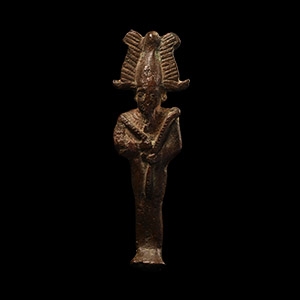
Egyptian Osiris Statuette
Late Period, 664-525 B.C.Sold for (Inc. bp): £780
A bronze votive figurine of Osiris, portraying the god standing, wearing a close-fitting mummiform garment and Atef crown, false beard, hands held at the centre of the chest holding the royal crook and flail; possibly from Saqqara. 37.1 grams, 80 mm high
From an old UK collection. From the private collection of Alf Baxendale (1941-2016) part 2, keen Egyptologist, member of the Egyptology Society, trustee of the Amarna Trust; thence by descent. Accompanied by an identification display card. Accompanied by a copy of his obituary published in Horizon, The Amarna Project and Amarna Trust newsletter, Issue 18, 2017, p.21, by Barry John Kemp, CBE, FBA, Professor Emeritus of Egyptology at the University of Cambridge and directing excavations at Amarna in Egypt.
Osiris was the foremost of the Egyptian funerary gods and ruler of the underworld. -
.jpg)
Egyptian Limestone Fragment with Face
Old Kingdom, 2686-2181 B.C.Sold for (Inc. bp): £4,420
A carved limestone relief fragment with profile male head facing left, with close-cropped hair and detailed treatment of the eye, ear and mouth; inked inscription to the reverse 'E. H. Heckett.'; set in an old velvet-covered mount. 129 grams, 71 mm wide
From the estate of a deceased American, acquired between 1970-1989. with Bonham's, London, Knightsbridge, 28 October 2009, lot 23 [Part]. Accompanied by a copy of the relevant Bonhams catalogue pages. This lot has been checked against the Interpol Database of stolen works of art and is accompanied by search certificate no.11596-198972. -
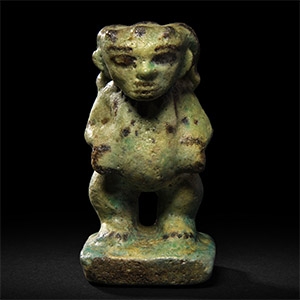
Egyptian Female Dwarf Statuette
Middle Kingdom, late 12th-13th Dynasty, circa 1878-1750 B.C.Sold for (Inc. bp): £3,380
A figurine in blue-green faience depicting a human female displaying traits of achondroplasia, with a disproportionate body, protruding abdomen, prominent buttocks, and shortened limbs; the large and exaggeratedly flattened head sports a distinctive hairstyle consisting of three ‘bunches’ on the front and three long braids at the back; the shaven top of the head is indicated by stippling; the figure wearing a long, single-strand shell necklace, armlets, and a girdle, all indicated in black pigment, as are the facial details, hair colour, pubic triangle, fingernails, and toenails. 50 grams, 66 mm high
Acquired from Dr Jan Beekmans, circa 1985. UK private collection. Accompanied by an academic report by Egyptologist Paul Whelan. This lot has been checked against the Interpol Database of stolen works of art and is accompanied by search certificate no.11594-198343.
This figurine belongs to a rare sub-type in a category of anthropomorphic figures produced during the late 12th-13th Dynasty. The category comprises around 200 figurines which include truncated-leg females, ‘grotesque’ human forms, and those displaying more distinct traits of achondroplasia, such as can be observed in this figurine. Very few examples of this particular sub-type are known, of which only one in the Metropolitan Museum of Art, New York provides a close parallel in terms of overall styling and form with this figurine. The purpose of this figurine is not fully understood, but other types of female representations in the large corpus of Middle Kingdom faience figurines are now considered to have embodied generative and regenerative power for their owners. This figurine shares the same distinctive three-braid hairstyle and the necklace, armlets, and girdle body adornments found on some. Body adornments of this kind also occur on wooden ‘paddle doll’ female figurines which are considered to have some connection with khener-dancers, who performed in royal, temple and funerary spheres. Since, in funeral contexts, ritual dances were often performed by dwarfs, a further connection can possibly be made between the role of khener-dancers and this figurine. The performance of such dancers in royal or funerary contexts was considered to bring the power of regeneration and potency to the recipient.
