
Loading, please wait...
_900x900.jpg "Egyptian Seated Gold Bastet Cat Amulet")
_200x200.jpg "Egyptian Seated Gold Bastet Cat Amulet")
.jpg "Egyptian Seated Gold Bastet Cat Amulet")
LOT 0013
Egyptian Seated Gold Bastet Cat Amulet
LATE NEW KINGDOM-THIRD INTERMEDIATE PERIOD, CIRCA 1069-900 B.C. OR LATER
1/8 in. (0.54 grams, 8 mm).
Modelled seated on a tongue-shaped base, with simple facial detailing and a suspension loop to the back.
ProvenanceEx French art market, 1920s.
LiteratureCf. Andrews, C., Amulets of Ancient Egypt, London, 1994, item 29(c).
FootnotesThe goddess Bastet was believed to be the daughter of the sun god and was shown with the features of a lion up until about 1000 B.C., when she was first portrayed as a cat or human with a cat head. As the daughter of Ra, she was associated with the rage inherent in the sun god's eye, which was considered to be his instrument of vengeance. Her development into a cat goddess occurred during the New Kingdom, but did not fully develop until the Late Period. She was still associated with the destructive power of the sun and was shown on the prow of the solar boat, decapitating the evil serpent Apophis in the Book of the Dead. The maternal, protective and hunting characteristics of the cat are obvious in Bastet, and she was seen as a protector of pregnant women and young children. In the Pyramid Texts, she is invoked by the deceased king to act as his protector and to help him reach the sky to join the sun god; the king proclaims that Bastet is his mother and nurse. Like her counterpart, Sekhmet, Bastet has an aggressive side and, in a text from Karnak, Amenhotep II described his enemies being slaughtered like the victims of Bastet. The goddess had a shrine at Karnak, where she is known as the 'Lady of Asheru', which aligns her closely with the goddess Mut, the consort of Amun-Ra. Her most famous shrine was in the north-east Delta region, at Bubastis, and was known as Per-Bastet or 'the House of Bastet.' Herodotus describes the festival of Bastet as one of the most elaborate in all of Egypt and identifies her with the Greek Artemis. Cemeteries of cats have been excavated at Bubastis, and at Saqqara and Memphis.
CONDITIONTimeLine Auctions follows a vetting process to ensure the authenticity and legality of all items, reinforcing our commitment to integrity and responsible trading. Each antiquity, antique, and coin lot undergoes thorough examination by a vetting committee of at least ten external specialists, professional trade association members, scientists, and archaeologists: Our Vetting Process
AUCTIONS:
TimeLine is a leading auction house specialising in antiquities, ancient art, collectables, natural history, coins, medals, and books. Our auctions offer museums, collectors, historians, and enthusiasts the opportunity to acquire unique and historically significant pieces.
-
.jpg)
Egyptian Blue Glazed Faience Pectoral
Late Period, 664-332 B.C.Sold for (Inc. bp): £364
Large rectangular shrine-shaped pectoral with subtle cavetto cornice top; obverse with black-painted Anubis reclining on a low pedestal, the reverse with two stylised tyet flanking a djed pillar; four piercings through the rear edge. 20 grams, 45 mm
From a 20th century UK collection. -
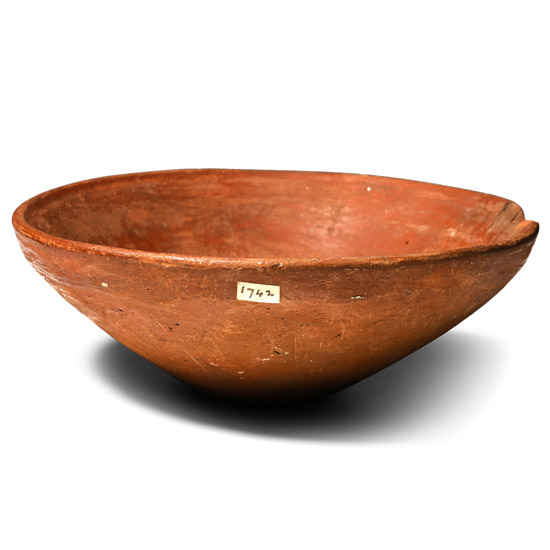
Egyptian Terracotta Bowl
Predynastic Period, 4th millennium B.C.Sold for (Inc. bp): £442
Conical in profile with narrow foot; old collector's notation to underside: 'Found by Petrie location Ballas and Naqada in 1895'. 375 grams, 15.5 cm wide
From the collection of David Donlan (1947-2025), a dedicated and lifelong collector with a passion for the ancient world and the natural sciences, forming his collection from 1960s onwards, using many reputable dealers across the United Kingdom, including the well-regarded Coincraft and The Parthenon Gallery.
Naqada (ancient Nubt) is situated on the west bank of the Nile, and is the type-site for the Predynastic period (Naqada I–III). It was a major centre of trade, craft production, and the process of unifying Egypt. Ballas is situated on the east bank opposite Naqada, and contains important Predynastic and Early Dynastic cemeteries excavated extensively by Flinders Petrie and James Quibell in conjunction with their work at Naqada. Their report was published in 1895. -
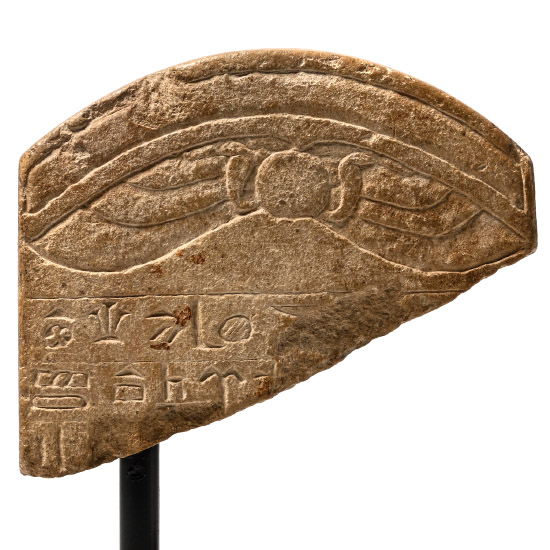
Egyptian Bifacial Magical Stela with Bes
Ptolemaic Period, circa 280-180 B.CSold for (Inc. bp): £4,160
Upper portion of an arch-top limestone stele fragment with two dressed faces; the obverse lunette features a winged sun disc flanked by uraei and two partial rows of incised pseudo-hieroglyphs below; the reverse displays the head of the god Bes in high relief, with traces of the head of the young Horus immediately below, who would have been depicted grasping the two partially preserved snakes and a scorpion carved in raised relief to the right; mounted on a custom-made display stand. 450 grams total, 11.6 cm high including stand
Frossart Collection, France, by the 19th century. Private collection, London, UK.
Although fragmentary, this stela is easily recognisable as a Horus cippus or magical stela. They were used to heal ailments caused by snake or scorpion venom. Ancient Egyptians believed that water poured over these cippi would turn into a healing liquid that the afflicted could drink or apply to their bodies.
